Monday, 14 December 2020

Urban birding at Hull: Noddle Hill LNR

It has been raining a lot the last few days, and we've had our fill of dark days, but today it promised to be a sunny, mild day, with southerly wind. I headed towards Noddle Hill, and I decided to walk along Foredyke Stream first.

I must have flushed a Little Egret, not a common sight inside the limits of the city. A flock of Lapwing and gulls are on the flooded fields at the other side of the drain. They were hard to count as there was a hedgerow and trees obscuring them. A few minutes later a Sparrowhawk managed to flush the flock and a photo of the Lapwing in flight revealed 164 individuals. Then, noisy skeins of Greylag started arriving from the North. The banks of the drain were very muddy which made for slow progress, but I got to the pumping station. A Buzzard was sitting on a fence and a female Kestrel hunted nearby. 

Female Kestrel
I search for Stonechats on the field south of the pumping station unsuccessfully, but hearing a calling Water Rail makes up for it. The female Kestrel sits on a hedgerow, the low winter sun silhouetting her. I take the perimeter path. Crows and a couple of Jackdaws raise, but surprisingly no Rooks.

A poor record shot of the Little Egret.
Flooded fields.
Lapwing, gulls and pheasants.

Lapwing flock.
Lapwing flock.
Greylag.

I arrive at the fishing lake, there is a large gathering of Greylag, and at least 50 Mallard. A young Grey Heron is sitting on a branch at the other side of the lake. I approach slowly and it appears oblivious to me. A Little Grebe is also about, which is a site tick. As I leave, a male Kestrel is hunting along the drain. A total of 39 species and some special encounters for a mid December day!

Grey Heron.


Flooded woodland.
A view of the lake.
The drain to the east of the reserve, running fast today.
Little Grebe.
Grey Heron.
Male Kestrel hunting over the drain in beautiful light.

Tuesday, 8 December 2020

Urban birding at Hull: December at Pickering Park

 I realised yesterday I had never been to Pickering Park in December, so that was the perfect excuse for a trip there. That, and the Goosanders! It was very cold and the very light southerly breeze made me keep my gloved hands in my pockets most of the time, especially when walking around the exposed lake.

As I got to the lake I saw the Mute Swan family gathered on the north edge of the lake. The adult pair had their two yearlings, born in 2019, and three young born in spring 2020. Usually swans chase their young away from their territory in the autumn, but this pair tolerates their young for much longer, probably because of the large size of the lake and plentiful food. The cob, however, was all fluffed wings and lowered head, a behaviour called 'busking' to one of the two older young. After a short chase, the young started flying, followed by a younger sibling and dad, and all three flew to the other end of the lake. I watched this happened three times while I was there. The swans only needed to drift on the wind to the top of the lake, and then take advantage of the gentle head wind for an easier lift. They yearlings might be getting ready to finally leave their natal lake, practicing taking off and landing.

Mute Swan family. A wing stretch.
The cob in busking position.
Two of the three young of this year, moulting into their white feathers, approach me in an area of the lake where the shore is very low, allowing for almost level photos of the swimming wildfowl. The single Pochard got very close too (top shot)
The cob at Pickering Park.

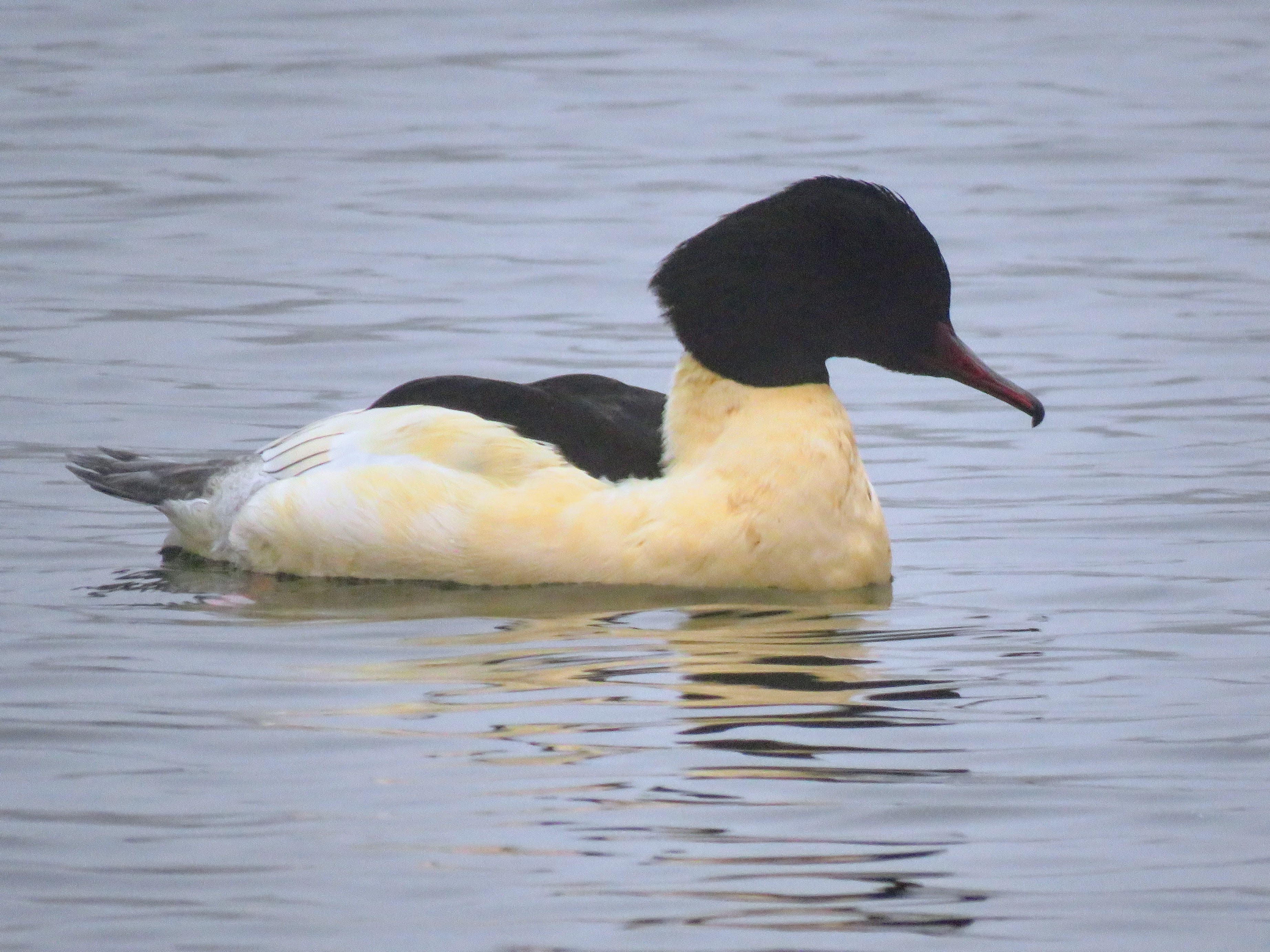
There were 15 Goosanders, with seven adult drakes and eight females and first winter males.

Most of the Goosander flock.
This could be a first year male.
Adult male.
Two of the females sat on the shore. Taking advantage on how quiet the park was today.
Drake Pochard.
To end, this grey squirrel, looking quite rotund, sat on a rock watching me.

Monday, 7 December 2020

Urban Birding at Hull: December Freezing Fog at East Park

A short drive to East Park today to check on the waterfowl. Thick freezing fog, the hoar on the trees and grass makes the park look magical. A lost Canada Geese calls regularly, trying to reconnect with the flock. Flocks of Goldfinches feed on the Alder catkins around the park.

A young Goosander drake, still some dark feathers on its chest and a female (above) preen on the main lake.

Female Goosander.
Drake Goosander.
Drake Goosander looking under the water.
I scan the central island, which is a sheltered area, away from disturbance. A Teal hides under overhanging ivy, five drake Pochards slumber with a drake Wigeon and a Great Crested Grebe.
Pochard and Wigeon.

Many Black-headed Gulls, keeping an eye on anything that dives. They are not disappointed as the Goosander flock that winters in the park is growing in size. 


Greylag flock grazing.
Several Goldfinch flocks on alder cones.
This Black-headed gull came right up to me.
Goldcrest.
Mistle Thrush.
The regular Grey Heron on the central island.
At least 11 male Goosanders and three females on the eastern side of the main lake, they were first fishing, pestered by Black-headed gulls, which await when they are fishing in case they can snatch a catch, as they do to Great Crested Grebes. Afterwards, the Goosanders decided to do a bit of preening (above). They are quite social and often dive in synchrony, the wing flapping was also done one.


Tufted Ducks.
Red-crested Pochard.
There is a pair of Mute Swans on the boating lake, the fog has lifted and the weak winter sun shines. The female swan starts bobbing slowly, the feathers at the top of her neck erect, then she preens her back, then shakes her head. The male follows her slowly, his neck straight, occasionally flicking its head up and uttering a soft snort.