Showing posts with label Flamborough. Show all posts

Monday, 12 October 2026

Great Bustard Old Country. Walk 2: Miss Rickaby's ride

The second walk in the series is between Bridlington and Flamborough. I take the 9:00am train to Bridlington and from the station to the harbour. It might appear odd to do a walk between Bridlington and Flamborough as one of the places where Great Bustards used to be found, but the area has changed beyond recognition in the last couple of centuries. The arrival of the railway in 1845 and the subsequent boom in coastal tourism meant that Bridlington Quay and the Old Town, previously separate, grew and merged into a larger conurbation. The railway itself, the urbanisation, and network of roads and traffic means there are few fields today, even the ones present are lined by hedges and belt plantations. Compare with the sparsely populated area towards the end of the 18th century Jefferys map (top image).

A rare open field between Danes Dyke and Flamborough.

A sighting of a drove

There are at least three documented links between Bridlington and the Great Bustard, but the one that inspired this walk is a letter by Mr Thomas Boynton (b. 1832, d. 1919), the famous local archaeologist and antiquarian, to the ornithologist Mr William Eagle Clark, as the latter was compiling his book on Yorkshire vertebrates, published in 1881. Mr Boynton recounted how 'the late Miss Charlotte Rickaby, of Bridlington Quay, when a girl, counted fifteen Great Bustards in a field while riding with her father from Bridlington Quay to Flamborough, early in the present century.' This is one of my favourite Great Bustard records, one of the few giving voice to a woman, and also of an observer, not involving the Great Bustards being shot, just taking the time to count the drove, as they went about their business, as father and daughter rode on their horses. Doing that walk today has its challenges. Early in the 1800s, where horses were the main way of transport, they probably took Flamborough Road from the north beach, then Sewerby road, Marton and Bridlington (visible in the map above, published in 1771), which is the route of bus 14. The B1255 is now a narrow busy road dangerous for a pedestrian. Instead, I decided to walk along the north beach promenade, visited the Clock Tower Cafe at Sewerby, and from there onwards I made my way inland towards Danes Dyke. It is a mild day, with high light clouds and brief sunny spells, and I have to take my raincoat off at some point. The tide is ebbing and quite low. The coastguard helicopter is doing some drills, first over Flamborough Head, then close to the beach by Sewerby. The loud engine noise would have drown the quiet, clip-clop, of Miss Rickaby's horses. This sighting happened when the Great Bustard has sizeable numbers in the area, although likely after a peak in numbers. There are still a few large fields in my walk. 

Miss Rickaby would have seen a group of Bustards, a drove, outside the breeding season. Photo © Graham Clarkson CC-BY-NC, via iNaturalist.

I manage to take a photo of Roe Deer near Bessingby from the train.

Coastguard helicopter drill.

An open view, looking towards Sewerby.
Someone threw bread and Carrion Crows and Herring Gulls didn't miss the chance for breakfast.
Low tide, with Flamborough in the distance.
One of the Fallow Deer in the Sewerby collection.
One of two Stonechats by the golf course, the male went down and got a large spider.
Meadow Pipit by the Golf Course.
The atmospheric dale at Danes Dyke.
There are a few paddocks with a dozen horses SW of Flamborough.
Rook in paddock.
Two Brent Geese fly over.
A mixed flock of Jackdaws and Rooks near Flamborough.


Travel. Train to Bridlington. East Yorkshire Bus 14 back from Flamborough Church.

Route. Bridlington railway station to Sewerby, Danes Dyke and Flamborough. 7.3 km. OS map. Flat along promenade, steps and uneven steep terrain around Danes Dyke. Field margin footpaths near Sewerby and Flamborough. All facilities in Bridlington, cafe and toilets in Sewerby Hall and Gardens (free entrance off season), toilets and cafe in summer months at Danes Dyke, more facilities at Flamborough.

More Information

Clarke, W. E., & Roebuck, W. D. (1881). A Handbook of the Vertebrate Fauna of Yorkshire. Lovell Reeve.

Credit for the top map: Jefferys, Thomas, The County of York, surveyed in 1767-1770. engraved by Thomas Jeffreys, 1771. Reproduced with the permission of the National Library of Scotland under a Creative Commons Attribution (CC-BY) licence.

Tuesday, 8 June 2021

A trip to Bempton Cliffs

 It has been a while since I've been at Bempton in June, peak season for breeding birds in the reserve. Today, a warm, sunny day with a light breeze, this was remedied. As I got to the reserve the main car park was already quite full.


 I walked East first. Meadow Pipits parachuting with their clockwork piping, Skylarks and Reed Buntings singing. On the hedges, both Whitethroat and Sedge Warbler. This superb reserve is well known for its seabirds, but grassland and farmland birds are also thriving on the grassland atop the cliffs, which was looking stunning today with the flowering red campion and umbelifers.

Grassland.
Five hares on a field, this is a record number of hares for me.
Tree Sparrows, an abundant resident at Bempton. Today they weren't visiting the feeding station, but they were spread around the fields, collecting insects for their young.
A male Swallow by the visitor centre. Him and his mate were inspecting the artificial nests under the entrance overhang.
Jackdaws are ever present at Bempton. They breed at the cliffs and are often at the picnic areas looking for tidbits.
Kestrel on nest box in front of the visitor centre.
A Barn Owl hunting at midday. Probably busy hunting for hungry chicks.
A bird that I not always manage to spot in the reserve, a male Corn Bunting.
And nearby, a Meadow Pipit.
A poor photo of a female Reed Bunting carrying food for chicks. She was quite nervous and didn't settle so I left her alone.

It is the seabirds that are the stars of the wildlife spectacle that is Bempton. To see a whirlwind of Gannets over the sea (top shot), thousands of birds sitting on the cliffs, and their behaviour, calls, and the smell of the guano, at close range: Bempton is on a league of its own.
  I walked to the 'Grandstand' viewing point. The first Puffin of the year came into view briefly. There would be many others the rest of the day. They all seemed a bit restless and some were on the water.

Two Puffins on the water, with a passer by.

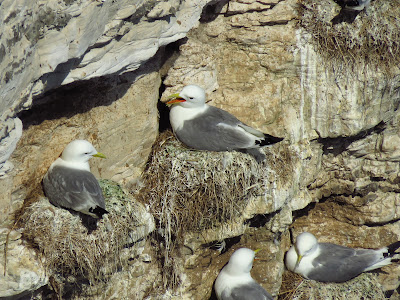
Kittiwakes were sitting on eggs. One stood up and two eggs became visible. Other Kittiwakes flew to a hollow on a field to collect nest material. There was a commute line back and forth of the field. Kittiwakes use grass and mud to make their nests.

A shelf of Kittiwake nests.


Kittiwake on nest with two eggs.

Herring Gulls are much scarcer breeding birds at Bempton, but there are a few scattered pairs.


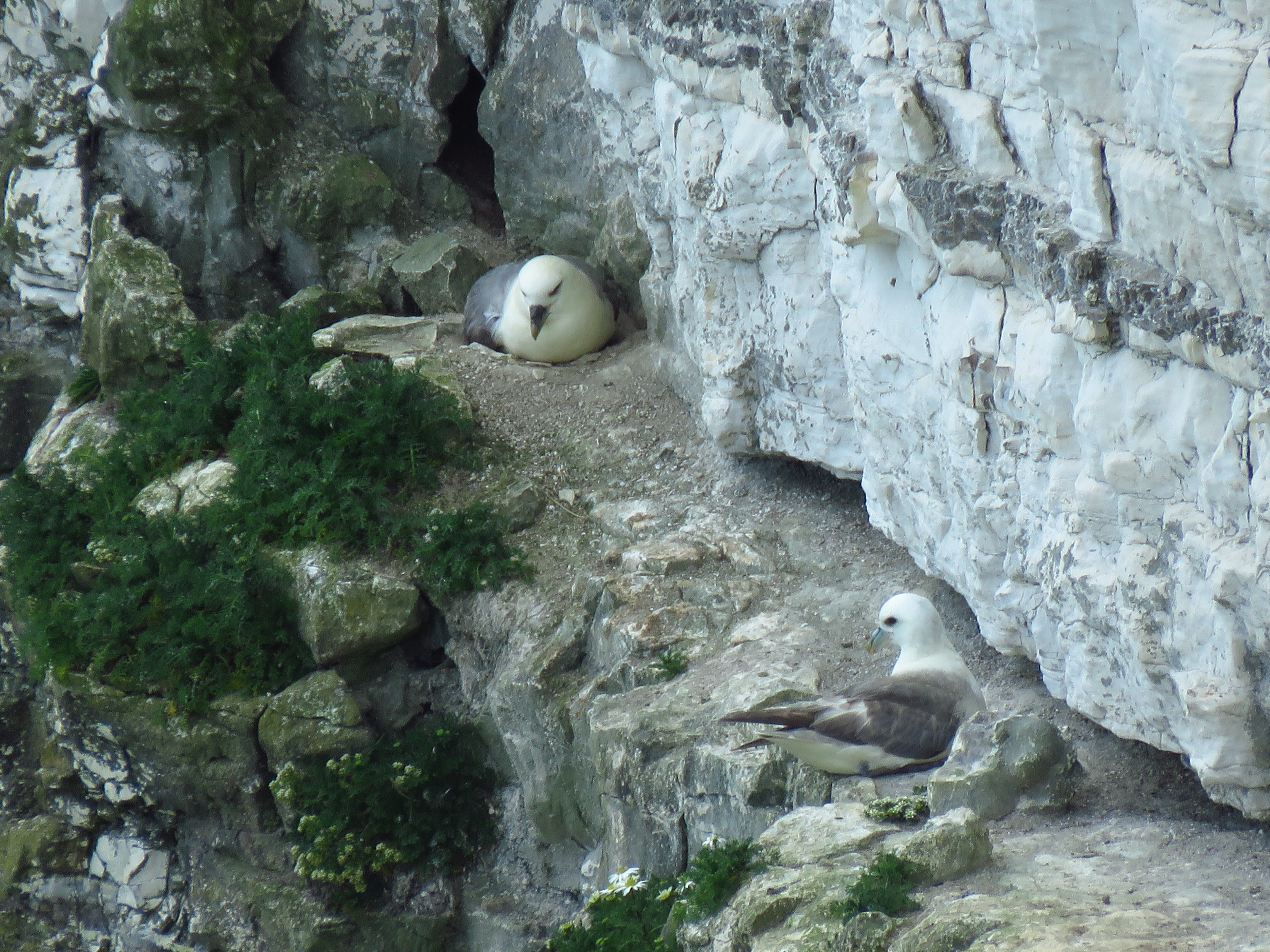
Fulmars are also breeding in the cliffs. Here, two are on their nesting shelves.

Today I paid special attention to Razorbills, my favourite sea bird.
A pair of Razorbills preening each other.

This individual atop the cliff gave great views.
Unlike Guillemots, razorbills seem to prefer to lay down instead of standing.
The end of a Razorbill display.
Often, Razorbills on their own on a cliff will stand up facing the cliff, flap their wings and open their bill, showing their yellow mouth in a display. Their calls are deep and guttural, with a purring quality.
Wing flapping.
Gannets were all on nests and 'clubs'. Some chicks could be visible. It being a warm day, some stood up to shade their chicks.

I love the regular nest spacing.
Gannet shading its chick.
Gannet portrait.
Gannet collecting nest material.
Look how well mowed the grass is near the cliff edge, this is due to the gannets collecting nest material.
Gannet landing to collect nest material.
Guillemot pairs were also displaying and bonding by preening each other and calling.


An illustration of the differences of Razorbills (left) and Guillemots (right).
A viewing platform at Bempton.
I walked the wildlife path and found several ovipositing pairs of Azure Damselflies.
Whitethroat.
Sedge Warbler.
And the final photo of the cliffs at low tide.