Showing posts with label Trans-Pennine Trail. Show all posts

Tuesday, 10 June 2025

Holderness: Skirlaugh to Hornsea

A mild day with light cloud and sunny spells, I take the but 24 to Skirlaugh. My route today takes me from Skirlaugh to Hornsea via the Hornsea Railway Trail, on the former railway line from Hull to Hornsea that now also serves as the last stage of the Trans-Pennine Trail. Unfortunately the bus stops are quite away from where the A165 crosses the trail, and this road is too busy and lacking a footpath, so I opt for taking Mulberry Road and Ellerby Road to join the trail. The route today takes me through farmland, mostly arable, except for the Lambwath valley SSSI, where hay is grown in traditional meadows. This section of the Lambwath is quite innaccessible, with few public rights of way, but I will devote more space to the Lambwath in another walk.

The trail is sound and even underfoot, some small sections tarmacked, and only a few muddy stretches. The banks have been mowed so it's wide enough. I meet some dog walkers, walkers and cyclists along the way, a loud group in the finishing stretch of the Transpennine Trail. The trail doesn't always run on the railway track, weaving sideways in sections, leaving the embankment on one side. Small copses and old hedgerows, today adorned with flowering dog roses, elder and honeysuckle, all adding to a wonderful fragance, line the way.

A Pied Wagtail collects insects on Silverhall Farm, near Skirlaugh.
I'm pleased to see good numbers of Small Tortoiseshells along the way.
Ellerby Road, between barley and rapeseed fields.
A Reed Bunting singing from the ripening rapeseed.
Skylark calling from a bare patch in the field.
I take a short detour to look for Twayblades and after some searching I'm rewarded with a single spike.
Whitethroat.
Linnet.
I cross the road at New Ellerby, a hamlet that was serviced by a station on market days. The platform and station remain, the latter now a private residence. In the wooded, more sheltered areas, Yellow-barred Longhorn moths gather and males dance flying up and down, occasionally resting on nearby leaves.
Large Skipper.
A good day for insects, a patch of Hedge Woundwort yields a Rhingia campestris, a hoverfly that likes tubular flowers.
I'm now descending the Lambwath valley. I climb the bank on the side of the trail and look across the bare field looking for hares. No hares, but I find a Buzzard gliding over the valley. I stop at the sound bridge over the Lamwath Stream. The water is clear, a couple of Azure Damselflies mate on the Reed Sweet-grass.

Buzzard.
Bridge over the Lambwath stream.
Lambwath stream, looking West.
Azure Damselflies.
Lamwath Meadows SSSI.

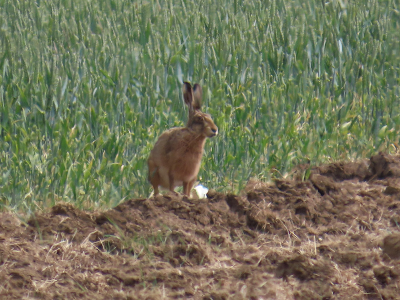
I climb the valley towards Whitedale, a hamlet that was also served with a station (top shot), now a private residence. A Swallow sings from the wires and House Sparrows are busy on its roof. After a little while, I find a spot with a nice view and I sit on the verge for lunch, a Yellowhammer and a Brown Hare for company.

Swallow at Whitedale.
Orange Tip, the only male I saw today.
Yellowhammer.
Reed Bunting.
Brown Hare.

It's time to carry on. A Marsh Harrier is quartering the fields in the distance, the Withernwick wind turbines as a backdrop. Another road crossing, this one between Little Hatfield and Great Hatfield, although the station itself is called Sigglesthorne. A small Local Nature Reserve has been designated along the trail, just north of the station. It has a wetland character, with reeds, willows, aspen and bracken. Soon I'm near Hull Bridge, a brick bridge where the Hull Road crosses the trail. The area is waterlogged and there are sedges, brooklime and ferns. There are records of Twayblade here, but I find none. 


Marsh Harrier.
Dog Rose.
Hull Bridge near Hornsea.

I'm now in Hornsea. Some Swifts fly over. On a field after crossing Stream Dyke, two crow Fledglings beg to one of their parents. I reach the final station of the trail and the promenade. The grassy area nearby is busy with a large flock of Starlings, with many young, and a pair of Linnets. A group of high school students are led along the promenade. This is a typical geography day trip spot to highlight coastal erosion and defences, so it's rare to miss a school trip on a visit to Hornsea. The tide is rising fast. On one of the end groynes, a pair of Sandwich Terns preen. Small parties fly past chirruping. Sand Martins pass over I'm ready for a rest, so I get an ice-cream and a coffee and sit on a picnic table by the new landscaped promenade gardens and fountain. My rest doesn't last long, as a feeding frenzy starts offshore. This is a high point in the promenade, offering a great view. A cloud of Herring Gulls surrounds small parties of Razorbills and Guillemots, which are very successful taking small fish. Two Gannets appear out of nowhere and dive bomb. As fast as it formed, the birds disperse and I'm glad to have watched this unexpected spectacle just before my bus back home is due. 

Swift.


Feeding frenzy with Herring Gulls.
Guillemot.
Razorbills.
Gannet.

Monday, 7 February 2022

A walk to Castle Hill and East Carr

A long, 18 km walk to Castle Hill, a mound on the outskirts of Hull by Holderness Drain. It is sunny and the wind has eased, although there is frost and ice on the ground. The walk was mostly along pedestrian/cycle tracks, especially the Hornsea cycle lane.
As I cross Wilmington Bridge I check on the Redshank roost: 11 today, but I dond't have much time, as the bridge engineer tells me he's opening the bridge in a few minutes.

The Redshank roost

As I carry on, a 20 strong flock of small birds calls my attention. I follow them with the binoculars and they end up landing on a large buddleia bush, and appear to start feeding on the seed heads, something I've never seen before. They are in a patch of land covered in buddleias, one of the fastest colonisers of cleared up land. Later, on the way back, I come across the Linnets again, this time as they feed on a large mound of soil.

Linnets.
After crossing Stoneferry Road and cutting across a estate, I join a pedestrian/cycle track again. 
Some sections are wide and have some green space on the sides. This bit is just before getting to Rockford Fields.

At Rockford fields there are quite a bit of Chaffinches, a male uttering it's broken early spring song. I hear the nasal call of a Brambling from a tall poplar, but despite some searching I can't find it and have to leave it at that.


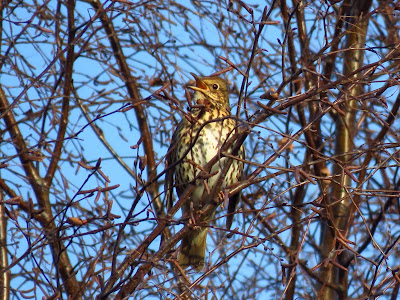
Singing Song Thrush.

I cut across the fields to join the Hornsea cycle track, also the TransPennine Way. The route has underpasses or bridges under some large roads, which is quite nice. The path is strait and by Sutton the landscape is more undulating, with steep banks covered on Ivy on the sides. Birds are plentiful.

As I step onto the first fields, I spot a Little Egret in the distance, glowing in the sunshine.

I get to Castle Hill just after crossing a bridge over Holderness Drain, which marks the Hull city boundary.

Holderness Drain.
 A Crow chases a Sparrowhawk. A flood in a field has attraced a flock of Black-headed Gulls, with some Common Gulls, a few immature Herring gulls and a Lesser Black-backed Gull. Disappointingly, no Yellowhammers on the hedges. I do a bit of exploring and climb to the top of the hill, to get a view (top shot). The paths are rutted, muddy, steep and very slippery. Eleven Jackdaws gather atop the mature trees on the hill. 
Castle Hill, the remains of a medieval motte, now a low mound elevated over the flat surroundings.
After this, I follow the Holderness drain SE on the Hull side. There is a newly ploughed field and I can hear the chirruping calls of Skylarks. After some searching I spot one quite close, appearing and disappearing on the clods of soil as it feeds, a new addition for the year list. In a few minutes, the song of a Skylark!

I get to Suttoncross drain, which is narrow and quite deep. It doesn't follow a straight path. I flush a Kingfisher. Fortunately it stops a bit ahead and lets me take a few photos.
Kingfisher.
Mallard.
Two Kestrels are hunting over a ditch one each side of the path.
Overall, three new species for the year, Brambling, Skylark and Little Egret, taking me to 69 for the year at Hull.

Monday, 5 February 2018

Walking the Humber. Stage 4. Hessle Haven to the River Hull

I have to run to make the 8:26 train to Hessle. It's a cold morning, but not frosty. It is almost high tide at Hessle Haven and the Humber is almost completely flat. I walk on the chalky beach on the haven: a Curlew, a few Redshank and some Black-headed Gulls feed by the pier. Chaffinches and Song Thrushes sing from the playing fields.
 To carry on, I need to retrace my steps and navigate around the industrial estate, find a narrow path flanked by high metal fences and strewn with rubbish and then rejoin the Trans Pennine Trail by the Humber.
 A flock of Lapwing sits on a spit by the reed bed waiting for the tide to ebb.
The path now runs just by the A63 and it is very noisy. For quite some stretch, a wooden fence separates the path from the motorway and it is scary that it has been smashed in several places. In a wooded area a flock of Long-tailed tits and a Goldcrest feed on the elder trees.
There is a wide strip of reeds before reaching the boundaries of the city of Hull. As I reach the corner by the Makro brownfield site, snows starts to fall, and the wind ruffles the Humber. A shag flies onto the water, it is wearing a blue ring, but I can't read it. It dives a few times and then flies east.
 The next stretch is on St Andrews Quay. The dock was filled and is now an urban shopping centre. The easterly wind is blowing the acrid smell of linseed oil from the Hull factory.
 There is an abandoned and infilled dock, St Andrew's dock, with pools and reeds by the derelict dock buildings at the eastern side of St Andrews Quay. On the sea wall, a 180 strong flock of Dunlin, with a smattering of Redshank and a lone Turnstone. They are flushed by a dog walker and settle ahead, giving me a chance for some photos.
I had never walked by Albert Docks. Large boats are moored in it with very exotic names such as Ocean Wanderer, Polar Surveyor and Toisa Explorer. On the estuary side the posts of an old pier serve as roosting sites for gulls, mallards and a Turnstone. A pipit flies over. The Trans Pennine trail then leads to some steps and a rooftop walk, offering a rare chance of a view over the city of Hull. Then it is just a short walk across the Marina and to the River Hull. The Deep (top) marking the begining of next stage.
Song Thrush.
Hessle Haven.
Curlew and Black-headed gulls at Hessle Haven.
The entrance to the old Ferry Boat Inn by Hessle Haven, it is now a gym.
A patch of flowering Winter Heliotrope, Petasites fragans
Roosting Lapwing.
Looking back to the Humber Bridge.
The path by the A63. Looks tranquil, but the noise is deafening.
A beached boat and rubbish by the strandline.
Shag. 
Signs warning of ongoing wildlife survey.

Moorings by St Andrews Quay.
Dunlin flock flying over the Humber.
Humber Pilots heading towards the bridge.
Dunlin and redshank flock.
Linnets.
Infilled St Andrews dock, now with pools and reedbed.

Derelict dock buildings.
Dunlin.
Dunlin, Redshank and Turnstone.
One of the large boats moored at Albert Dock.
Old pier.
Turnstone.
Stairway to heaven.
The view from the dock rooftops.
Albert Dock locks.
Roosting Black-headed gulls by Hull Marina.
The Deep and tidal barrier on the River Hull.
Today's walk. 11 km.