Showing posts with label Hornsea Mere. Show all posts

Tuesday, 1 April 2025

Holderness: Seaton, Wassand and Hornsea

A cool, sunny and breezy day, I get bus 24 to Seaton and walk to Wassand and along the public right of way on the south side of Hornsea Mere to Hornsea. Seaton has a small common or green and a village pond. A Moorhen skulks on the margins. Plenty of finches, with Linnets, Goldfinches, Chaffinches and Greenfinches in the village. I cross the busy A1035 and then I'm in the Wassand estate. A large pond holds Greylag, Moorhen and Little Grebe. A Kestrel flies away and then I hear raptor calls, there are two Marsh Harriers, one of them showing very well.

Seaton village pond.
Peacock.
Little Grebe in the Wassand pond.
Wassand pond.
New lambs with ewe.
Marsh Harrier.
Skunk Cabbage in bloom, a plant that can become invasive and favours wet woodland. Seems to be doing very well here by a ditch.
The first distant view of the mere. Also the top photo, with a curious old coppice stool with still some life in it.
Another pair of Marsh Harriers displaying.
Lund.
Skylark rising.
Reed Bunting singing.
The mere.

I get to Hornsea and join the Transpennine trail on the old railway line, finishing at the old railway station, which is the start of the long distance trail. I get my lunch at the Bay Tree Kitchen and then walk to the beach until the end of the sea defences, before getting my bus back home.

The Old Railway station.
Station and monument to the Transpennine trail.
Stream Dyke, the outflow of Hornsea Mere.
At the end of the Hornsea Defences, the sea is eroding the boulder clay cliffs creating an embayment between Mappleton (in the distance, also defenced) and Hornsea.
Some of these static caravans are sticking out of the cliff edge. I don't fancy their chances!
St. Nicholas Church.


Friday, 3 July 2020

Migrants Way. Stage 10. Hornsea to Atwick

I hesitated in doing the walk today as the weather was looking pretty rough, showers and a strong SW wind. But by 10am it looked that at least the rain wasn't going to be too bad, so I headed for Hornsea. I got to Kirkholme point and as soon as I left the car I realised I had underestimated the wind. The point is very exposed and the wind direction made it hard to shelter anywhere. There were clouds of hirundines and swifts feeding on the sheltered side of the trees and of Swan Island (above). The rain was light and I decided to start the walk and stop by the mere on the way back, in case the wind had eased.
Canada Geese, with some greylags.
A Mute Swan pair with cygnet on a relatively sheltered spot.
I cut across the streets of Hornsea toward the boating yard. The tide was low, and flowing. I walked by the promenade, surprisingly lively given the weather.
Summer plumage Redshank on a groyne.

Sea defences at Hornsea North Cliff.
A stranded flat fish.
 At Morrow Street I turned inland and walked alongside Cliff Road until Double Gates, where it is possible to descend to the beach, clambering down the rocks that defend the ramp. I walk on the beach the rest of the walk.
The ramp at Double Gates.
The cliffs off Atwick, looking north, the cliff reduces on height towards Skipsea.
A palaeolithic moment
A crow was feeding on something in the distance, on the beach. When I got there, it was a dead Grey Heron. Little meat left on it, but the head and legs looked in very good condition. Unfortunately the head was very well attached to the body and I had no tools. Thinking on a messy job I covered the head with sand and carried on. It wasn't a long walk today and I got to Atwick quickly afterwards. I tried to find a sharp rock to get the heron's head, but all the flints were quite round. I decided to have a go at knapping, something I hadn't done since I was a kid. I found a piece of flint, and hit it with a rock to remove a few flakes off it. The edge produced was so sharp, I had to be careful when I put it in my pocket for later. After a quick lunch it was time to turn back to the heron. The flint edge dealt with the heron's skin in no time, and I put the head in a bag.
My flint flake and the heron's head.

I walk on the beach all the way to Hornsea as the tide was still out. On the way, a Little Egret flew north, Gannets south, Common Tern and two Turnstones were other fly pasts.
Little Egret.

North Cliff fishermen.
 I make my way back to the mere though Hall Garth Park.

Hornsea Mere
As I return to the mere I'm blasted by the wind again. I walk to Kirkholme Point, a spit made of gravel, part of the glacial moraine that dammed the lake in front of the receding glacier.
The Mute swan family had moved on and were taking the brunt of the waves.
One of three Swallow Fledglings at the cafe.
The most spectacular sight were the swifts circling  the swarm of swifts feeding on the lee of the wind at Swan Island. You may need to click on this photo to enlarge.

Swifts.
Coots, Greylags, Mallards and Swans also sheltered on the behind Swan Island.
Common Tern over Mute Swans.
Swan Island from Kirkholme Point on a brief sunny spell.

The last Ice Age
The last Ice age, also known as the Devensian, lasted from 115,000 to 11,700 years ago, with glaciers at their maximum extent 22,000 years ago. An ice sheet up to 300 m thick grew over Holderness, butting onto the Wolds, and plugging the Humber Gap at North Ferriby. The seasonal fluctuations meant that during summer, ice melt water rushed out from glaciers, accumulating in a massive lake called Lake Humber -upstream of where the Humber Bridge is today and alongside the Vale of York - and at Lake Pickering, between the Yorkshire Wolds and the North York Moors. The sea level of -100 m exposed Doggerland south of the ice. According to Bryony Coles, it was
 “a rolling landscape cut by the tunnel valleys and longitudinal lakes, drained by braided rivers, with many areas of unstabilised sands and gravels, subject to desiccation and permafrost, and colonised by tundra-like vegetation”
Few plants and animals could survive on the ice, although mosses have been dated from sandy lenses at the cliffs at Dimlington towards the end of a glacial advance. On the areas away from the ice sheet, short vegetation developed, similar to what is found in the Arctic today with lichens and dwarf birch and willow and grasses that would slowly grow in the summer. Herds of Woolly Mammoth, Woolly Rhinoceros, Bison and Reindeer grazed the plains.
Featured bird: Swift
This week is peak autumn migration period for Swifts. Autumn? It may appear surprising, as breeding Swifts are busy feeding chicks and you are likely to see them around until mid or the end of August. It is the yearlings - birds born last year - who migrate into their breeding grounds, prospect for potential nest sites, and may wander widely, but don't stay to breed, who return to Africa at the end of June/early July. Last Sunday, at Hunmanby Gap (just North of Bempton Cliffs) an astonishing 18041 swifts were counted migrating, one of the largest Swift counts in the UK (read a first hand account at Mark James Pearson blog. Swift breeding populations have been in steep decline since the early 1990s and it is an Amber Listed species in the UK.
Breeding Bird Survey index for Swift (from Maximino et al 2019).

Walk information
10 km circular. Start at Mere Side, Hornsea, TA199475 or Kirkholme Point TA198473. Finish at Atwick Cliff Rd. Check tide tables if walking on the beach. Kirkholme point is private land, holding a cafe and a sailing club. The gates are only open Thursday to Sunday 10:00 to 16:30. Access to beach at Hornsea Promenade and Double Gates, sailing club. 

More information
Walk here: ViewRanger - Hornsea - Atwick Loop - Walking route in Hornsea, East Riding of Yorkshire, England, United Kingdom.

Arctic animal remains found in quarry at Burstwick and Atwick “A walrus tusk from Kelsey Hill and the tooth of a mammoth from the cliffs at Atwick”.

Mammoth tooth discovered at Spurn. https://www.yorkpress.co.uk/news/10652492.mammoth-tooth-to-go-on-show-at-spurn-national-nature-reserve/

Paleolithic Yorkshire Fauna:
Palaeolithic Yorkshire – mammoth and other ancient elephant finds

Ice Age in East Yorkshire:  http://www.hullgeolsoc.co.uk/holdice.htm

Massimino, D., et al. (2019) BirdTrends 2019: trends in numbers, breeding success and survival for UK breeding birds. Research Report 722. BTO, Thetford. www.bto.org/birdtrends

Monday, 22 June 2020

Migrants way. Stage 9. Mappleton to Hornsea

A sunny, warm day with a south westerly breeze. I start my walk at Mappleton at 8:30, about an hour after high tide. Today's walk is mostly on the beach. As the tide ebbs, the huge expanse of the sandy beach opens. The cliffs are about 15 m high, with a reddish till at the top and a purplish one at the bottom.
At the top of the beach there is a band of exposed clay bed with stuck pebbles, occasional glacial erratics, and shingle with some pieces of wrack in the tide line, then there is clear sand.
Fossil hunting
This is a good fossil hunting area. The fossils were brought here in the till with the glaciers from the Jurassic, Cretaceous and Carboniferous clays and rocks from Flamborough and more northerly areas. I find an ammonite fragment, Gryphaea, a snail, and coral fragments. The photo above shows my little haul.

Mappleton and Rolston sands
A Curlew flies north by the beach. An then a Cormorant. I can hear a Skylark singing from the fields above.
At Rolston Sands there is a busy Sand martin colony.
 The Sand Martins fly low over the beach in groups: one lands and the others follow, just to fly again. It looks like a dare game, or maybe they are collecting nest material?
I move to the top of the beach and, on the tide line, I find a dead Puffin. No rings. Sadly, this is my first Puffin this year.
A Buzzard hovers overhead. Linnet sing from the soft cliffs.
A Gannet flies south, then changes its mind, rises and drops down into the water to fish, like a missile. A little splash, it missed! Then it laboriously takes off.
 As I arrive at Hornsea I spot a Great Crested Grebe on the sea.
I get to Hornsea defences. These are widely used as an example on the effect of hard structures on rates of erosion.
I climb the steps to the promenade and after the boating yard I walk by the public footpath by Stream Dike.
Up to now the drains and streams flowed towards the Humber estuary, from now on. the streams flow directly to the North Sea. Stream Dike is the outflow to the sea from Hornsea mere controlled by a sluice. My plan was to visit Kirkholme Point at Hornsea Mere for lunch. Unfortunately, the entrance to the point is gated, and locked. A local lets me know it opens Thursdays to Sundays. I walk to Fair Place instead and sit on a bench and watch the swifts and hirundines above. Then a Swallow alarm calls and I see a Hobby in hunting mode chasing swifts! A Cetti's Warbler sings. Then I hear two booming notes, a Bittern? After a short rest, I move to the southern side of the mere, from where one of the islands, Swan Island, and a gravelly spit behind it, are visible.
Hornsea Mere
Hornsea Mere is the largest natural lake in Yorkshire and the only surviving mere in Holderness. It is a freshwater, shallow lake (1.2 m deep on average) of glacial origin, forming as the ice melted and the water dammed by a moraine. The lake is fed by several streams. It is fringed with a belt of reedbeds and fen and grasslands. Carr woodland is best developed on its west end, at Wassand. It is a SSSI for its aquatic plants, wetland habitats and wintering and breeding bird populations, and Special Protection Area due to the large numbers of post-breeding and moulting Mute Swans and over-wintering Gadwall. In addition, Hornsea Mere is also well known for its autumn concentrations of Little Gulls. It is a magnet for swifts and hirundines, and Hobbies are not uncommon. The birds of the mere are documented on the Mere Birders Blog. The fact that the lake is close to the sea and the combination of habitats means it can attract a range of marine birds, especially in rough weather, and rare migrants. The mere bird list is an impressive 232 bird species.
Swan Island from the SE corner of the mere.
I make my way back via the Hull to Hornsea train track, and retrace my steps.
The tide is now almost fully out. Gulls coast or loaf by the water line: Herring Gulls mostly, but also the occasional immature Great Black-backed gull and two Lesser Black-backed gulls. Two Black-headed Gulls and a Common Gull.
Immature (2nd summer) Common Gull.
Great Black-backed Gull (3rd summer)
The gulls' loafing place.
Herring Gulls and Lesser Black-backed gulls.
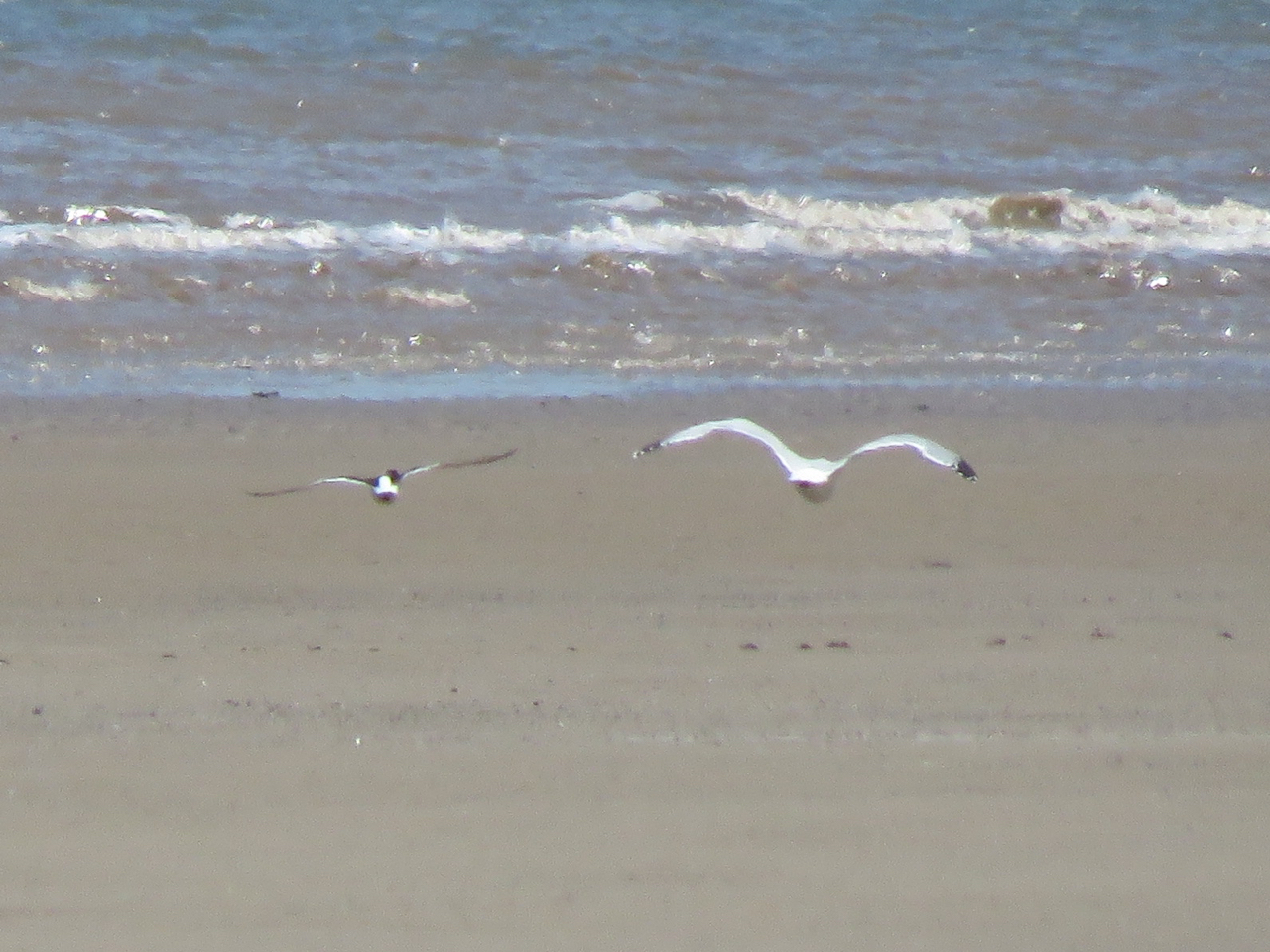
An Oystercatcher flies over and starts feeding not far from the loafing gulls. The gulls are keeping a close eye on it, as when it catches something, a Herring Gulls pursues it.
Herring Gull chasing Oystercatcher.
It has been quite interesting to be back on the beach for a walk. Next week, I'll start at Kirkholme Point, where there is a much better view of the Hornsea Mere and its birds.
Record shot of Hobby today.
Featured bird: Hobby
The Hobby is a migratory falcon. It hunts on the wing, and is very agile, catching hirundines, swifts and dragonflies in mid air. It gives a dark, giant swift impression. I was lucky today to watch a Hobby as it hunted, flying very fast and doing stoops. Although it is by no means common, the Hobby is expanding its range, possibly following the expansion and increase population numbers of their dragonfly prey due to climate warming or habitat availability, as Hobbies favour gravel and sand quarries. It is Green Listed.

Walk information
13 km circular. Start: Mappleton Beach car park TA227438 (free). Finish at Hornsea Mere. Walk on the beach. Check tide tables. Beach can be accessed at slipway at Mappleton Cliff lane, and though steps by promenade at Hornsea. Coffee shops and toilets at Mappleton and Hornsea.

More information
Fossils at Mappleton beach https://ukfossils.co.uk/2010/03/16/mappleton/