Showing posts with label common seal. Show all posts

Wednesday, 15 April 2026

Holderness: Ottringham, Sunk Island and Stone Creek

I take the bus to Ottringham, where I start of the walk. The walk is on very flat, exposed terrain so a bright day with little wind seemed ideal for it. Ottringham I didn't mind repeat visiting and the wide open never ending fields and straight roads paid off with some nice migrants. Swallows are back at Ottringham too. Soon after leaving the village a Buzzard was soaring, then a few minutes later it flew over carrying a vole. I visited Sunk Island and Stone Creek in 2018, during my walking the Humber series, where I wrote about the strange history of the island and its name. It is a massive area, reclaimed from the Humber and therefore very flat with the land virtually all devoted to intensive arable. In a field where wheat is starting to grow, three Lapwing are dispersed, one of them looking like it's making a scrape. Two Shelduck and a Little Egret flies over. The road is lined with trees, which add some shade and interest. I cross the North Channel and the Sunk Island drain and I am now on the island.

Herring Gulls at Ottringham Church.
Swallow at Ottringham
Buzzard with Field Vole prey.
Lapwing making a scrape?
Looking west along Marsh Drain from Ottringham Drain.
The North Channel.
We are now in Sunk Island.

Shortly after 'crossing' onto the island I spot a bird on a glowing rapeseed field, a Whinchat! On the same field there is a Reed Bunting. I plough along the straight road, not even trees or hedges along it. Sunk Island village is made up of a church and a school at a crossroads, with farms spread across the island. Although Stone Creek is just a boating compound on an inlet at one end of Sunk Island, I decide it adds to the interest of the walk, as I will have lunch by the Humber.  I popped into the Churchyard and record some plants and bees. The Rookery is noisy and Jackdaws fly overhead. I turn right at the crossroads and head towards Stone Creek. Yellowhammers call 'zit' from the hedges. A female and then a male Marsh Harriers quarted over the fields. As I get to Stone Creek, on the coastguard cottages I spot a Tree Sparrow. Sadly, Iit's been a while in the Holderness series that I've seen one. I sit down on one of the compound ramps to a boat and watch the Teal, Redshank and Curlew feeding on the creek. A Grey Plover arrives, landing quite close to me. A Marsh Harrier, then a Kestrel flies along the saltmarsh. Before I leave, I scan the distant saltmarsh and mudflats for seals and I see three, quite distant and hard to photograph with the heat haze, most likely Common Seals. The highlights of the way back is a Wheatear and a Corn Bunting, both on the same field of the Lapwings, just by the garden centre. I am quite happy with today's migrants. I do some recording around the bus stop at Ottringham and I head back home, after a total of about 22 km walked.

Whinchat.
Reed Bunting.
Large Rapeseed field.
At a crossroads.
Holy Trinity Church at Sunk Island.
Marsh Harrier.
Male Marsh Harrier.
Male Marsh Harrier.
Tree Sparrow.
I surprised this female pheasant and she just crouched there, not moving.

Teal.
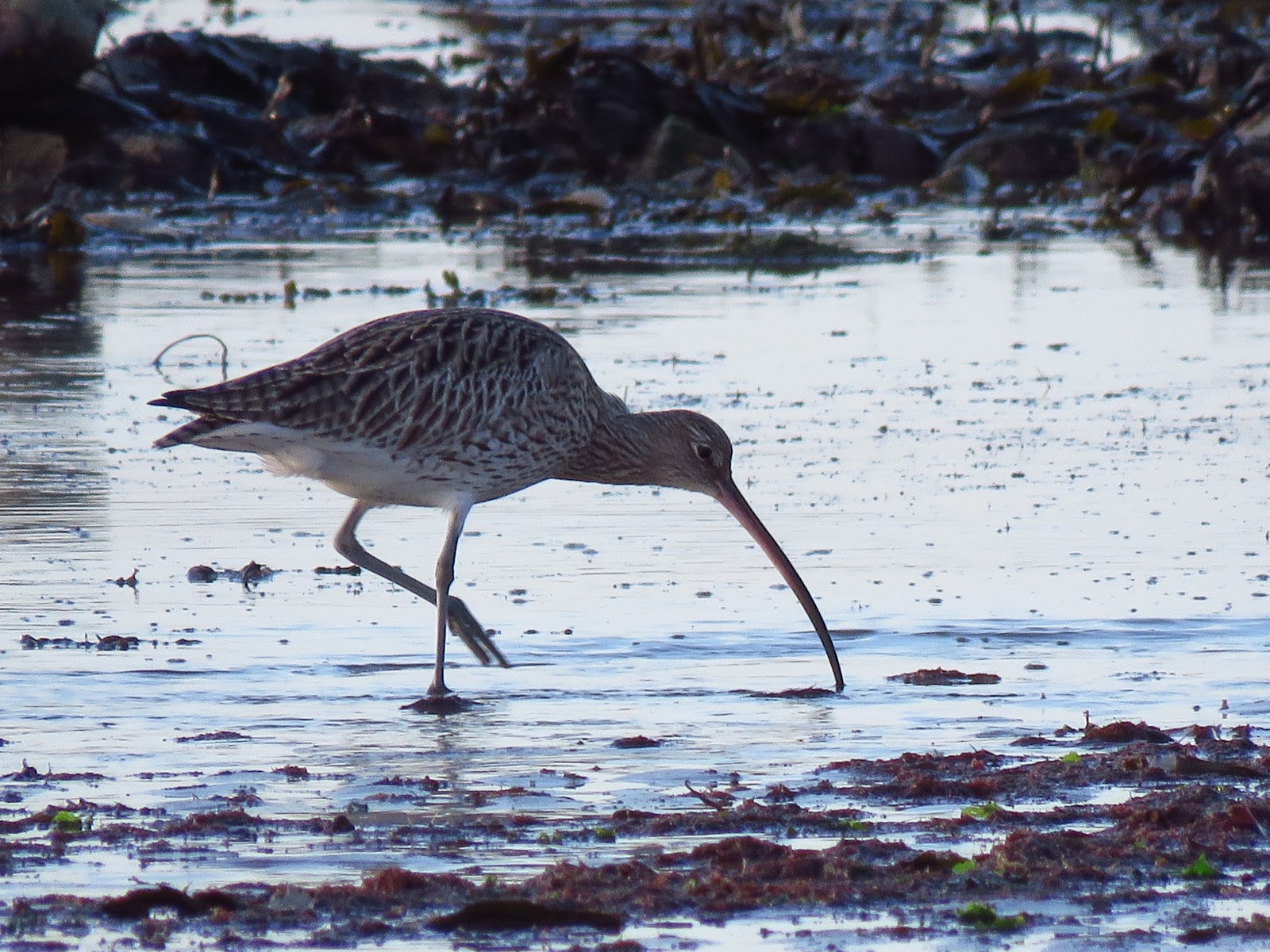
Curlew.
Grey Plover.
Redshank.
A very fuzzy photos of three common seals. Not helped by the heat haze over the saltmarsh.
Reed Bunting.
Little Egret.
Linnets
Yellowhammer.
Wheatear.
A surprise Corn Bunting on the edge of the Wheatear and Lapwing field.


Monday, 18 December 2017

A calm low tide at South Landing

A very calm, sunny and mild day at South Landing. The tide was completely out on arrival. The usual Pied Wagtails and Rock Pipits fed by the stream and on the tide line. At the other end of the beach, where the tiny waves were lapping the beach, a curlew and some Oystercatchers searched for food.
Pied Wagtail on the stream.
Curlew with ragworm.
Curlew.
Robin on the beach.
South Landing low tide.
Carrion Crows mobbing something atop the cliff.
A cacophony of harsh crow calls called my attention. Over 40 crows were circling and calling low over the cliffs. I kept looking in their direction hoping for a raptor to appear, but I had no luck. The crows settled a bit and then I noticed they were breaking shells at the top of the beach (something I have watched previously at Sewerby beach, nearby, see this blog post). They were collecting periwinkles at the bottom of the exposed beach, then flying to the top, where there are large exposed flat rocks and dropping them, the impact audible, immediately flying down to reap their reward: an exposed, cracked periwinkle. I know that's what they were eating as I collected lots of freshly broken common periwinkle (Littorina littorea) shells, their shards very sharp plus a clam and a mussel. 
The moment the crow drops the shell.
Crow eating periwinkle.
An intact periwinkle and lot's of broken fragments collected at the top of the beach.
Freshly Broken mussel shells.
Broken periwinkle shells on flat rock.

It was almost an hour later, when the crows started gathering and cawing insistently again, I looked up, and the profile of a fox showed at the top of the cliff. The crows would fly low and pester him. The fox moved across the cliff giving me a chance to record a video of it before it walked out of sight.
My first sighting of the fox.
Fox. Video here:

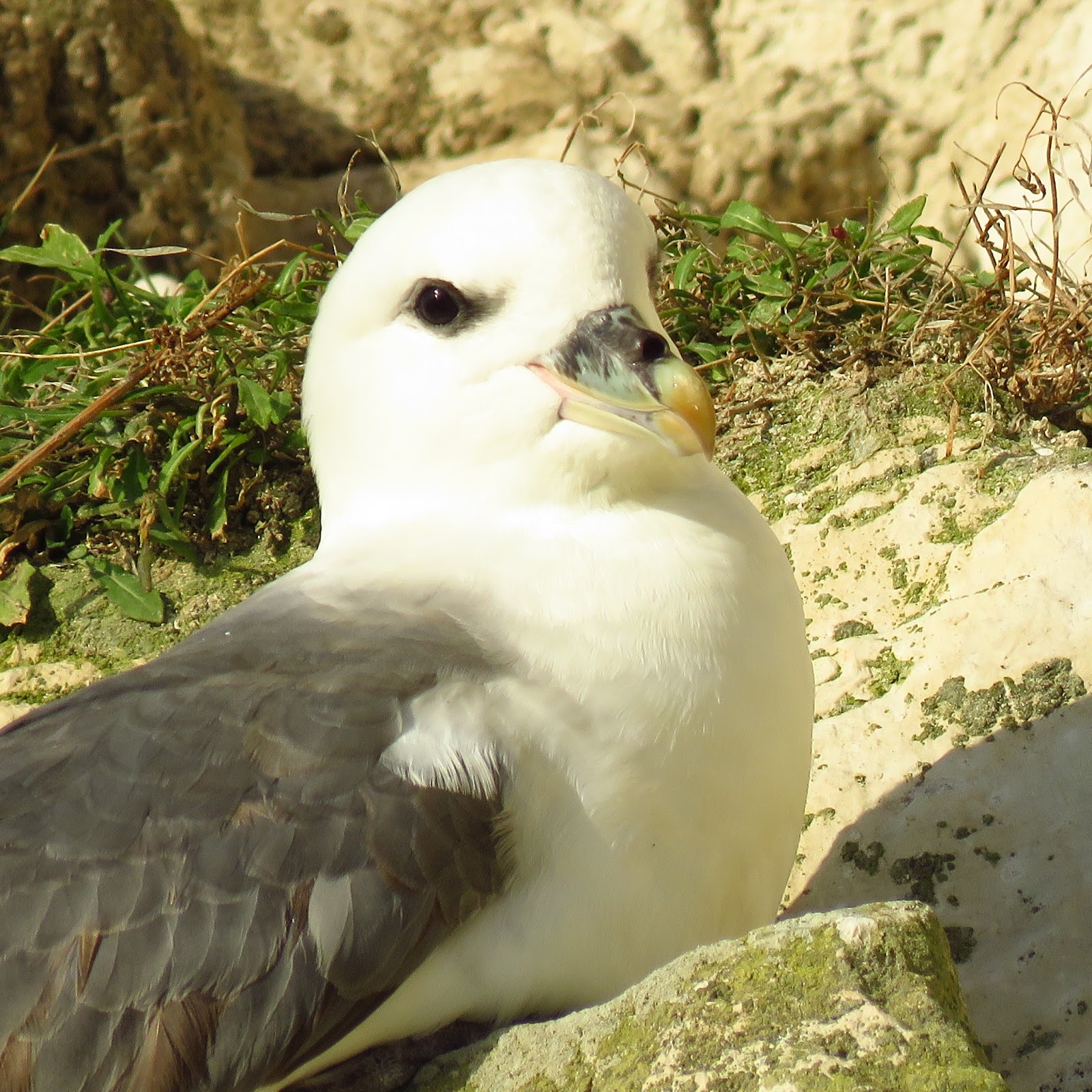
It went quiet again, but not for long. As I walked on the beach in the direction of Danes Dyke I heard the cackling calls of fulmars. I would have completely missed them if I hadn't heard them, sitting on the cliffs. There were nine of them, some in pairs, which called and billed and gently nipped each other. Two of them kept circling, landing occasionally, and then leaving again to circle the cliffs.
Fulmar pair.
Fulmar pair.
Four Fulmars on the cliffs and two came from circling.


After lunch with the fulmars, I headed back to the landing. A Turnstone was digging the soil between the cracks in the rock. A clear element in coastal erosion, turnstones!
Turnstone on the cliff.
There was a Common Seal perched on a rock near the landing. The tide was starting to come in, and the rock where the seal was was quickly becoming submerged.
Common Seal.
Trying to keep flippers dry.
Barely any rock left!
On the sand, six sanderlings stopped for a few minutes to rest from their constant races.
Sanderling.
As I was leaving I noticed a bird washing on the stream. It was a Stonechat.
Stonechat bathing.
Here it is again, now mostly dry

A wonderful day out, plenty of mild sunshine and a great assortment of birds and mammals on South Landing today.