Showing posts with label breeding season. Show all posts

Sunday, 22 June 2025

Urban chicks

I couldn't find my bins this morning, and I thought I might have left them at work, so I changed my plans and walked to work instead, no bins. I walked to Oak Road. It was a sunny and a light wind westerly wind warm, but not as much as yesterday. I thought I'd try and document as much breeding as possible.

I peek over the bridge over the Barmston Drain at Beresford Avenue and there is a Coot on a nest with some young cootlings, but nearby there is a swimming chick. A photo reveals it is a Little grebe chick (I like to call them greblings). An adult appears and the chick starts begging. I try to take the path by the drain but it is too overgrown, the grass taller than me.

Little Grebe chick.

Adult Little Grebe and chick.
Coot and chicks.

I carry on towards the lake. The first young is a Magpie, but in the best surprise is that there is a duck on the lake that doesn't look like a Mallard...it's a Pochard with three medium sized ducklings (top shot and below). It is the first time that I see Pochards breeding in Hull.

The family climbs to a floating trunk to rest.
 

As I talk to someone on the river bank, a Mute Swan's head pops up from the grass: the Mute Swan family has gone for a trip to the river and are waiting to go back. I'm surprised they have done this. I've seen the cob walking back from the river, maybe there is not enough food in the lake. Sure people bring food for the swans, but there is little floating vegetation, the perimeter of the lake is mostly reeds, which may be too tough for the cygnets. In any case, the parents walk slowly and stop and watch attentively. Every time thry stop, the cygnets sit down for a rest. It must be quite an effort to walk the distance. I watch them as they return to the lake. The cob flaps its wings and flies/paddles to one end of the pond.

The parents watching from the edge of the river.
The parading family.
Reed Bunting in song.
Dragonflies
It is a great morning for dragonflies. On the lake there are two patrolling male Emperors and both stop eventually. A single Four Spotted Chaser is also about, and, for the first time ever, I see at least two male Black-tailed Skimmers on the fishing platforms. To complete the odonata list, a single female Banded Demoiselle and a couple of Blue-tailed Damselflies.

Black-tailed Skimmers.
Female Banded Demoiselle.
Four-spotted Chaser.
Male Emperor.

Butterflies


Red Admiral.

A comma licking salts from the edge of the pond.

My first Small Skipper of the year.

Although not in large numbers, Small Tortoiseshells seem the most common butterflies about.


To finish off, a Buzzard flying over as I walked home.


Tuesday, 8 June 2021

A trip to Bempton Cliffs

 It has been a while since I've been at Bempton in June, peak season for breeding birds in the reserve. Today, a warm, sunny day with a light breeze, this was remedied. As I got to the reserve the main car park was already quite full.


 I walked East first. Meadow Pipits parachuting with their clockwork piping, Skylarks and Reed Buntings singing. On the hedges, both Whitethroat and Sedge Warbler. This superb reserve is well known for its seabirds, but grassland and farmland birds are also thriving on the grassland atop the cliffs, which was looking stunning today with the flowering red campion and umbelifers.

Grassland.
Five hares on a field, this is a record number of hares for me.
Tree Sparrows, an abundant resident at Bempton. Today they weren't visiting the feeding station, but they were spread around the fields, collecting insects for their young.
A male Swallow by the visitor centre. Him and his mate were inspecting the artificial nests under the entrance overhang.
Jackdaws are ever present at Bempton. They breed at the cliffs and are often at the picnic areas looking for tidbits.
Kestrel on nest box in front of the visitor centre.
A Barn Owl hunting at midday. Probably busy hunting for hungry chicks.
A bird that I not always manage to spot in the reserve, a male Corn Bunting.
And nearby, a Meadow Pipit.
A poor photo of a female Reed Bunting carrying food for chicks. She was quite nervous and didn't settle so I left her alone.

It is the seabirds that are the stars of the wildlife spectacle that is Bempton. To see a whirlwind of Gannets over the sea (top shot), thousands of birds sitting on the cliffs, and their behaviour, calls, and the smell of the guano, at close range: Bempton is on a league of its own.
  I walked to the 'Grandstand' viewing point. The first Puffin of the year came into view briefly. There would be many others the rest of the day. They all seemed a bit restless and some were on the water.

Two Puffins on the water, with a passer by.

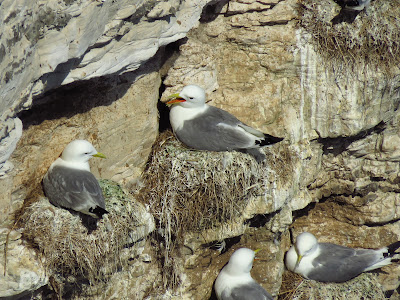
Kittiwakes were sitting on eggs. One stood up and two eggs became visible. Other Kittiwakes flew to a hollow on a field to collect nest material. There was a commute line back and forth of the field. Kittiwakes use grass and mud to make their nests.

A shelf of Kittiwake nests.


Kittiwake on nest with two eggs.

Herring Gulls are much scarcer breeding birds at Bempton, but there are a few scattered pairs.


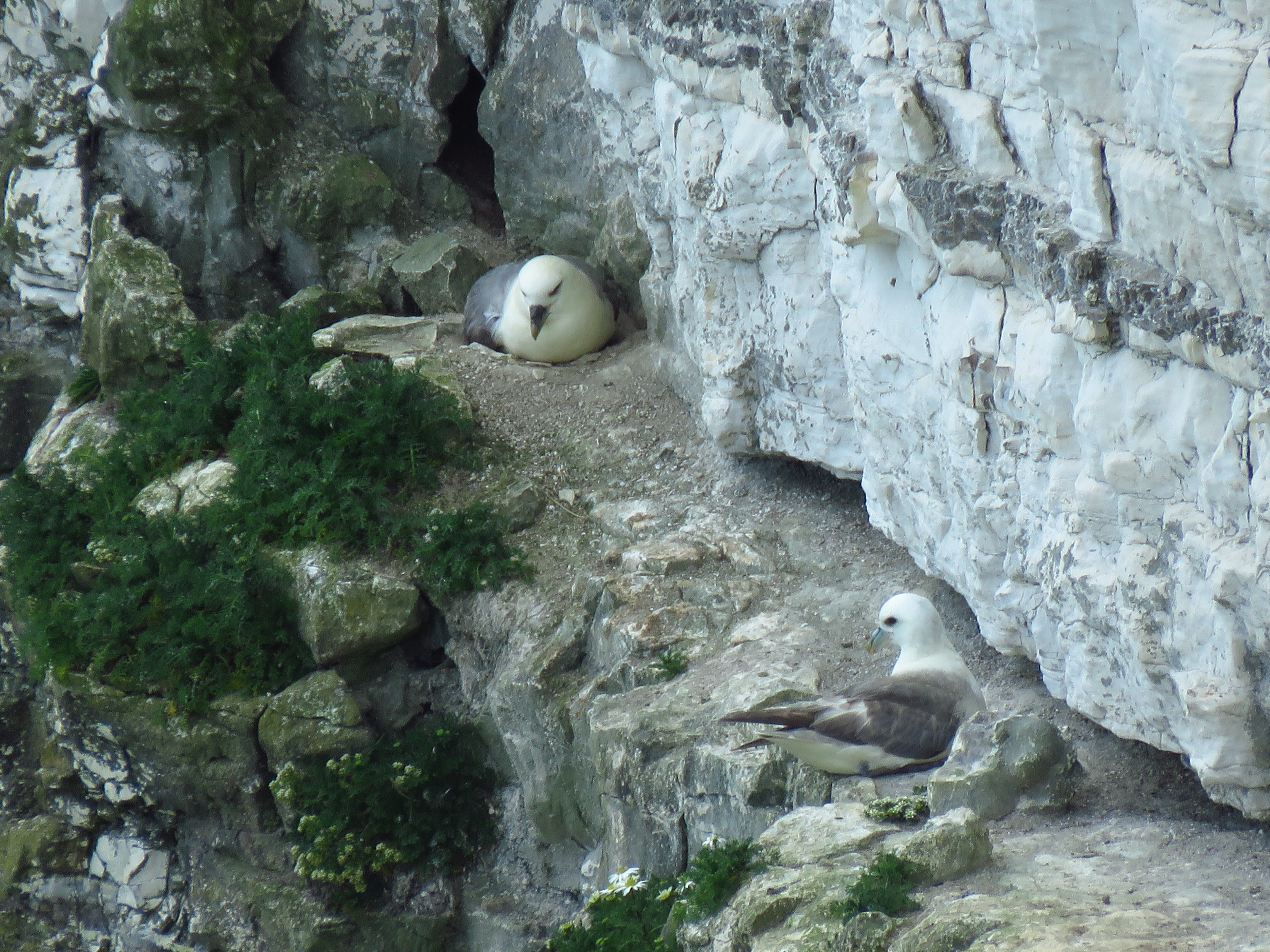
Fulmars are also breeding in the cliffs. Here, two are on their nesting shelves.

Today I paid special attention to Razorbills, my favourite sea bird.
A pair of Razorbills preening each other.

This individual atop the cliff gave great views.
Unlike Guillemots, razorbills seem to prefer to lay down instead of standing.
The end of a Razorbill display.
Often, Razorbills on their own on a cliff will stand up facing the cliff, flap their wings and open their bill, showing their yellow mouth in a display. Their calls are deep and guttural, with a purring quality.
Wing flapping.
Gannets were all on nests and 'clubs'. Some chicks could be visible. It being a warm day, some stood up to shade their chicks.

I love the regular nest spacing.
Gannet shading its chick.
Gannet portrait.
Gannet collecting nest material.
Look how well mowed the grass is near the cliff edge, this is due to the gannets collecting nest material.
Gannet landing to collect nest material.
Guillemot pairs were also displaying and bonding by preening each other and calling.


An illustration of the differences of Razorbills (left) and Guillemots (right).
A viewing platform at Bempton.
I walked the wildlife path and found several ovipositing pairs of Azure Damselflies.
Whitethroat.
Sedge Warbler.
And the final photo of the cliffs at low tide.