A sunny day with a light northerly wind. I only put a jacket in the car as an afterthought, but I end up wearing it all the time as the breeze is cool. Welwick saltmarsh is a YWT nature reserve, a wide expanse of saltmarsh and mudflats. I drive from Welwick village and park on the side at Sheep Trod Lane, a farm road a short distance away. I walk to Winestead Outstrays pumping station to start the stage (there is no access across Winestead drain by the station) and then retrace my steps on the sea wall until the next pumping station, Skeffling.
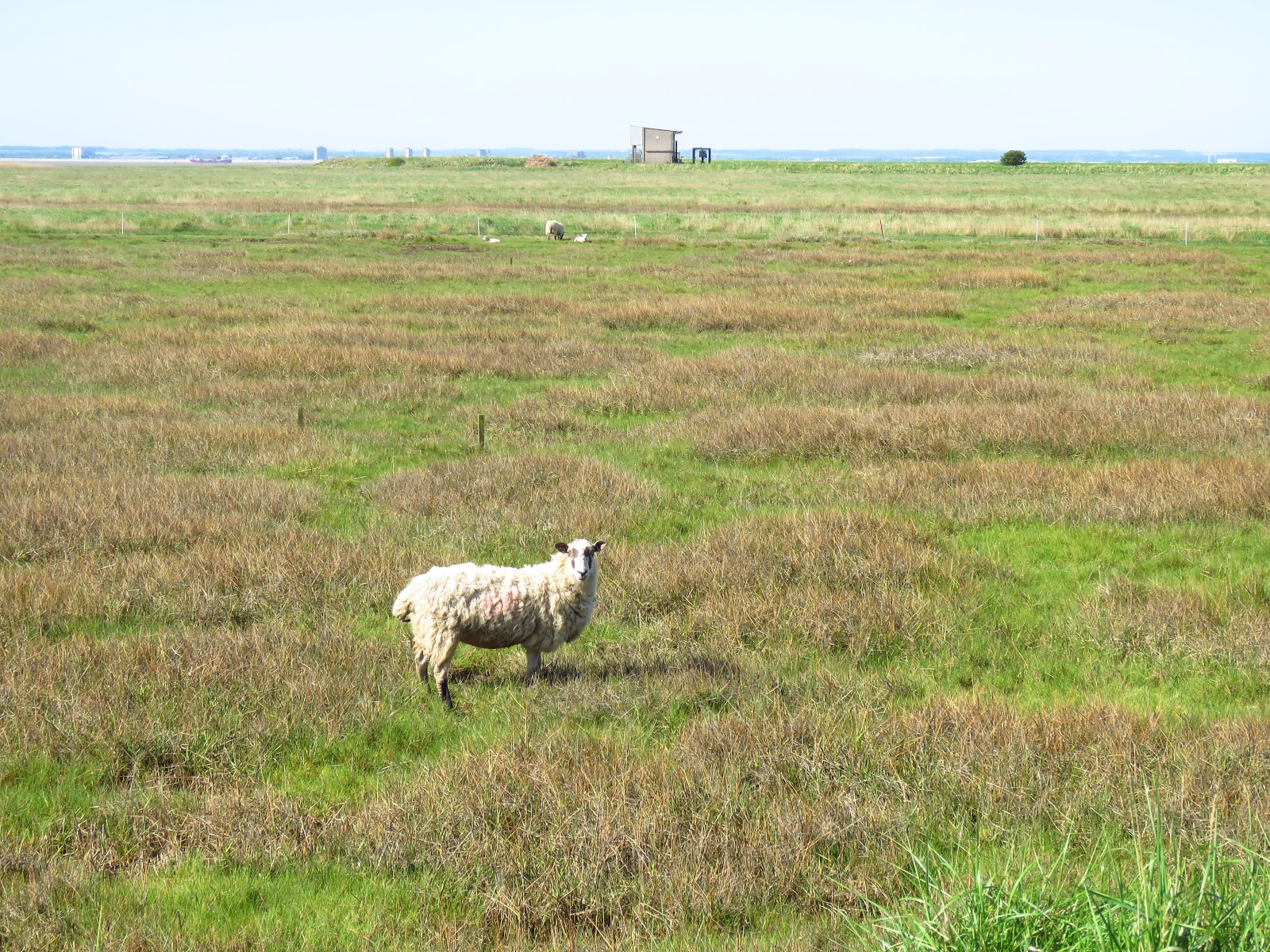
There are expansive views across the saltmarsh, with the pumping station in the distance. Today the sheep keep me company, most of them with two or three lambs grazing on the sea wall or the marsh, or dozing under the hawthorn hedges, cautiously getting out of the way as I walk. But you may wonder what are sheep doing in a nature reserve...
Conservation Grazing
Before farming and domestic animals were introduced in the UK, saltmarsh grazing depended on now extinct large native herbivores such as European Bison, Aurochs, wild horses and Elk. Animal grazing contributed to maintain plant biodiversity. When cattle, sheep and horses were introduced in the UK they replaced the native megafauna as grazers in saltmarshes. Indeed, saltmarshes subject to spring tides provided excellent grazing grounds. However, grazing in marshes has been reduced considerably since medieval times due to land reclamation and the construction of floodbanks, as the land is of very good quality for crops. In the absence of grazing, rank coarse grasses and uniform stands of reeds tend to develop, reducing plant biodiversity.
In order to manage saltmarsh, grassland or heathland biodiversity, conservation organisations use domestic animals - often hardy breeds - to graze nature reserves. The Yorkshire Wildlife Trust has introduced sheep and cattle grazing in several of its reserves, such as North Cave wetlands, Spurn and Welwick. The RSPB uses Konik ponies at Blacktoft Sands. Conservation grazing in other reserves often uses YWT own stock of hardy breeds such as Hebridean sheep or Highland or Longhorn cattle. In contrast, at Welwick grazing is carried out also part of a program of development of links with local farmers. A small flock of mule sheep were introduced in the reserve in summer 2012 with a view to develop a commercially viable sheep flock in collaboration with a local farmer.
Just a few minutes after starting my walk I watch a male Marsh Harrier quartering the marsh. It flies just in front of the pumping station.
A view across the marsh. A patch of old reed and freshly growing grasses.
Little egret.
Little egret feeding on the marsh.
The sea wall by a drain.
A patch of relic dune showing a small bank with plenty of bee holes. No bees today though.
The sheep have no trouble grazing even in the water.
Many shelduck rest or feed on fields. This one sat in the middle of a bare patch on a rapeseed field.
Goldfinch feeding on dandelion seeds on the side of the path.
A new scrape teeming with birds: Lapwing, Avocet, Oystercatcher, Shelduck and Redshank.
One of eight Avocets. At least two seem to be sitting on eggs.
There was a large flock of vagrant Carrion Crows. One of the crows found something on the mudflats, probably a crab, and the rest chased him.
Shelduck flying over the fields.
About 50 Dark-bellied Brent Geese were resting or feeding by the tide line.
Brent Geese.
The breach on Spurn Head in the distance.
Grey Heron.
The end of the stage is Skeffling pumping station. I have lunch on the fence stile, watching the comings and goings of Linnets and Meadow Pipits.
Meadow Pipit.
I was thinking that I hadn't seen any Roe Deer when I see a pair crossing the mudflats in the distance.
They trot across the mud and reach the saltmarsh at Welwick.
They cross the saltmarsh, walk over the sea wall, jumping at least two electric fences and stopping briefly at the scrape to feed...
The avocets start mobbing them as soon as they get near their nests, harrying them along to the fields.
Shortly afterwards, a pair of young Lesser Black-backed gulls arrives to the marsh. Avocets and Lapwings mob them.
The sheep grazing the marsh.
Many butterflies on the wing today. This Red Admiral the most obliging. Also seen at least two Orange tip and a Green-veined white.
Raptor Roost
Welwick Saltmarsh is known in birdwatching circles for their raptor roost. In an evening visit in winter up to nine species are possible: Marsh Harrier, Hen Harrier, SEO, Barn Owl, Merlin, Peregrine and Kestrel. Today I saw two Kestrels and the Marsh Harrier. The roost is really a winter feature and I wasn't expecting much more!
Featured bird: Reed Bunting
Many male Reed Buntings were singing from the marsh, and the side of ditches by the sea wall. Their song is not very melodic, just three or four earnest notes repeated at regular intervals (I use the mnemonic 'cheese--on--toast' to contracst with its relative the Yellowhammer, which has a more pleasant, longer sentence). The male in the photo above sung in between gusts of wind, when it could keep his balance on the grass. As other buntings they sing with their head kept high and the bill wide open. Reed Bunting are a success story. They were red listed in the 70s but are now listed amber after a
striking recovery, which means they could soon be out of the list altogether. Their recovery has been quite astounding in Yorkshire, with 82% increases in breeding pairs since 1995 (BBS 2017 report). Although they are tied to wetlands in the breeding season, they are more widely distributed in the winter where they feed on seeds.
Today's walk, about 9 km round trip.
More information
Chatters, C. 2017.
Saltmarsh. Bloomsbury.
Conservation Grazing at Welwick Saltmarsh. See
this and
this.
YWT homepage for
Welwick Saltmarsh NR.