Showing posts with label Swinemoor. Show all posts

Tuesday, 3 June 2025

Swinemoor with Hull Nats

A mild afternoon with sunny spells and a stiff breeze, we visit Swinemoor, one of the commons of Beverley. Unlike the Westwood, on the foothills of the Wolds, this is in the river Hull valley, an ancient floodplain which was fen before embankment of the river, and the digging of the Beverley and Barmston Drain dried it. It has peaty soil and it is still flooded seasonally, small parts year round unless it is a dry summer. It is still acting as a common land, with horses and cows grazing in the summer months. The area still holds some plants that are uncommon in the area and represent marsh. wet meadows and marginal and aquatic plants, despite many losses over the years. One of our members is a local who takes pleasure in showing us the Swinemoor botanical delights. We enter the common by Hull Bridge and walk along the river bank, recording the marginal and aquatic plants that have survived grazing thanks to the protection afforded by the moorings and jetties. Despite the very wet winter, when the common was flooded between the river and the drain, the long dry spring meant that the moor was very dry. We walked across an expanse of dried and exposed peat, which was now mostly dry towards 'Bricky Bridge'. It was amazing to see the density of Brooklime and celery leave buttercup in huge areas. There were one or two places where the peat was damp, but the only area holding water was a pool just north of the bridge, on the east side of the Barmston drain. There, to everyone's surprise is a pair of Avocets with two grown chicks. One of the adults flew off and called in alarm constantly, while the other led the chicks quickly away. They calmed down as we got to the bridge. A pair of passing crows lifted six Lapwings and soon enough we counted a few scattered chicks, beautifully camouflaged. I was amused to see how the Lapwings mobbed the Swifts, two fantastic flyers in pursuit. A small flock of Canada and a Greylag, some Pied Wagtails including a fledgling and a pair of Shelduck were also around the pool.

 We then walked on the west side of the drain where we recorded a patch of Adder's tongue, and found some Marsh Arrowgrass, the latter a first for me. 

Goldfinch singing by the Barmston Drain.
Female Banded Demoiselle. The wind kept the flying insects down. I record a Common Blue damselfly and this Banded Demoiselle. A large dragonfly, maybe an Emperor, patrolled the drain at Hull Bridge, but we didn't manage to clinch the id.
This is River Water dropwort, Oenanthe fluviatilis, a strange aquatic umbelifer, with fine sub aquatic leaves, which flop when out of the water giving it a sickly appearance, it has thick stems.
Appearance of the sub-aquatic leaves of the River Water dropwort.
Brooklime.
Hemlock Water dropwort..
Three white geese. A flock of white geese has been at the river at least since 2017.
Swift.
Water forget-me-not.
11 spot ladybird.
Alarming Lapwing.
Avocet and chicks.
One of the several horses at the Moor with pool on the background.
Shelduck.
Lapwings and chick.
Barmston drain by Bricky bridge.
Territorial Swan.
Slender Groundhopper.
Adders tongue.


Adder's tongue.

Sunday, 10 June 2018

Sunny afternoon around Hull Bridge, Tickton

Another sunny afternoon after a cloudy, cool morning, I head to Hull Bridge at Tickton, back to the River Hull. I'm hoping to find Banded Demoiselles, Calopteryx splendens, a species that is not very common east of the Wolds, but that in recent years it has established itself in some stretches of the river Hull. I park right by the bridge over the Beverley and Barmston drain and right on cue, just as I leave the car a male Banded Demoiselle flies past. I look over the bridge into the canal and there are around nine males and at least a female, flying over a large patch of Potamogeton crispus, males chasing and hovering over the plants, which will be the female's choice of ovipositing sites.


Although they are great fun to watch, they are a bit distant, so I decide to walk by the drain and see if I can get closer views. As the drain runs closer to the River Hull I climb the bank to have a look at the river and it is on the river bank when I find a settled female on a willow, and later of a male, which alights close to the female. There are many settled males on the grassy bank, I count 15 individuals in a short stretch of river.
A male Banded Demoiselle on the River Hull, with some male Azure damselflies.
Female Banded Demoiselle.

Male Banded Demoiselle.

I cross the bridge to Stork Hill Wood, a place I haven't been before. From the bridge, more Banded Demoiselles and Azure damselflies ovipositing.
 Stork Hill Wood was planted in 2004, a board informs me, and the map shows a small pond in the middle, so I head for it. The water level is quite low and it looks like it might dry any day, but there are many Azure Damselflies ovipositing and a single male Large Red Damselfly. An Emperor flies past at some point but doesn't settle.

Azure Damselfly.
Ovipositing Azure damselflies.
Mayfly in Stork Hill Wood (Ephemera vulgata)
Azure Damselflies were ovipositing everywhere, these on the Stork Hill Wood pond.

Male Large Red Damselfly.
On my return I walk to the ford on the drain in Swinemoor. There is a nice patch of Potamogeton with ovipositing Azure damselflies, but I also find a teneral and a male Common Blue and a male Red-eyed damselfly patrolling away from the shore, a very distinctive species even from a distance, with a strong flight and a distinctive dark thorax, with a bright blue band near the tip of the abdomen.
Teneral female Common Blue damselfly.
Male Common Blue Damselfly.
Pair of Azure Damselflies in tandem.
Male Red eyed Damselfly, it only settled in the middle of the drain.
As I got to the car I had a last look at the Banded Demoiselles on the drain, I was rewarded by a Water Vole, crossing the drain and disappearing into the sweet reed grass, a great end to a great day!

Wednesday, 10 May 2017

Swinemoor with Hull Nats

A beautiful, still and mild evening put an end to the Arctic wind we have been putting up with in the last week. I revisited Swinemoor Common in the Tuesday night field meeting of Hull Nats. We walked around the common going south by Beverley and Barmston drain and then following the river upstream.
We started by admiring the horses galloping alongside the river bank.
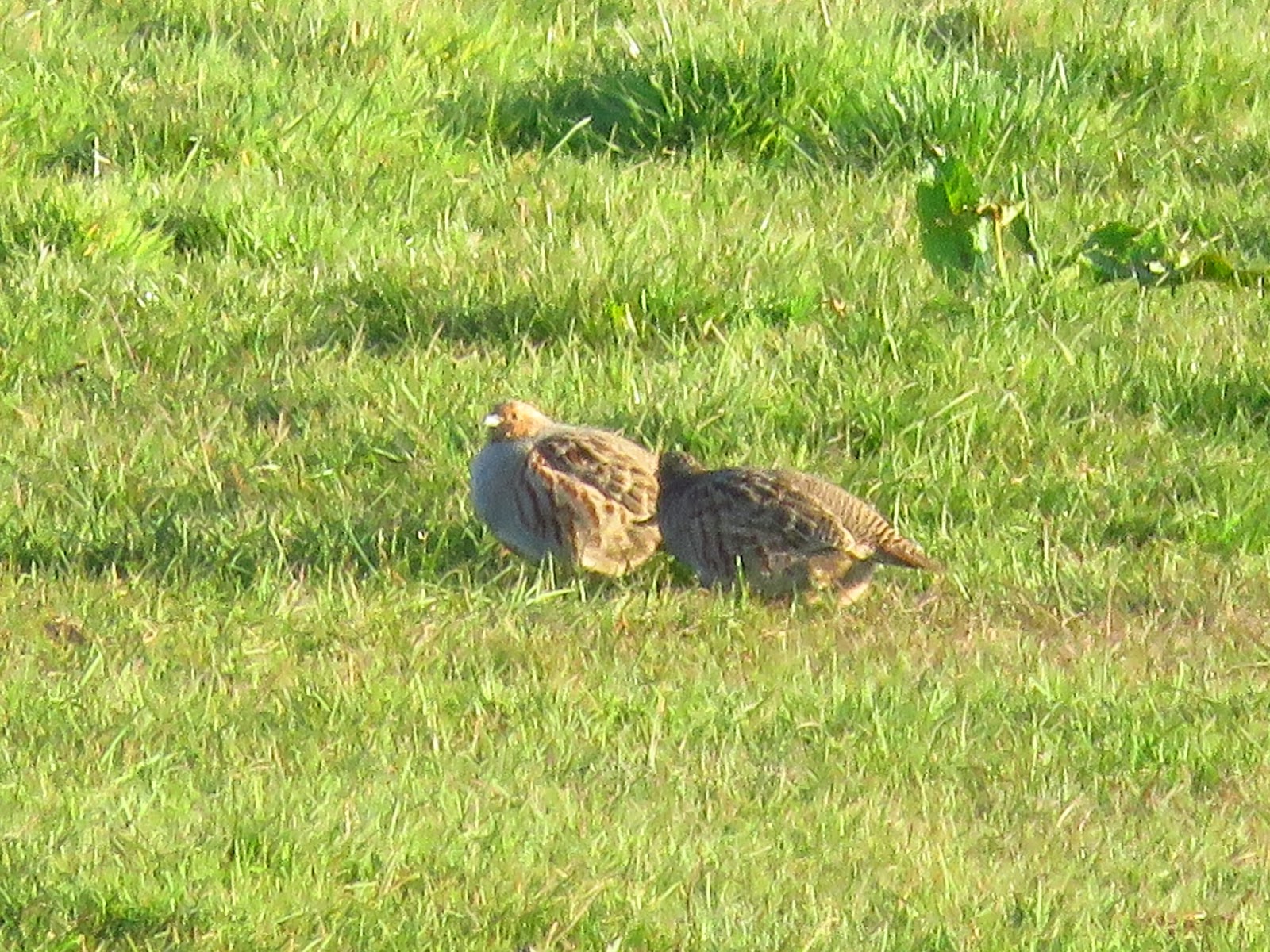
Andrew spotted a pair of Grey Partridge feeding close to us, the first time any of us sees this species there.
One of the two Yellow Wagtails we saw. 
A Lapwing with 5 young chicks. They were very busy chasing crows and jackdaws away (top shot), and also an unfortunate Little Ringed Plover that dare approach the chicks. 
The shadows of Hull Nats members observing Lapwing chicks through Andrew's telescope. 
Male Lapwing in the wet pasture. 
We were hoping to watch Snipe drumming. Instead, we were treated to the sight of 16 local Snipe joining in a flight (a wisp of Snipe that is) around the common.
Plenty of Swifts and Swallows about, and this is what they are after following the river, drains and other wet areas during their migration, clouds of midges gathering over Beverley and Barmston Drain. 
The only Domestic Geese left. 
The trip finished with a beautiful sunset over Beverley.