Showing posts with label parkland. Show all posts

Monday, 2 June 2025

Urban birds at Hull. 49. Great Spotted Woodpecker


The Great Spotted Woodpecked needs little introduction.  It is a very distinctive bird by appearance and behaviour. Despite their name, they are quite small, the size of a Starling. Our most common species of woodpecker, it is associated to large gardens, parkland, hedgerows with mature trees, and woodlands. They are a smart black and white, with checkered wings, white belly and large white wing patch, and a large red patch under the tail. Males have a red patch behind its head, and young have a red cap. During the breeding season, starting from January, they drum on tree branches, often, resonating dead ones. They also call repeatedly from atop a tree, 'kik!'. The flight is undulating. Great Spotted Woodpeckers feed on three trunks and main branches, picking insects from crevices or pecking under dead bark. 

Male Large Spotted Woodpecker, 7/03/2022. Willerby Carrs.
Female Great Spotted Woodpecker, 19/11/2021.

Status and distribution in Hull

A species that is becoming more common around Hull, judging from Richard Broughton's assessment in 2002, where he gathers most records were of wintering birds, with possible breeding in a few places. It is a widespread, resident species, although limited by the cover of mature trees. Breeding has been confirmed at Pearson Park, Northern Cemetery, University, and St Nicholas Primary, but they are resident in all the large cemeteries, parks and along the northern urban section of the River Hull, where they are also likely to breed.

A dead standing trunk peppered with woodpecker holes, probably as the bird searched for wood-boring beetle larvae. Jack Kaye Field. 3/04/2021.
Woodpeckers will readily visit bird feeders, where they favour fat balls and peanuts. Western Cemetery, 28/03/2021.
Excavating a nest hole, at Pearson Park, 1/03/2017.
A chick peeping out of the nest hole, almost ready to fledge. Northern Cemetery, 29/05/2024.

A young at its nest. Pearson Park. 22/05/2025. When ready to fledge, the young woodpeckers become very vocal and they can be easily tracked to their nest.
Conservation and management

Great Spotted Woodpeckers are Green Listed birds. Populations dramatically increased across the UK in the 1970s, and again in the 1990s and 2000s, also expanding in range. From 2010 onwards the population has been more or less stable. This might have something to do with changes in woodland management, with more standing dead wood and increased food availability in gardens.
More information
BTO Birdfacts. Great Spotted Woodpecker.
Broughton, R.K. 2002. Birds of the Hull Area.

Monday, 9 November 2020

Urban birding at Hull: A November Walk to Pickering Park

A still cloudy day that started less misty than previous days and noticeably milder. I took a walk to Pickering Park, about one hour away from home, passing through the General and Western Cemetery, Spring Bank West, to Anlaby Road through the pedestrian/cycle lane, and next onto Boothferry Road and a small foray to Peter Pan Park. Some of these areas I had last visited in the spring lockdown.

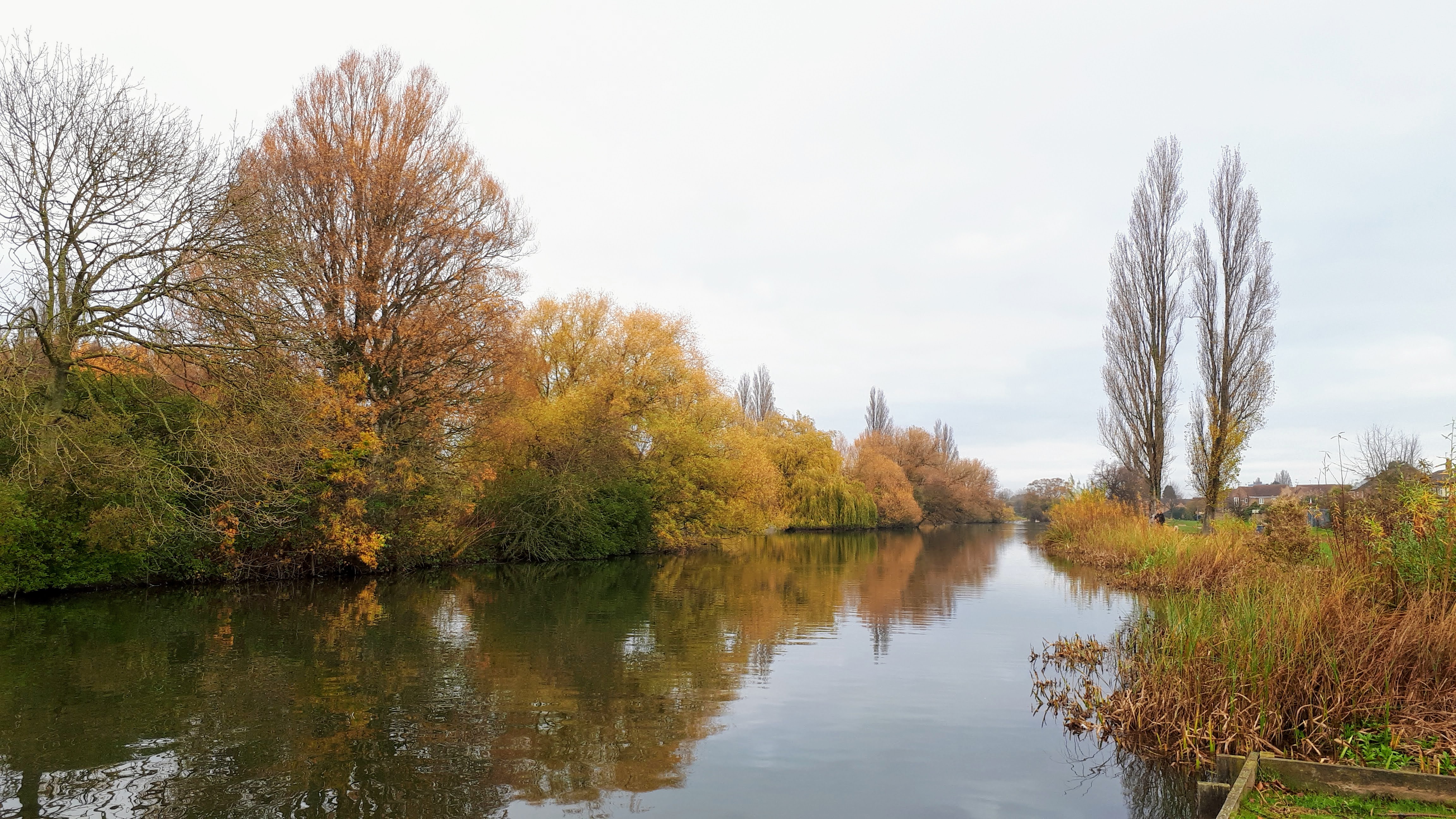
I take a mental note of the plenty of berry-laden rowan trees along the roads in case of a waxwing irruption. Pickering Park is looking splendid with the autumn colours. The occasional flock of Fieldares and Redwings fly high overhead, and also a large Woodpigeon flock. There are no Goosanders yet. 

The extended Mute Swan family is spread around the lake. The two last years young are in the southern side of the lake, whereas two young from this year are in the northern side practicing their courtship skills. One of them eventually gets left behind and it utters its contact call. The third young of the year exercises its flight muscles while on the shore.

I watch a crow chasing a female sparrowhawk.

Collared Doves at Spring Bank West.
A Blue Tit feeding on horse chestnut leaf miner pupae.
A swan mussel shell near the edge of the Peter Pan lake.
A 100+ strong Woodpigeon flock in migration.
The cob Mute Swan.
The sun came out at about eleven, bringing out the colours even more.
One of two Tufter ducks at Pickering Park lake.
The Stock Doves are very tame at Pickering Park and come right next to me as I crouch on an area where people have left peanuts. 
Shaggy scalycap, Pholiota squarrosa, cluster growing at the base of a willow.
A Mistle thrush 'frozen' as starlings and goldfinches take to the wing, possibly due to a Sparrowhawk.
As I walk back through the Western Cemetery, a Woodock took flight and flew around the trees. A very nice addition to my lockdown list and year list!

Tuesday, 21 April 2020

Urban birding at Hull: general and western cemetery

Since the lockdown started, I've been birding as part of my daily exercise walk. The local cemetery, which I have covered before in this blog, is a ten minute walk away and sometimes I don't come across anybody in my walk, ideal for social distancing. In the spring, the cemetery is full of song, Chiffchaffs and Blackcaps have several territories. The lush undergrowth supports plenty of Wrens, Robins and Dunnocks. The other day I witnessed a food pass between a pair of Sparrowhawks.
This cemetery is actually two, on the eastern side is the General Cemetery, now not an active burial ground. It was acquired by Hull City Council in 1974. The lack of maintenance resulted in the emergence of dense woodland with understory of ivy, brambles and some garden plants like cherry laurel. There are large ashes, some oaks, beech and sycamore, some engulfing the old headstones. The base of lime trees is thick with epicormic growth, which provides additional shelter.

Western cemetery
The Western cemetery, which is split by Chanterlands Avenue, is open parkland, also with some mature trees. In both there are plenty of Yew.

Both cemeteries include a diversity of mature trees, and some fallen and standing wood. Given the lack of woodland in the local area, the cemeteries, particularly the General Cemetery, provide a haven for woodland birds like Song thrushes, Treecreepers, Stock Doves and Great Spotted Woodpeckers.
 I went for my daily walk to the cemetery this morning. I'm not taking as many photos as normal, but I took some with my phone and I had to take my camera out of my bag to photograph the blackcap that sung in the flowering maple (top shot). It was a fine sunny morning and a Treecreeper, Goldcrest, Chiffchaff were also singing.
A path in the General cemetery.

Ivy-clad trees in the General Cemetery.
A large Ash in the Western Cemetery.
The mowing misses some weeds on the edges of the old fallen headstones.
An exposed root plate and dead wood.
Flowering cherry.
A large copper beech had fallen overnight the other day.
Flowering maple.
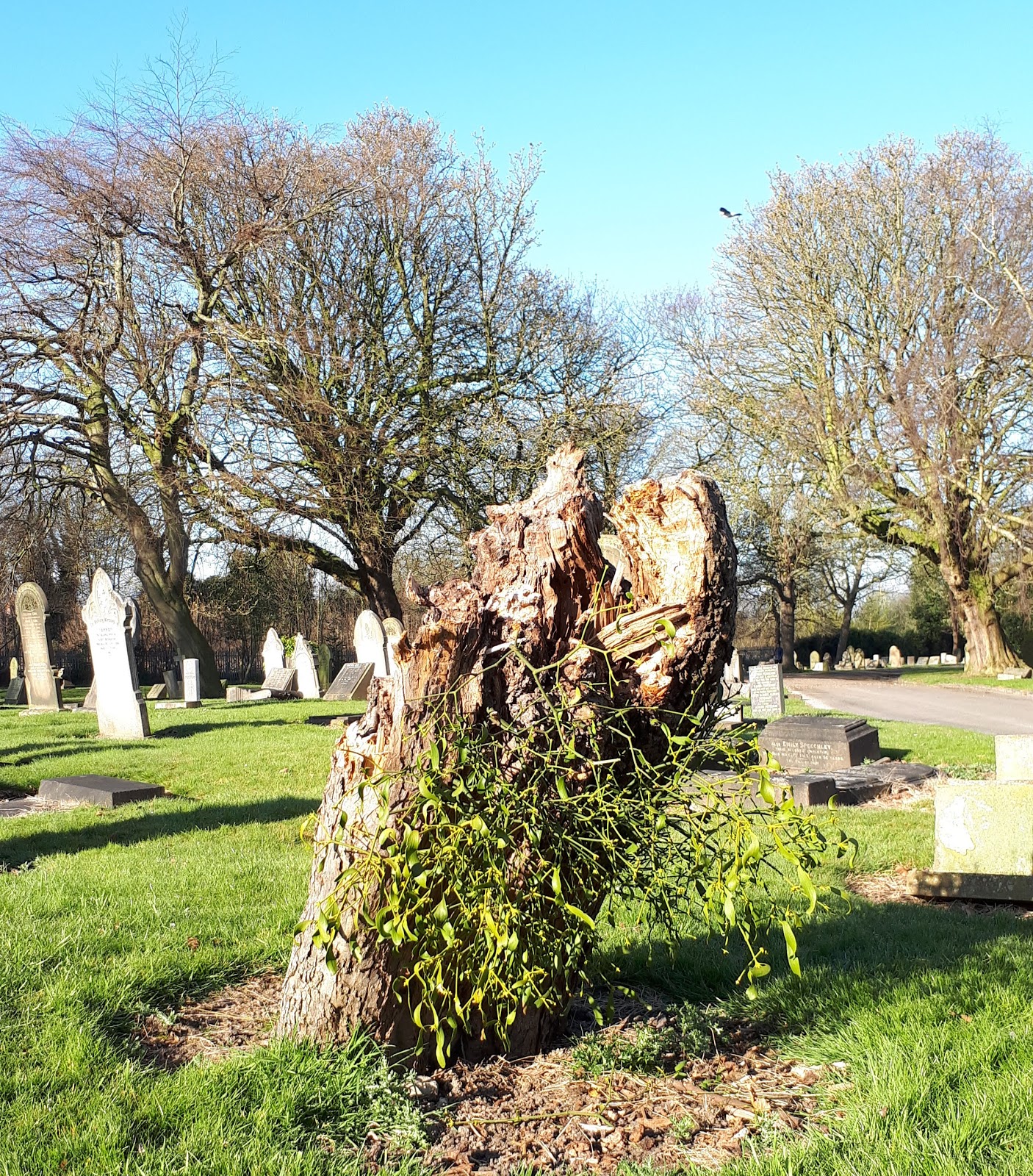
A Mistletoe in a tree stump.
Some mature pine trees.
Today's Bird list
  1. Blackbird
  2. Blackcap
  3. Blue Tit
  4. Bullfinch
  5. Carrion Crow
  6. Chaffinch
  7. Chiffchaff
  8. Collared Dove
  9. Dunnock
  10. Feral Pigeon
  11. Goldcrest
  12. Goldfinch
  13. Great Tit
  14. Greenfinch
  15. Herring Gull
  16. House Sparrow
  17. Lesser Black-backed Gull
  18. Magpie
  19. Mistle Thrush
  20. Robin
  21. Song Thrush
  22. Stock Dove
  23. Treecreeper
  24. Woodpigeon
  25. Wren