Showing posts with label ravines. Show all posts

Wednesday, 6 September 2023

Train trip: Scarborough to Crook Ness


I took the train to Scarborough for a walk along the coastal Cleveland Way. The day started a bit misty, but warm, and soon the sun was shining and the light breeze atop the cliffs made for a wonderful summer feel walk. I headed straight for Scalby Mills, as I was keen to explore two ravines, Scalby Mill and Crook Ness. Both have a southerly aspect and I was wondering if an undiscovered population of Dark Bush-crickets might be lurking there. I'll give you the answer now: no Dark bush-crickets were found, however, there were other bush-cricket surprises!

Looking back with Scarborough Castle on the horizon.
It was nice to see a female Common Field Grasshopper jumping down from a concrete post and start to lay eggs on the soil. This is the only grasshopper species seen, but it was plentiful. 

Long-winged Conehead habitat by the road.

Of course I had taken my bat-detector along. The first surprise was Long-winged Cone-heads on a patch of grassland by the road just up from the Scalby Mills pub. This wasn't a very large surprise through, as we saw the species at Ravenscar, a more northern location. Long-winged Cone-heads were calling all along the walk, they seem very established as they've been there for a while. Unfortunately the high temperatures meant that they weren't showing much, so no photos, just sound recordings of them.

I cross the bridge over Scalby Beck, always picturesque and much better on a sunny summer day!

View while climbing the small valley to carry on the Cleveland Way.
From the sea came the wailing calles of Oystercatchers and Curlew. Cormorants dried their wings on rocks as the falling tide exposed them and Grey Heron stood by rock pools having a go to pond dipping.  

Grey Heron.

The walk gets more interesting as I start picking the first Roesel's buhs crickets on the grassland over Scalby Beck. They are numerous and the habitat forms a long strip along the path, so their whirring accompanies me along. Although I try to triangulate their position with the bat detector, I fail to spot any, probably also hiding inside the grass tussocks. When I get home I check and find these are the first Roesel's in VC62 and some of the northernmost in the UK.

The views of this walk are truly spectacular!

An interpretation board for Scalby Lodge ponds. No water was visible from the footpath.
Curlew.

I'm very pleased to spot a few Wall Butterflies basking on the footpaths... 

or feeding on Creeping Thistle.

Arriving to Crook Ness.

The interpretation board has fallen to the ground. Interesting to read that the track to the beach along the ravine was used to collect building materials with donkey and cart. The cliffs are quite high and this is one of the few access points to the beach. The ravine is very narrow and steep, and there is a trickle of water on the beck. Ferns clothe the sides of the ravine, but it is very enclosed and as soon as you are on the beach it feels very dry. The only orthopterans to be seen or heard were Common Field Grasshoppers.

Common Field Grasshopper.
I have my packed lunch on a large boulder overlooking the sea. I'm quick, as there is a long way back to the train.
The bottom of Crook Ness.
There are reeds, but not many brambles at the bottom of the ravine.

Saturday, 26 August 2023

Hayburn Wyke and Ravenscar

I was very keen to return to Hayburn Wyke after last years visit with Hull Nats, so I got a lift to join a trip by the Fern Group today. The weather forecast was changeable for the weekend, with rain and thunderstorms predicted for the afternoon. We were lucky the weather held on and we enjoyed a pleasant temperature, barely any wind and plenty of sunshine. It was lucky, as my main aim for the day was to record Dark Bush crickets and I had taken the bat detector to check for calling males.

Kite-tailed Robber-fly on the car park.

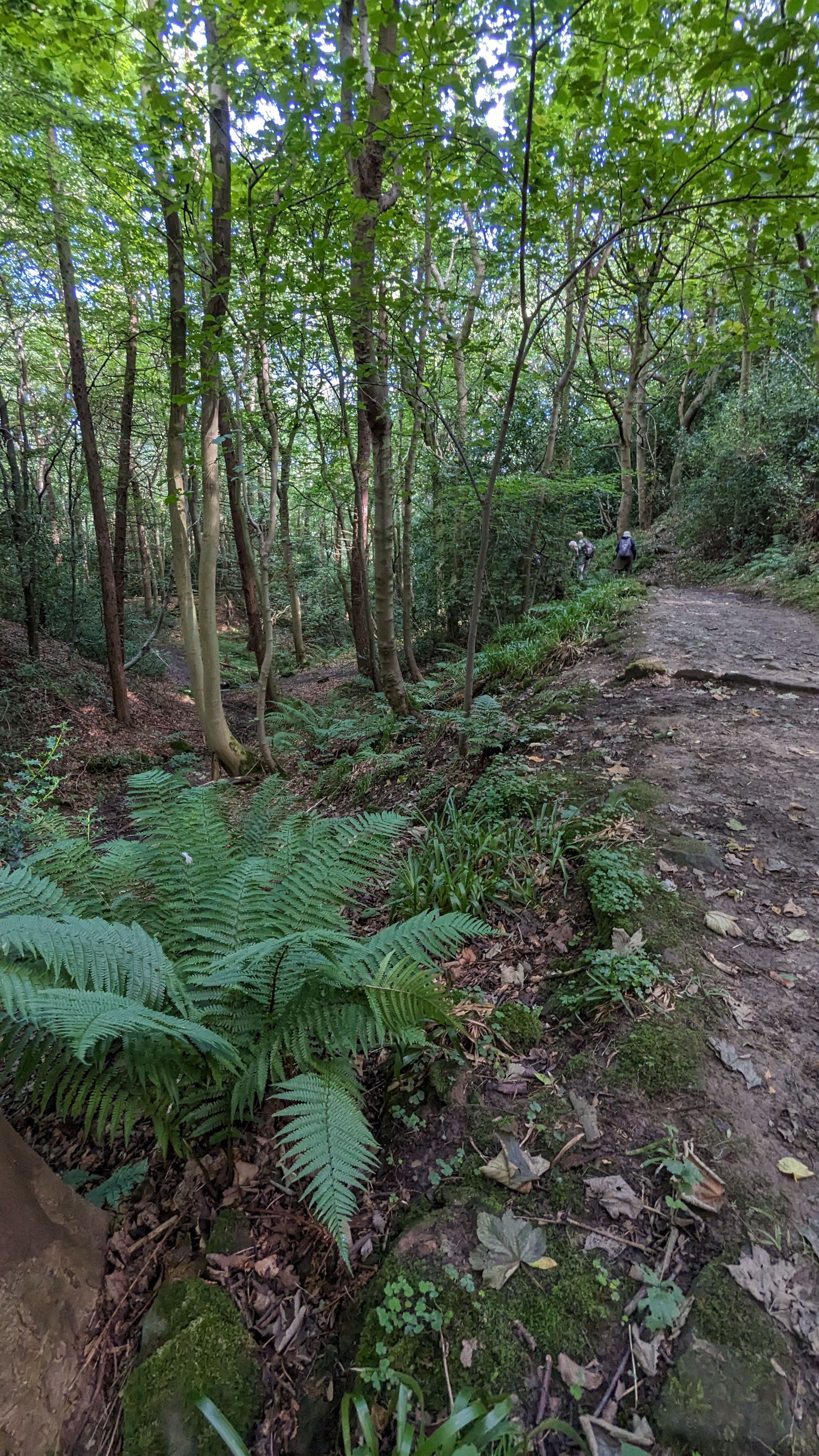
First, we took the path down the ravine. The ferns look magnificent, much larger than the sizes we are used to. Soft Shield Ferns are plentiful, as are Hard Fern. We saw some Lady Ferns too. We didn't come all the way down to the beach, just to the view point near the wooden bridge at the end of the trail. We were supposed to be following a trail along the beck, but somehow we lost it and it was like being in a ferny and boggy jungle. Anyhow, it was a great adventure going 'off piste' within the wood. Hayburn Wyke wood feels like a temperate rainforest. 

Lady Fern.
Soft shield fern.
The path to the beach.
The first viewpoint to the little cove.
A racing pigeon had decided to spend the day at the beach, enjoying the sunshine.
Devil's-bit Scabious with Common Carder Bee.
Spot the Slow Worm.
View of the head.
Slow Worm.

Sericomya silentis, the Bog Hoverfly, a lovely, large hoverfly typical of moorland and woodland clearings.

Female Dark bush-cricket. Three were basking near each other at the base of a south-facing hedge, where males were also calling. On a different field after lunch, also from a hedge, I picked two male calling. It appears the Hayburn Wyke population is doing quite well.

The beck.
Our lunch spot.
Leopard slug.
Ferdinandea cuprea. An uncommon woodland hoverfly. 

After the adventure in the woods, we decided to pop to Ravenscar to enjoy the view and have an icecream. I switched on the bat detector, hoping for Dark bush crickets, but, surprisingly, I picked a Long-winged Conehead calling, which I couldn't locate, in the field just by the car park (below). After a walk to the fantastic viewpoint towards Robin-hood's Bay down the hill (top shot), we returned to the car, but Roland immediately spotted the calling conehead when I pointed the area where it was calling! I check at home and this is the second most northerly record of Long-winged Conehead, and only the second from VC-62.

Conehead field.
Long-winged Conehead.

Common Green Grasshopper.