Showing posts with label lockdown birding. Show all posts

Monday, 29 March 2021

Hull urban birds. 14. Song Thrush

 
The Song Thrush is a small, shy thrush. Its upper parts are a rich brown colour, with its white chest speckled with tear-shaped spots. It often keeps close to cover, and flies to shelter when disturbed, with a distinctive call, 'zit'. Song Thrushes can often pass unnoticed until males start singing, often very early in the year, then they appear to be everywhere. It is a loud and pleasant song, of whistled phrases repeated several times at regular intervals, drawn from a wide repertoire. The presence of Song Thrushes can also be detected by their anvils, a hard surface where they crack snails in dry weather, when worms become unavailable. It feeds on worms and other ground invertebrates, and in the autumn and winter it supplements its diet with berries.  

Status in Hull

Although not particularly numerous, it is a widespread, resident bird in the city, and breeds in parks, cemeteries and residential urban and suburban gardens. It is also found on the edges of playing fields and the river and drains where there is plenty of cover. The Song Thrush was included in the Hull Biodiversity Action Plan. It doesn't appear to be declining in Hull.

Conservation

The Song Thrush is a UK Amber Listed species due to population declines. Between 1970 and 1998 the population fell by 56%, possibly due to changing farming practices and pesticide use. There has been some recovery since then, but the population density remains much lower than in the past. 

Management

Avoiding pesticide use in gardens and parks (including slug pellets). Sensitive management of hedgerows, avoiding trimming during the breeding season and berry season, and a layer of scrubby understorey in parks and gardens should encourage Song Thrushes in the city.

31/03/2019, Pearson Park.
A Song Thrush anvil, a brick, with the broken shells of Cepaea snails.
Noddle Hill LNR. 7/05/2017
A Song Thrush in habitat. Bridlington Avenue, 27/02/2021.
Pearson Park. 17/02/2017
Singing atop a roof at Pearson Park. 1/03/2017.
Two Song Thrush fledglings at Pearson Park, 13/05/2015.
Song Thrush 'frozen' at the sight of a Sparrowhawk, by Bransholme 9/03/2021.

Monday, 22 March 2021

A local Hawfinch twitch

I took a long walk today. It was an unashamed twitch, I must confess. I absolutely love Hawfinches and the lockdown has meant that I can't travel for my yearly fix at Clumber Park or Rufford Country Park. A Hawfinch has been wintering in a local nearby site. The site is sensitive and I've been asked not to disclose by the local officer that first spotted the bird. This male (or a different) Hawfinch was seen at the same site in 2019, in mid April, not seen last year, and then seen again this year since the 17th February. During lockdown I've only been birding during walks in my local area, so I was a bit hesitant to go. However, I decided that it would be local if I just walked there and back. It wasn't really much further than my usual local walks, just outside the Hull city boundary. Today, the forecast was for sunny, cool weather, ideal for photography under trees. I knew that I needed an element of luck, as local birders have been there and missed it. I got up early, packed a lunch, just in case, and took off aiming to get there around 8:30. 

42 Pink-footed Geese flying NW.

It was a very pleasant walk, with highlights a skein of Pink-footed Geese flying over, a singing Green Woodpecker, a pair of Kestrels and two male displaying Sparrowhawks, doing the rollercoaster dive signalling their territorial ownership.

Kestrel.
Reed Bunting singing.
My first Anthophora plumipes female.
Anthophora plumipes male.

So, I got there, I found the favoured spot and started the wait. Children walked to school across the cemetery, then at 9 o'clock it got very quiet. It was pleasant enough. A retinue of birds visited the feeders. Long-tailed tits, Coal Tits, Dunnock, Robin, Blackbird. A grey squirrel. There was another birder about who put some seed on the feeder. I thought that the Hawfinch wouldn't pay much attention to this but he said 'birds attract birds', which is quite right. Then AA turned up, which I took as a good omen as he sees all the birds! We were catching up on stuff, hadn't seen each other in ages, when he looked and listened intently. I stopped talking and look to the feeders and the magnificent Hawfinch landed on a pole. I said, it's here! How did you know? He said that the officer had told him that Blue Tits called in alarm when the Hawfinch appeared, maybe due to its large size? The fact is, we were watching the bird and it was feeding on the seeds that the first guy had put on the table. Black sunflower seeds in particular. It had taken 45 min wait. After feeding for a while, the Hawfinch flew to a branch, where he wiped his bill and stayed for a bit before dropping to drink for a second and then disappearing on the trees.
Peeling sunflower seeds.


The male Hawfinch in all it's beauty. The metallic, frilly ends of its primaries are visible in this photo. A subtle combination of colours, matching with the wall behind!


Monday, 15 March 2021

Urban birding at Hull: A walk along the Beverley and Barmston drain

 Today I walked to the north edge of the city at Orchard Park via Beverley Road, Strawberry Lane, Green Lane and then taking the public footpath by the Beverley and Barmston Drain from Endyke Lane. 

Mallard pair.

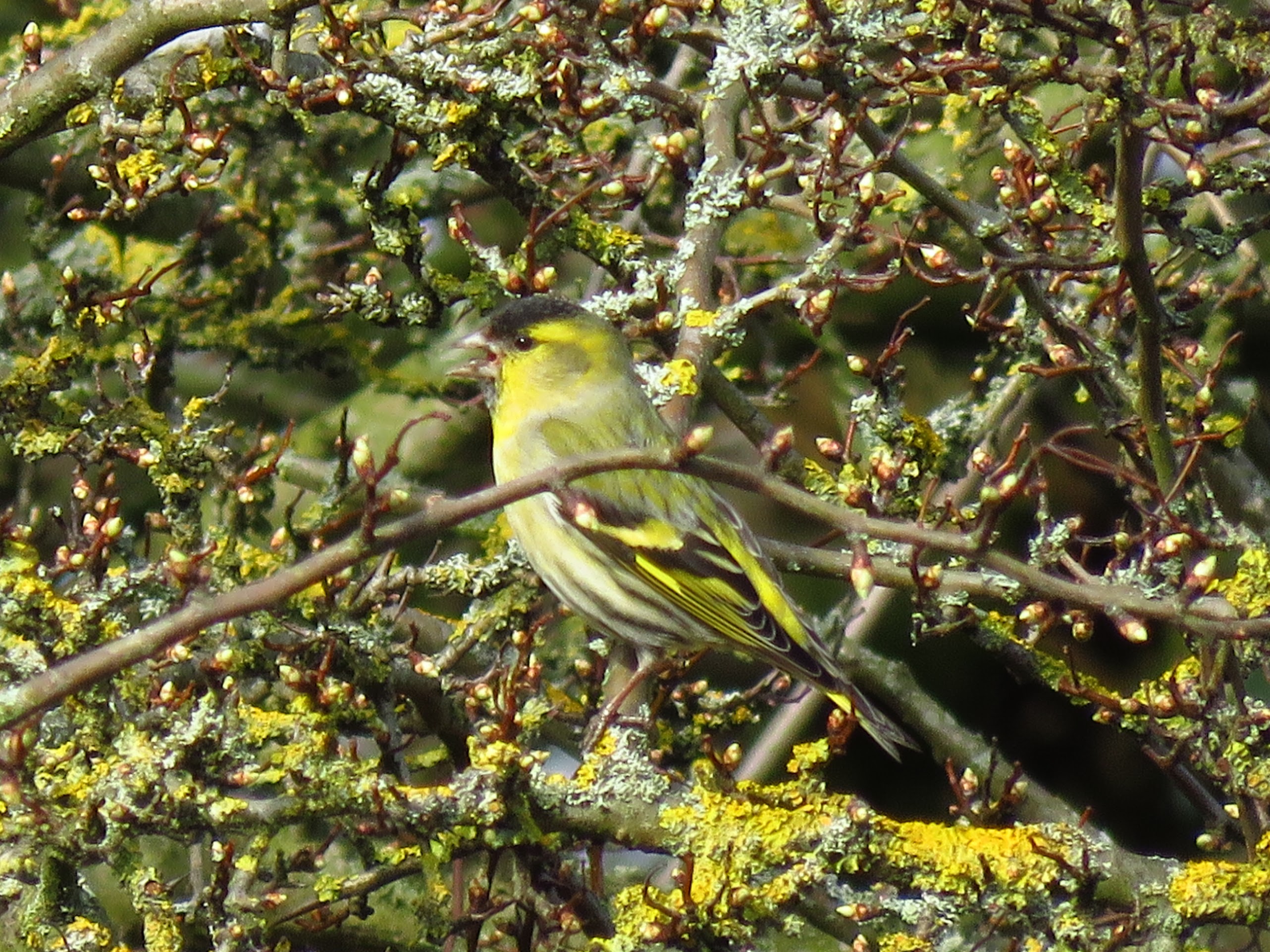
I popped to the drain at Beresford Avenue and surprised a fox, who was going down to the water, who promptly disappeared through the hedgerows of the allotments. The usual Moorhens and Mallards were at the drain, but no Little Grebes, which seem to have moved back to their breeding sites after the icy weather. At Oak Road I took Green Lane, a pleasant public right of way by the Playing Fields. Of note were four Siskins, which were feeding on some Alders, but came down to drink at a puddle.

Green Lane.
Goldcrest singing.
Siskin.
Siskin.
A common gull in breeding plumage swims in the flooded field.
The still flooded Oak Road Playing fields.
Mistletoe clump atop a Poplar.
Mistletoe.
I crossed Beverley Road again and walked by Endyke Lane to join the drain again. 
Moorhen. With a bit of effort not to get any litter in the frame.
I do not often reflect this, but the drain has got a litter problem. The banks are very steep and even if some volunteers wanted to do a litter clean this would be quite tricky unless you were on a kayak. I often use the Trolleywise app to report shopping trolleys on the drain, but this is just the tip of the iceberg.
Sunny sky and a cool, pleasant temperature.
After Greenwood Avenue, I spotted the pair of swans that live on the bend of the drain. On the way back the pen was pulling vegetation and throwing it to her side, the first stirrings of nest building.
These looked like water vole burrows, but hard to know how old they are.
Mute Swan cob.
Mute Swan pair.
The lovely bend on the drain with a small reedbed and willows.
Mute Swan pen with nest material.
On the stretch after Hall Road, a pair of Greylag were on attendance. I noticed that the male kept its tail up, possibly displaying to the female.
Looking north. A very straight stretch of the drain.
Greylag pair.
Buzzard and Kestrel.
The Counter Dyke, looking west.
Buzzard.

I reached the limits of the city. There is a small hill with large trees. A Buzzard flew over, later with a Kestrel in the distance. At the Counter Dyke I turn round. I stop at Oak Road lake for my second picnic of the year before returning home, in total a 14 km walk.

Colts foot. 1st one I see in flower this year.
A very confiding Robin by the lake.
A male Reed Bunting, on the same spot where I saw a female last week.