Showing posts with label warblers. Show all posts

Tuesday, 20 April 2021

April at Noddle Hill


Another lovely sunny day, can't get enough of them. It started cool, but soon warmed up. I took a walk around NoddleHill LNR. As I got to the Foredyke Green, it was misty. I scanned the fields to the North of the reserve, but they had been tilled and no Lapwing were visible. Several Pheasants and a Brown Hare were on them.
Brown Hare, my first hare this year within the city limits.
 In the same spot where I had Grey Partridges in my last visit, confusingly, I had two Red-legged Partridges, which flew in different directions. One sung later from the NE of the reserve. I walked to the pumping station and heard Tree Sparrow calls. One flew to the trees at the other side of the drain. A bit later, I waited until one became visible on the hawthorn hedge of the station. My first Tree Sparrow this year!
Tree Sparrow.
As I tried to re-find the partridge I found a distant pair of Yellowhammers. Later a pair was present on the reserve itself.
As I walked around the NE corner of the reserve, I heard a Whitethroat, first of the year. It was skulking on the bushes and I only got poor shots. Another showed more clearly later. 
Whitethroat, singing from inside bushes. The second seen today.
Record shot of Yellowhammer. At least 2 pairs, one of them within the reserve.
 The paths and many flushes now dry, although there is still plenty of open water.
Another surprise addition to the year was Shelduck, with a pair flying over the reserve towards the fields.
Two shelduck over.
Willow Warbler singing. There were a number around the reserve. I stopped counting at some point, definitely over 5.

The song of Willow Warblers, Chiffchaffs and Blackcaps was all round. On a patch of brambles near a large, well vegetated pond, I heard a Cetti's warbler singing. 


Noddle Hill is a haven for warblers and it was nice to add this colonising species to the site, which should suit it really well.
I also did a butterfly count. First Speckled Wood of the year, plenty of Peacocks, Small Tortoiseshell, Small Whites, 2 Brimstone, Green-veined White and Comma.
Comma.
1st Speckled Wood of the year.
I walked around the fishing lake before leaving. There were at least 6 pairs of Greylags with young. Another pairs were mating.
Greylag after mating display (male on the right).
Greylag family.
One final surprise was a bat, which was flying around the lake.
Bat, flying at midday around the lake, probably my earliest bat ever!
Buzzard record shot
Dry flushes.
I finished my lunch on one of the benches and did a litter pick afterwards. I'm glad I did it afterwards and not before, as I emptied a beer bottle before putting it in the bin, a sludge made of a rotting small mammal carcass and the bodies of at least 13 Nicrophorus dead beetles came out with a horrific stench. Litter kills!


Possibly Bombus barbutellus.
The only dairy left in Hull, looking very atmospheric with the mist.
Rook over.
Great Spotted Woodpecker on post.
Overall, five sp added to Hull bird year list, now on 88 sp.

Monday, 29 April 2019

Leven Canal and Leven Carrs

Since I walked the River Hull a couple of years ago, I have wanted to walk the Leven Canal. The canal, 5 km long, is not in use for navigation, and is actually split in half and not connected to the River Hull, but since 1962 it is a SSSI due to it's aquatic flora. The canal is fed by springs and its waters are very transparent, the submerged, wrinkled leaves of the Yellow Water Lily visible. The canal path is enclosed by overgrown hedgerows in its first stretch, but then it opens up and appears higher than the surrounding countryside, affording views across the low-lying, generally flat area surrounding it, while still lined with reeds and scrub with occasional willows and hedgerows. There are two bridges to navigate, one pedestrian, which sits atop the aqueduct that allows Holderness Drain to cross the canal (although the canal has been infilled in this stage, and the Waterloo Bridge, from which I took the photo above. Up to this bridge the land is cultivated and there are small copses, but in the area between this bridge and the river Hull there is wet grassland, which is being managed under a stewardship scheme to enhance its biodiversity value.
Leven Carrs.
The weather was fair, calm, but cloudy, and cold, about 10 degrees C. I parked on Carr Lane in the village about 9:00 and joined the canal path at Sandholme bridge, by the caravan park. Birds were in full song, warblers in particular, with Willow, Chiffchaff, Blackcap, Reed and then a Sedge Warbler, my first this year.
Sedge Warblers were indeed singing at regular intervals all along the canal. Whitethroat joined the warbler list not long after and further along the canal, by Leven Carrs near the river, 4 Cetti's warblers were in song. Despite my best efforts I had just a glimpse of one of them as it skulked in brambles. The best was still to come. I realised I was hearing the reeling song of a Grasshopper warbler! I had been unable to see/hear one in the last couple of years, so that was a very pleasant surprise. On the wetlands north of the canal, several waders were present: Whimbrel, Greenshank, a pair of Little Ringed Plovers, a pair of Oystercatchers, and Lapwing.  Also Mallard with ducklings, Shelduck, Wigeon, Greylags and a few Black-headed gulls. I wished I had a telescope as some birds were too distant. As I reached the river Hull, three Sand Martins flew north.
Reeling Grasshopper Warbler.
 I turned back and reached the Grasshopper warbler again and decided to have lunch on the path there in case it became visible. It was singing from the other side on the canal. I scanned the area and managed to see it through some reeds at the same time that a cuckoo called (for some reason I often hear cuckoos in my lunch time, around 12:00, coincidence?).
On the way back a few sunny spells and slightly warmer temperature meant some butterflies were on the wing. Peacock, Orange Tip, Speckled Wood and Green-veined White were recorded.
Yellowhammer.
Female Linnet with nest material. 
Brown Hare. It seemed to have some sort of abscess/injury on its shoulder, but it could run well, and it seemed to be enjoying rolling on the soil.
Male Linnet singing.
Orange Tip, overexposed, but they are so hard to get. It flew off before I had the chance to adjust the settings.
Another view of Leven Canal.

I must return to the canal later in the year during peak dragonfly season.

More information
An informative video on the creation of wetlands and fenland in Leven Carrs. Here.

Friday, 22 May 2015

A walk in the woods

The morning was overcast, but mild and not windy. I headed up to North Cliffe woods, which looked beautiful with carpets of Bluebells and drifts of Greater Stitchwort. Bugle was in bloom too. A Garden Warbler sung well hidden in a tall oak and I only got fleeting views of this and another individual later in the morning. I noticed little holes on the path, and then surprised a mole on the path itself, which tried to run away from me as fast as its short legs took him, which was surprisingly fast. The dry, compacted ground on the path appeared to have prevented it from going underground, but it finally disappeared in the long grass at the side of the path. It was my second live mole ever!
 Near the heath area a male Whitethroat was in full song and I heard the call of a Great Spotted Woodpecker.
A couple of brief sunny spells brought some butterflies out, including two Peacocks, a Speckled wood and a Large white and Green-veined white.
I walked inside the woods, where the most remarkable bird sightings were a Marsh Tit, a female
Blackcap with nest material and the laugh of a Green Woodpecker. A humming noise alerted me to the presence of an active honeybee hive inside a dead tree. A pair of robins were very agitated, but I couldn't spot the source of their distress. I was hoping for a mustelid, but failed to see any signs.
 I returned to the heath area. As I sat down on a bench for lunch a distant male cuckoo called three times, what a great sound. A Buzzard soared over the heath, while a Carrion Crow had me under surveillance the whole time I sat there. A lovely trip to the woods.

The mole, climbing the middle of the path.
Bugle 
A battered large white
Green-veined white
Peacock
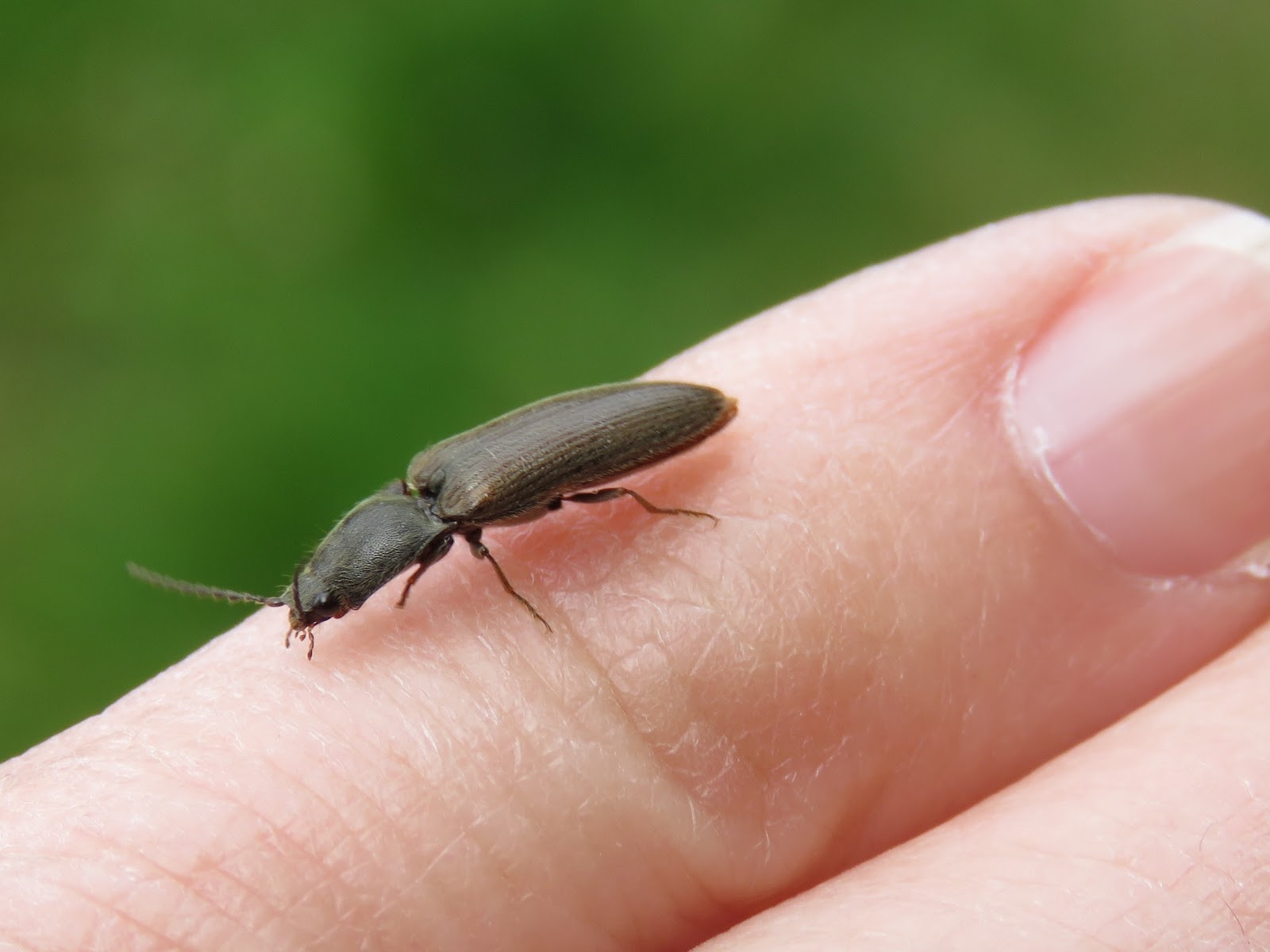
Click beetle
Click beetle about to fly off
Bird list
  1. Black-headed Gull
  2. Blackbird
  3. Blackcap
  4. Blue Tit
  5. Buzzard
  6. Carrion Crow
  7. Chaffinch
  8. Chiffchaff
  9. Coal Tit
  10. Cuckoo
  11. Dunnock
  12. Garden Warbler
  13. Great Spotted Woodpecker
  14. Great Tit
  15. Green Woodpecker
  16. Jackdaw
  17. Long-tailed Tit
  18. Mallard
  19. Marsh Tit
  20. Pheasant
  21. Robin
  22. Rook
  23. Skylark
  24. Swallow
  25. Whitethroat
  26. Willow Warbler
  27. Woodpigeon
  28. Wren
  29. Yellowhammer

Monday, 28 April 2014

Warbler jazz jam and ratty at Noddle Hill

The reserve was quite empty on arrival, just one car in the car park, probably a fisherman's, and I didn't see anybody until the very end when I walked around the lake. I went anticlockwise using mainly the perimeter path, and a bit of crisscrossing. On the woodland area both Blackcap and Chiffchaff were singing, and then I heard a faintly familiar song on the woodland edge. Clear from branches, almost atop a hawthorn, a Lesser Whitethroat sung, it threw me as they usually hide when singing. On the scrub there was a band of Whitethroats and a sprinkle of Sedge Warblers, all singing to the top of their voices and performing aerial acrobatics while singing. A Dunnock also sung replying to Whitethroats and a male Reed Bunting joined in. Ahead in the path I noticed a strange reeling, cicada-style noise emanating from a large clump of brambles, it was just audible and as I got as close as I could I realised it was a Grasshopper Warbler. Unfortunately I couldn't get very close as the brambles were quite inaccessible. I returned before leaving the reserve and it was still singing in the same spot.
 A Skylark was singing too and later a Willow Warbler.
Suddenly a flock of starlings took off from the fields opposite the entrance of the reserve, and the crows too. Then I heard the rattling call of crows and I saw two mobbing what it appeared to be a kestrel flying straight through, however, its tail and wings were very pointy and the forewing appeared curved, a cuckoo?! I heard no calls though and the crows let it go and it disappeared into the distance.
 I finished of with a walk around the lake. There were several greylag families and a few mallards. As I passed by a cleared out area in the shore, a dark, round thing plopped into the water just by me. I stayed still, and a few seconds later a water vole emerged taking little notice of me. It cut leaves of the marginal vegetation and took them away, presumably to eat. As I was taking the water vole photos, I heard a Reed Warbler singing, my first of the year, and later, I even managed to capture a shot. A total of 33 birds species (not counting the possible cuckoo).
Lesser Whitethroat, singing exposed
Whitethroat
Sedge Warbler
Reed Bunting
And another whitethroat
Gosling
Greylag family
Water vole, taking away some leaf fragments.
Reed Warbler