Showing posts with label brownfield. Show all posts

Saturday, 8 February 2025

Hull urban birds. 36. Stonechat

Stonechats are small perching birds, the size of a robin, with rusty-red chest and brown and black tones. Males have a black head with white patches on the side of the neck. During winter, the black feathers of head and back are fringed with brown,giving them a dark chocolate tone. Females are browner. They have relatively long black legs and black bills, and short tails. When they are around, they are obvious birds, with a habit of perching on prominent posts: fences, or tall flower heads, from which they watch the ground in search of invertebrates. They will dive down, and soon return to their perch. I have described how pairs of male and females, not breeding pairs, defend winter territories. In Yorkshire, Stonechats breed in upland heaths and coastal grasslands, and move to lowland areas, to the coast or along the Humber and river valleys during the winter. Their name stems from their call, which sounds like two pebbles knocking together.

A female at Noddle Hill, 18 September 2019.

Status and distribution in Hull

A scarce wintering bird found in singles or pairs in rough grassland on the outskirts of Hull and by the Humber. Willerby Carr, the banks of the River Hull by Kingswood (top shot, 11 November 2024) and the north side of Noddle Hill and the Docks are good areas to look for them, especially in patches of scrubby long grasses, from the end of September until March. Broughton's Birds of the Hull area indicates very sporadic wintering individuals before 2002, with multiyear gaps, whilst recently the species appears to have become a regular, if still scarce and very local, wintering one in the Hull area.

A male at Haltemprice Priory grounds, 3 February 2025.

Conservation

Stonechats were moved to the Green list in 2009, as they recovered from previous population losses. They appear to be benefiting from a warming climate, with an increase in range in the north and movement to higher altitudes for breeding. They are susceptible to cold winters, given their invertebrate diet, and the cold winter of 2009-2010 resulted in a strong dip in populations, but they have since strongly recovered. Given the local and scarce numbers in the Hull area, and their association to regularly managed river banks, an archaeological site and a Local Nature reserve no particular conservation management aspects are needed for the species.

More information

Broughton, Richard K. Birds of the Hull Area.

Yorkshire Bird Report 2018/19. YNU.

Thursday, 4 May 2023

Hull City Nature Challenge - Day 3 - KC Stadium railway triangle, Noddle Hill

I got nice and early and I was ready to go, only to realise I had stupidly forgotten to charge my phone overnight, which meant waiting for half an hour for it to charge before leaving the house. My plan was to head to the KC stadium triangle via the General Cemetery, then to Albert Dock. Not encouragingly it was cloudy and drizzling intermittently. 

I love to record Convalaria majalis, it reminds me of my mum, one of her favourite plants! Small and beautifully formed.

I was up for a lovely surprise as I hadn't even got inside the cemetery when I heard the song of a Treecreeper. This species can be very hit and miss, despite being resident at the cemetery. I recorded the song and then even managed a few record shots. A good start for the day!


I found a great illustration of rewilding at the cemetery (top shot), the Ivy and the Sycamores hugging a headstone, with the lush growth of Cow Parsley on the ground. But must concentrate on recording.

After a good search, I managed a single individual of Discus rotundatus under a log. They don't seem to be doing well, maybe the dry summer and autumn has meant their hiding spaces have declined. The cemetery is one of their hotspots in Hull.

The Wood Anemone, its last flowers all ragged, was hard to find, hidden by the incredible plant growth on the cemetery verges.
I moved to the KC stadium triangle, my aims were Rabbit, Kestrel and Long Tailed Tits, which had evaded me so far.
Rabbit was pretty easy, I found a young one right away, feeding with relish on the fresh growth of Giant Hogweed!
Giant Hogweed on the foreground and KC stadium on the background.
A carpet of Cowslips.
I briefly saw a Kestrel, but it didn't reappear and I got no record.
A view of the site from the mound, currently a Rabbit warren.
Chiffchaffs, Blackcaps and Whitethroats were singing. The scrubby area by the railway line was favoured by Linnets and a singing Sedge Warbler, which I failed to see.
Singing Linnet.
Singing Song Thrush.

The Long-tailed tits were very busy moving back and forth between a patch of brambles and some Sycamores, obviously feeding chicks. I failed to take any photos of them and they were quiet so sound recording wasn't an option. After a long wait, I decided to try and find the nest. I pointed my binoculars to the area where they were getting into the brambles, and luckily found it right away as the nest opening was facing me. My camera zoomed in to the entrance, it was a matter of waiting for an adult to return to get a photo. The Long-tailed Tits nest is very distinctive, so it alone could have made a record. After getting some photos, I left the Long-tailed tits to their busy feeding schedule and moved on. 

Long-tailed tit entering the nest with food.
The beautifully camouflaged, lichen-covered nest.
This Rabbit posed for me for a while.
Male Linnet collecting nest material.
My phone charge was getting low, so I headed back for lunch and a battery recharge at home via Princes Avenue. I made a stop at the Church on the Way to record some ferns, which were looking very fresh.

Wall Rue
Hart's tongue fern.
Maidenhair Spleenwort.
I was meeting MM after lunch for a trip to Noddle Hill Local Nature Reserve. I have blogged quite a bit about this wonderful suburban reserve, a haven for warblers. Blackcaps, Whitethroats, Lesser Whitethroats and Willow Warblers were recorded quickly, as was this Yellow-bellied Slider swimming in the pond.

Roe Deer.

I wanted to record Tree Sparrows, but the hedge at the pumping station where I usually find them up to two months ago had been completely removed. The removal of the hedge revealed these three old nest boxes, one of them without a roof. To my knowledge, this was the last area where Tree Sparrows nested in Hull. The species is Red Listed, and also in the Biodiversity Action Plan of Hull. We can't even give them a hedge and some decent nest boxes, so sad.

Reed Bunting.

Raptor wise we had Kestrels, two Buzzards and two Marsh Harrier flyovers, a species I wasn't expecting to add to the challenge. Yellowhammers are regular there but we missed them too.

Buzzard.
Marsh Harrier.
We walked on the north side of the reserve, and flushed a Fox without getting a photo, a Little Egret flew past and after an enjoyable chat with a very knowledgeable local, we managed a recording of a singing Cetti's Warbler. A nice bunch of species added to the challenge.

Monday, 17 April 2023

Early spring at KC stadium railway triangle


An early morning walk to KC stadium, it had been a while since my last visit. It was cloudy and still quite cold, so no invertebrates out. There was nobody on site and Rabbits were on evidence. The Cowslips were putting a wonderful display (if you ignore the litter!).

Rabbit
A Kestrel was hunting over the grassland, then sat on a tree.
Hovering Kestrel.


A female Linnet collecting nest material.

Cowslips.
Song Thrush. There was a Song Thrush contest, with three males singing at the same time.
These pointy, large pellets looked more roe deer than rabbit.
The Giant Hogweed is sprouting vigorously.
I make a mental note of visiting on a sunny afternoon.

Sunday, 5 February 2023

Sunday morning at Jack Kaye field

 On Friday I took a short detour on my way to work around the Jack Kaye field. I was very surprised to flush two Jays from the path at the western end, which I lost from view. Jays are extremely rare at Hull and the surrounding area, given its low woodland cover. There are a number of oaks at Jack Kaye and the avenues area which are now maturing and probably provide enough food for Jays, still it was the first time I spot them on the site. it was a sunny, still, and frosty morning. Three Song Thrushes and many Dunnocks  were singing . As I climbed onto the footpath parallel to the railway track, a Jay flew onto a tree near me. I managed a few photos this time (top shot). 

A view of the area where the Jays were on Friday (background).

Song Thush singing.

I meandered around the avenues on my way back. Two Mistle Thrushes were feeding on Ivy berries.


Robin feeding on seeds.

Wednesday, 14 April 2021

Hull urban birds. 16. Kestrel

Kestrels are small falcons that live in open spaces. They have pointed wings and a relatively long tail with a black tail band and speckled chest and back, with dark lines from the eyes down. Males have grey/blue head and tail and russet mantle, while females and juveniles are browner and more speckled. Kestrels feed mainly on small rodents (voles and mice), which are supplemented with insects, worms and birds. When hunting in windy conditions, they use a distinctive hovering technique. In still weather they will perch on a lamppost, fence post or tree branch) and use a sit-and-wait strategy.

Kestrel hovering over grassland on railway triangle. 
A pair of Kestrels breed in the middle of the city. The railway triangle includes scattered trees, plenty of rough grassland and a lack of disturbance. Both photos taken 16 June 2014.

Habitat

Kestrels breed in open areas with rough grassland or scrub, where they can find their prey. They readily use urban areas including wide road verges and banks, railway sidings and brownfield and industrial land. They can use old crow nests to breed and they will also use next boxes.

Status and distribution in Hull
Kestrels are breeding resident birds in Hull, where they are more common in the outskirts, industrial estates and playing fields. Population may increase during passage or during winter. Reliable sites are Noddle Hill LNR, Wilberforce Wood, Oak Road lake and the railway triangle by KC Stadium.
Male Kestrel on CCTV post. Stockholm Road. 13/April/2021.
Male Kestrel in flight. Sculcoates. 13/April/2021.
Female Kestrel. Noddle Hill LNR. 14/Dec/2020. 
 Railway triangle by KC stadium. 24/Nov/2020.
Female at Oak Road playing fields. 16/Feb/2021. 

Conservation status and management

Amber due to sustained population declines in the last decades, which mirrors the wider situation in Europe. Organochlorine pesticides, used widely to increase agricultural production affected Kestrel populations through Europe due to egg shell thinning in the 50's and early 60's. Populations recovered and then started a decline from the 80s once these pesticides were banned. The Breeding bird survey shows that for the Yorkshire and the Humber the population is still declining, and has been reduced by a third (−30% between 1994 and 2019). The reasons behind this decline are likely to be complex. They may include habitat loss (for example in urban habitats, development of brownfield sites or tree planting of grassland), decreased prey populations due to agricultural intensification, competition with other raptors, secondary poisoning from rodenticides, and lack of suitable nest sites. A recent study found that 67% of Kestrels found dead in the UK and sent for analysis between 1997 and 2012 had chemical residues of one or more anticoagulant rodenticides. Adults had more chemical concentrations than juveniles, indicating poison accumulation and repeated exposures. The lethal levels of these chemicals in Kestrels are unknown, but the study showed that these chemicals have a negative effect on Kestrels, as in years when total anticoagulant concentrations were higher, the Kestrel population index was significantly lower.
Breeding Bird survey results for Kestrel in Yorkshire and the Humber, from 1994 to 2019.The first year is set to 100 for convenience.
 
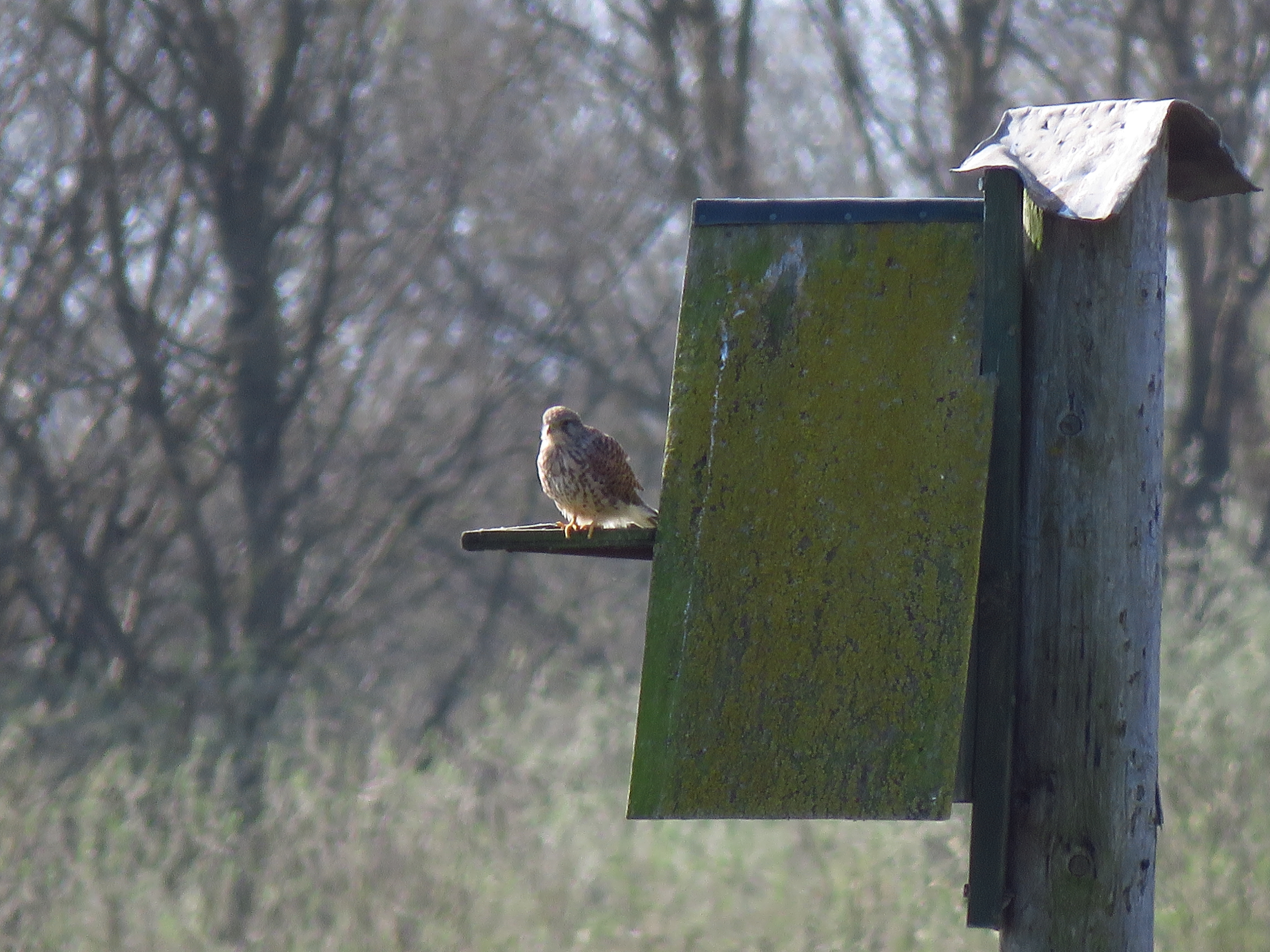
A Kestrel on a Barn Owl box at North Cave Wetlands, 14 April 2019.

Management actions to favour Kestrels in Hull could include: 

  • Installing and monitoring nest boxes. These can be fitted to buildings or trees. Nest boxes could be fitted, in collaboration with industry partners, on warehouses and industrial buildings, where there is little risk of vandalism. Liaise with conservation organisations to follow on any nest boxes installed, for example colour-ringing the offspring.
  • Kestrels will benefit from converting regularly mowed grass into wildlife meadows, or from reducing the mowing regime to encourage longer grass to increase their favoured prey habitat.
  • Kestrels should be taken into account when tree planting not to encroach on their open habitats.
  • The use of rodenticides should be avoided in areas used by Kestrels. A publicity campaign in industrial estates and local pest controllers to increase awareness on the risks of poisoning of non-target species such as Kestrels, Buzzards and owls could be helpful.

More information
Breeding Bird Survey Results website.
Hawk Conservancy Trust. Kestrel Conservation Monitoring. website.

Top shot: Male Kestrel hovering at Noddle Hill LNR.14/Dec/2020.