Showing posts with label reedbeds. Show all posts

Thursday, 5 June 2025

Urban birds at Hull. 50. Reed Warbler


The Reed Warbler deserves inclusion in the urban birds series, despite its retiring habits, always in the midst of reeds, rarely exposed: a bird that is hard to see. However, once you are familiar with the, rhythmic cadence of scratchy notes, each repeated several times and including occasional mimicry, a walk by any patch of reeds at the right time of the year is likely to reveal its presence, and if you are lucky, a sighting, as it sings from a perch in the middle of a reed stem. Reed Warblers are warm brown birds, with creamy underside and a light eye stripe and bright white throat that gleams when it sings. Both sexes look alike. It has a pointy bill and rounded tail. It is amusing to watch how deftly it moves in its element of vertical, tightly packed reed stems, siddling up and down like they are moon-walking.

7/05/2022. Beverley and Barmston Drain.
Status and Distribution in Hull

Reed Warblers are summer migrants, that usually arrive in the last week of April or first week of May and settle in their territories and sing right away. It is in these first days that they are easiest to spot, the new reeds still short and the old stems thinned by the winter. They are locally distributed, due to their restricted habitat requirements and breed on the fringing reedbeds along the river Hull north of Stoneferry, the Beverley and Barmston Drain and at Noddle Hill, and in the Humber reedbeds east of Hessle and by St Andrews Quay. Other small patches of reeds by ditches in the outskirts of the city are also likely to hold a pair. They usually produce two broods and most birds leave during September. During migration, they can turn up anywhere.

Beverley and Barmston Drain by Bridlington Avenue, 21/05/2023.
Beverley and Barmston Drain by Sculcoates, 21/04/2025.
Recently fledged Reed Warblers, still attended by parents, Beverley and Barmston Drain, 8/08/2022.

Conservation and management

Reed Warbler are Green Listed, as populations have increased over 40% in the last three decades. Their distribution range is also expanding north, having recently colonised southern Scotland, most likely benefiting from the warming climate. Increases appear to be due to more productivity, due to earlier egg laying, rather than better adult survival. Improved reedbed management may have also helped the species. An appreciation of the conservation value of urban reedbeds, which offers resources for a range of birds that feed chicks with insects, is likely to benefit this and other urban species.

More information

Broughton, R.K. 2002 Birds of the Hull area.

BTO Birdfacts. Reed Warbler.

Monday, 20 September 2021

Humber South Bank. 2. Alkborough Flats

 A sunny, still day that started cool but ended quite warm, I headed to Alkborough Flats. I was hoping for a good walk around the reserve and wasn't expecting anything in particular. As I approached the first tide, a birder was photographing some birds on the ground. As I kept my distance and focused with the binoculars, I realised they were Bearded Tits. At this time of the year, they switch from an insect to a seed diet and need grit to help them digest the reed seeds that will be their staple in autumn and winter. Early in the morning, they gather on the paths of the reserve to get some grit. About two dozen Bearded Tits were gritting. I have never seen this before, a true spectacle, they kept coming and going, with constant 'pinging', not 10 m away from three people taking photographs of them. Alkborough is a stronghold of Bearded Tits and one of the places in the upper Humber where you are most likely to see this stunning species. 

I count 20 Bearded Tits in this photo.
A Cetti's Warbler emerged from the reeds and landed on the fence to check what all that pinging was about.


A group of Swallows flied East over the reserve. The Bearded Tit flock dispersed and I got in the hide. There are great views now that the reed have been cut and there are many waders: Redshank, Black-tailed Godwit, 9 Curlew, 2 Snipe, a Dunlin, 120 Avocets, about 200 Lapwing, 2 Ruff and a single Spotted Redshank. As for ducks, a dozen Pintail upend in the distance, Shoveler and Teal are also about. There are many geese, a skein of Pink-footed Geese, Barnacle Geese and Greylag. Two Water Rails make an appearance. Two Marsh Harriers flush the waders several times.
A skein of Pink-footed Geese.
Water Rail emerging from the reeds.
Avocets.
Black-tailed Godwit.

I did a counter-clockwise circular walk around the Trent, but first I walked to the end of the public footpath on the old floodbank near the breach. 


Grazing cows. The Humber and the Wolds in the background.
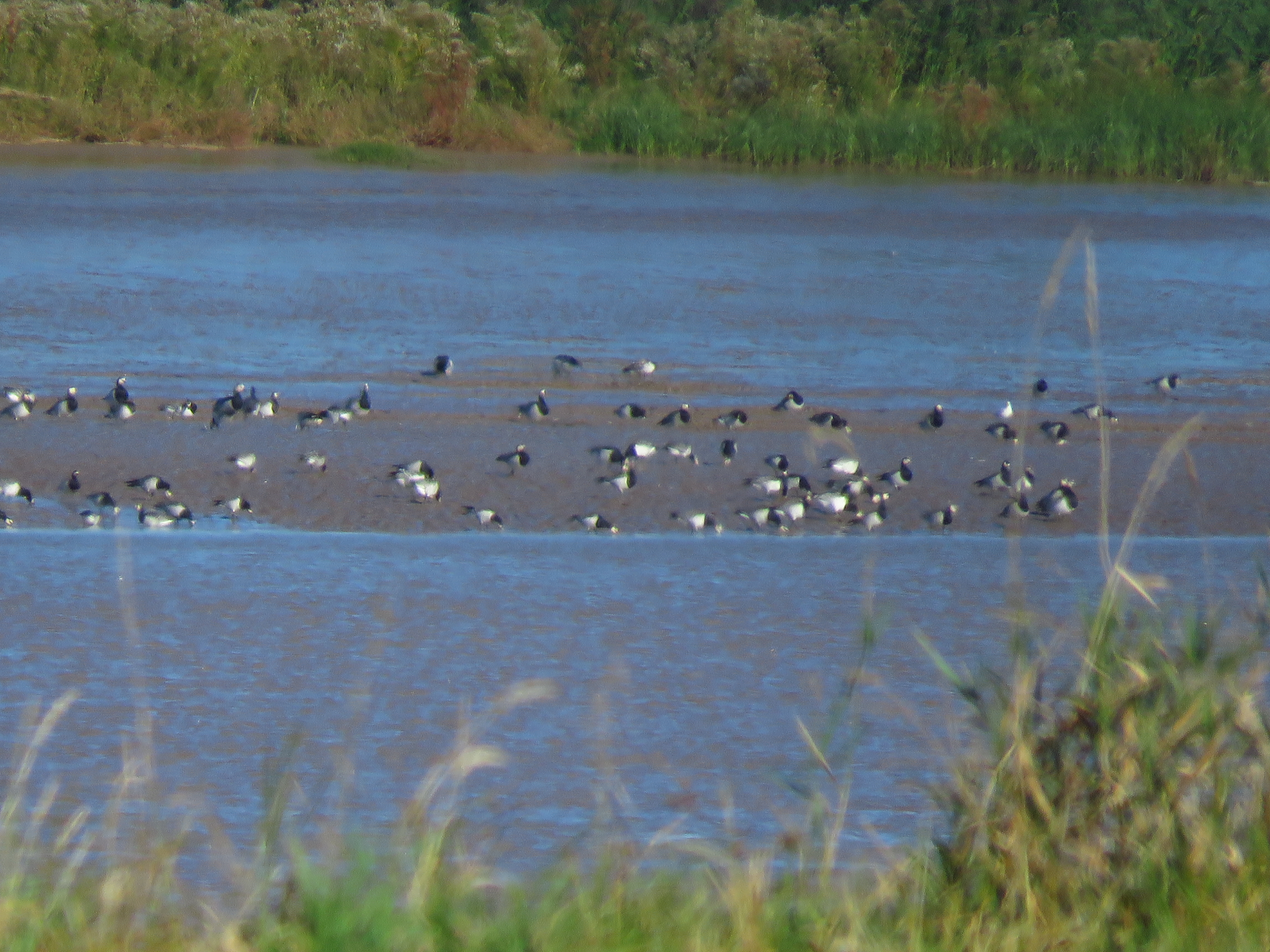
A large flock of Barnacle geese visible on the Humber mudflats.
Lovely to watch a flock of Curlew.
Pink-footed geese.
Stonechats.
The shallow pool where the Glossy Ibis and many egrets were feeding last time was much dryer. Many geese, including Pink-feet were resting on it.

As I walked towards the Trent, it felt quite warm. Dragonflies started being more obvious. A Ruddy Darter posed for a while. A Brown Hawker was patrolling on the low crossing, which was passable, if a bit muddy today. 

Ruddy Darter.
Bulrush Bug, Chilacis typhae
This was one of my highlights today, a Common Hawker, despite the odd angle, the yellow costa (the vein on the front of the wing) is visible.
Common Darters ovipositing.
This almost dry pool had several pairs of Common Darters ovipositing.
Sheep graze some of the wet grassland of the flats.
I returned to the hide for lunch. A pale wagtail landed in front. I thought it might be a White Wagtail, but no, a Pied Wagtail for me.

Pied Wagtail and Redshank.
Spotted Redshank.
Snipe.
Curlew, Redshank and Black-tailed Godwit.
In the next stage, I'm hoping to walk from Alkborough village to Whitton.

Tuesday, 10 November 2020

Urban birding at Hull: Oak Road Lake and the River Hull in November

Another still, mild morning starting misty, then some sunny spells developed. I walk to Oak Road via Pearson Park, Beverley Road, Ryde Street, and Clough Road and then walked on the bank of River Hull. Pink-footed geese call overhead, but I can't see them with the fog. I'm impressed they even leave their roosts with the little visibility. When the sky clear a bit I see a small skein of 11 flying East. 

The new resident pair of Mute Swans at Oak Road Lake have successfully raised three young this year. They were incubating during the spring lockdown. I stop to give them some clover from the shore, which they love, but can't reach as there is no easy way out of the lake for the swans. A ramp would probably be welcome for the swans.


Grey Wagtail.
The river is flowing downstream with the tide, and its quite low, I walk towards the Croda factory. Two Grey Wagtails feed on the exposed banks, repeatedly crossing the river. A Redshank calls and flies away. 

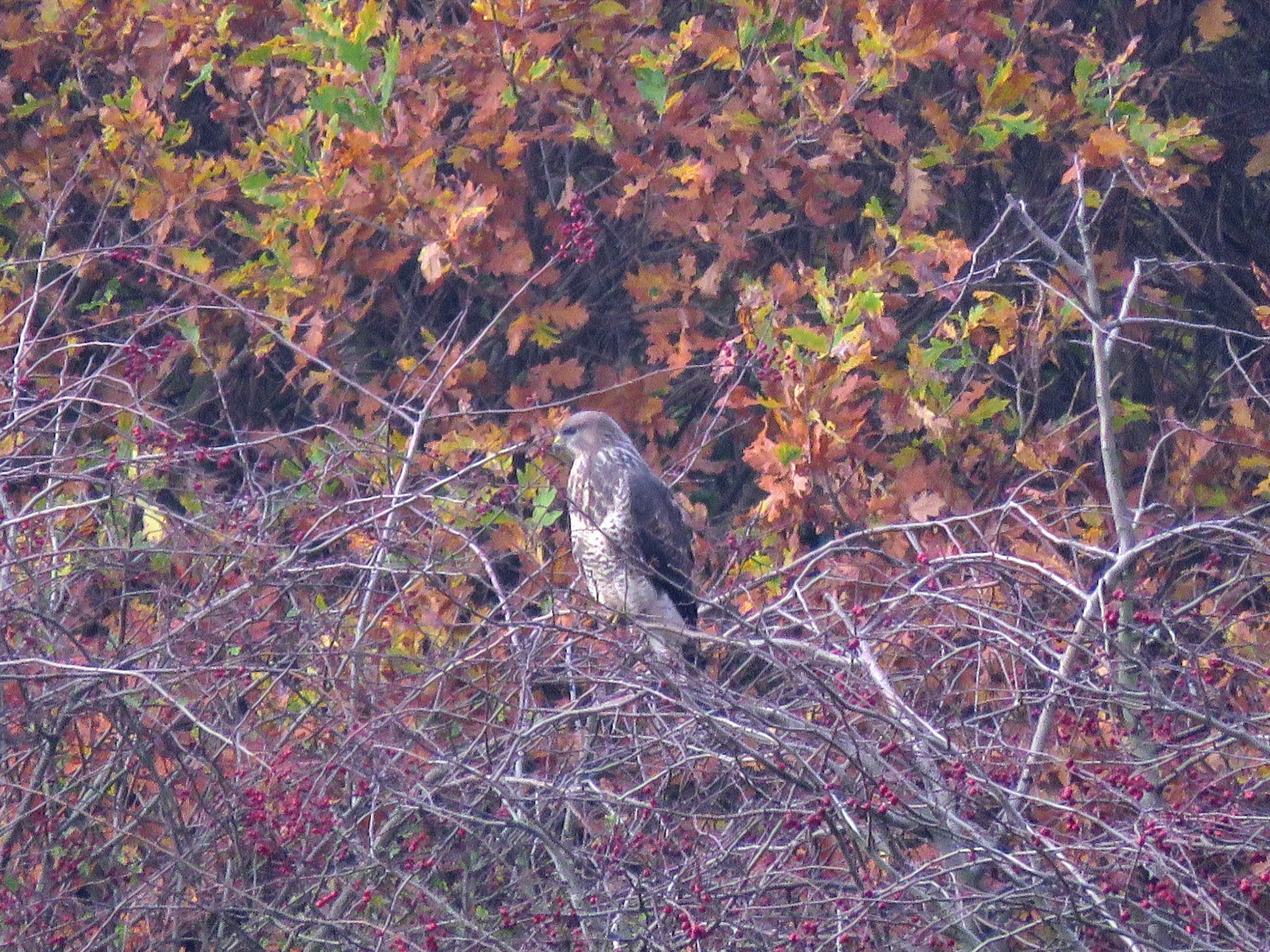
I spot a Buzzard sitting on a hawthorn, with two magpies keeping an eye on it.

Buzzard.
Buzzard and Magpie.
As I walk back by the lake, I hear a Cetti's Warbler singing at the lake. Cetti's warblers are a relatively recent colonist in East Yorkshire, first bred north of the Humber in 2006, after having started colonising the south of the UK from the early 70s. It has colonised Tophill Low, and North Cave Wetlands, and in the last few years it appears to have colonised the area around Oak Road, as I heard it in May singing from the Croda grounds.
Path to the lake.
Cormorant over.
The cormorant flew around the lake, but didn't land.
Blackbird feeding on hawthorn berries.

On the walk back I come across this lovely street art, who doesn't love some house martins in November?

Monday, 4 May 2020

Urban birding at Hull: Oak Road Lake and the River Hull

A morning walk to Oak Road Lake via the Beverley and Barmston drain.
Beverley and Barmston drain.
I walk round the lake, the cob mute swan is busking on the male canada goose. The canada goose is forced to step out of the water, it hisses to me when I walk past, obviously still riled by the swan attack. 
The Canada female is momentarily standing over the nest on the raft, but no eggs are visible. The female swan is sitting on her nest eggs amongst the reeds, but then she stands up, looks down and does the egg rolling movement, before sitting again. 
No Willow Warblers singing today, but there is one singing Reed Warbler. After a circuit around the lake, I move to the river bank. A group of Swallows and House Martins are flying over the river. A male Kestrel flies over. I hear a singing Reed Bunting and find him on the other bank amongst the reeds. 

Spot the female Reed Bunting on the river bank.
A Sedge Warbler sings from the hedge in a display flight, but no photos. Then I hear a high-pitched song I don't recognise coming from the bottom of the bank. I hear it again a few times and then a Grey Wagtail flies to the other bank. It is a summer plumage male! In the last year I saw a pair of Grey Wagtails in Zebedee Yard in town and also a young fledged one at East Park. I'm used to Grey Wagtails as upland birds in summer, although I come across them in the city during migration and during the winter. But they now breed in parks in London. I wonder if they are becoming urban birds? 
Male Grey Wagtail by the river Hull
A few habitat shots follow.


Bird list
  1. Blackbird 
  2. Blackcap 
  3. Blue Tit 
  4. Canada Goose 
  5. Carrion Crow 
  6. Chaffinch 
  7. Chiffchaff 
  8. Collared Dove 
  9. Coot 
  10. Dunnock 
  11. Feral Pigeon
  12. Goldfinch 
  13. Great Tit 
  14. Greenfinch
  15. Grey Wagtail 
  16. Greylag Goose 
  17. Herring Gull 
  18. House Martin 
  19. House Sparrow
  20. Kestrel 
  21. Lesser Black-backed Gull 
  22. Lesser Whitethroat 
  23. Long-tailed Tit 
  24. Magpie
  25. Mallard 
  26. Mistle Thrush
  27. Moorhen 
  28. Mute Swan
  29. Reed Bunting
  30. Reed Warbler 
  31. Robin
  32. Sedge Warbler 
  33. Song Thrush 
  34. Starling
  35. Stock Dove 
  36. Swallow
  37. Whitethroat
  38. Woodpigeon
  39. Wren