Showing posts with label Hornsea. Show all posts

Tuesday, 9 September 2025

From Hornsea to Bridlington on the beach

A spring tide, a couple of hours after high tide gave me an opportunity to do this walk that I had planned for some time. A warm, sunny day was something that couldn't be planned, but gave the perfect setting to enjoy this northern section of the coast of the Holderness peninsula. I took the 24 EY bus to Hornsea and got to Marine Drive at 9:30. I walked along the promenade and descended the steps to the beach. A wide expanse was already available. I explored the sandy upper beach and spotted two Small Coppers and two Common Blue butterflies. After some more recording it was time to start walking. The sky is so clear that Flamborough cliffs are visible on the horizon.

The view north from Marine Drive.
Cormorants.
Small Copper.
The upper beach just north of Hornsea.
Woodpigeons drinking from a small rivulet of fresh water draining from the cliffs.
Meadow Pipit.

The beach is mostly sand, peppered with small pebbles, with shingly sections in places, and pleasantly firm under foot. Soon I reach Double Gates, the entrance to a boatyard compound. Here the erosion is more noticeable, with an undercut at the bottom of the cliff excavated by the sea and a steeper beach. 

Double Gates.
Undercut at the cliff.
Looking back towards Hornsea.
Digging for bait.

A few people are walking dogs, or digging for bait, but away from easy descent points, soon there are few people around. The wide beach encourages sea birds to land and loaf. Herring Gulls, large groups of Common Gulls, Black-headed Gulls, and the occasional Great Black-back Gull form loose groups. Terns, both Sandwich and Common, often sit on the edges of these gull flocks. Even Cormorants sit at the edge of the water, wings open, preening. Walking north on such a sunny day with the sun on your back makes it easier to scan these flocks looking for something rarer, and this is how I spot the only Mediterranean Gull I see today.

Great Black-back Gull.
Sandwich Terns.
Adult Mediterranean Gull.

At particular places there have been slumps of sections of cliff. These sometimes male the the vegetated slopes more accessible. I climb one of these slumps near Skipsea Withow and I find two Araneus quadratus or Four Spot Orb-weaver on their webs, which they usually hang low on the vegetation.

Araneus quadratus.

The layer of dark peat marking the Withow Gap, the site of an old drained mere.
A trunk section sticking out of the peat. This was the site of a Beaver dam.
Withow Gap from the beach.
I stop for a quick lunch on the gap. A Buzzard soars over the field, and a Kestrel hovers later, announced with the alarm calls of Swallows. The view to the north is quite wonderful from this spot (top shot).

Buzzard.

The infilled lake bed is now a pasture.
Kestrel over the pasture field.
A loafing group of Common Gulls.
Balls of peat eroded from the cliff face litter the beach north of Withow Gap.
Common Gull.

One of two Wheatears on the Galleon Beach fish and chips, which is now perilously close to the cliff edge. The old coastal defences of Ulrome long gone.

I climb the small cliff to avoid walking on the outflow at Barmston Main Drain, where there are many birds gathered, them climb the rocks back down to continue on the beach.

Steps cut onto the clay offer beach access to the holiday park.
North of Barmston, there is no cliff, the beach is separated from the footpath by a small step, the sand blowing onto the adjacent field. This low lying land is the site of another old mere, a layer of peat visible on the beach.
The exposed layer of peat on the beach north of Barmston.

The low lying land has a couple of drains onto the beach.
Sand Martin colony. I saw a couple of Sand Martins in flight, but the colonies scattered along the walk were eerily quiet, the young probably all fledged and gone.

As I approach Fraisthorpe beach, I spot a group of Tree Sparrows on the clifftop bushes. I walk to the Cow's Shed cafe, looking forward to a hot drink, but I'm disappointed to find that they close on Mondays (and Tuesdays!). I make a quick stop to drink water on the picnic benches, and as I leave the cafe grounds, I see five Yellow Wagtails on the path, a lovely surprise that compensates for the lack of coffee! I have seen them on the farm before and I'm very pleased they are hanging around. Bridlington is less than 5 km away, and I increase my pace to catch the 15:40 train to Hull.

Tree Sparrows.
Yellow Wagtail.
Yellow Wagtails.

Tuesday, 10 June 2025

Holderness: Skirlaugh to Hornsea

A mild day with light cloud and sunny spells, I take the but 24 to Skirlaugh. My route today takes me from Skirlaugh to Hornsea via the Hornsea Railway Trail, on the former railway line from Hull to Hornsea that now also serves as the last stage of the Trans-Pennine Trail. Unfortunately the bus stops are quite away from where the A165 crosses the trail, and this road is too busy and lacking a footpath, so I opt for taking Mulberry Road and Ellerby Road to join the trail. The route today takes me through farmland, mostly arable, except for the Lambwath valley SSSI, where hay is grown in traditional meadows. This section of the Lambwath is quite innaccessible, with few public rights of way, but I will devote more space to the Lambwath in another walk.

The trail is sound and even underfoot, some small sections tarmacked, and only a few muddy stretches. The banks have been mowed so it's wide enough. I meet some dog walkers, walkers and cyclists along the way, a loud group in the finishing stretch of the Transpennine Trail. The trail doesn't always run on the railway track, weaving sideways in sections, leaving the embankment on one side. Small copses and old hedgerows, today adorned with flowering dog roses, elder and honeysuckle, all adding to a wonderful fragance, line the way.

A Pied Wagtail collects insects on Silverhall Farm, near Skirlaugh.
I'm pleased to see good numbers of Small Tortoiseshells along the way.
Ellerby Road, between barley and rapeseed fields.
A Reed Bunting singing from the ripening rapeseed.
Skylark calling from a bare patch in the field.
I take a short detour to look for Twayblades and after some searching I'm rewarded with a single spike.
Whitethroat.
Linnet.
I cross the road at New Ellerby, a hamlet that was serviced by a station on market days. The platform and station remain, the latter now a private residence. In the wooded, more sheltered areas, Yellow-barred Longhorn moths gather and males dance flying up and down, occasionally resting on nearby leaves.
Large Skipper.
A good day for insects, a patch of Hedge Woundwort yields a Rhingia campestris, a hoverfly that likes tubular flowers.
I'm now descending the Lambwath valley. I climb the bank on the side of the trail and look across the bare field looking for hares. No hares, but I find a Buzzard gliding over the valley. I stop at the sound bridge over the Lamwath Stream. The water is clear, a couple of Azure Damselflies mate on the Reed Sweet-grass.

Buzzard.
Bridge over the Lambwath stream.
Lambwath stream, looking West.
Azure Damselflies.
Lamwath Meadows SSSI.

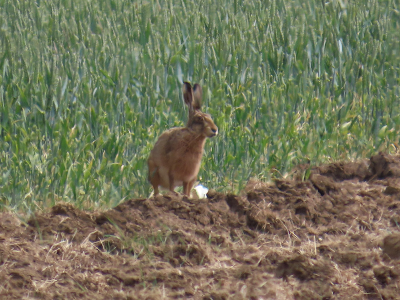
I climb the valley towards Whitedale, a hamlet that was also served with a station (top shot), now a private residence. A Swallow sings from the wires and House Sparrows are busy on its roof. After a little while, I find a spot with a nice view and I sit on the verge for lunch, a Yellowhammer and a Brown Hare for company.

Swallow at Whitedale.
Orange Tip, the only male I saw today.
Yellowhammer.
Reed Bunting.
Brown Hare.

It's time to carry on. A Marsh Harrier is quartering the fields in the distance, the Withernwick wind turbines as a backdrop. Another road crossing, this one between Little Hatfield and Great Hatfield, although the station itself is called Sigglesthorne. A small Local Nature Reserve has been designated along the trail, just north of the station. It has a wetland character, with reeds, willows, aspen and bracken. Soon I'm near Hull Bridge, a brick bridge where the Hull Road crosses the trail. The area is waterlogged and there are sedges, brooklime and ferns. There are records of Twayblade here, but I find none. 


Marsh Harrier.
Dog Rose.
Hull Bridge near Hornsea.

I'm now in Hornsea. Some Swifts fly over. On a field after crossing Stream Dyke, two crow Fledglings beg to one of their parents. I reach the final station of the trail and the promenade. The grassy area nearby is busy with a large flock of Starlings, with many young, and a pair of Linnets. A group of high school students are led along the promenade. This is a typical geography day trip spot to highlight coastal erosion and defences, so it's rare to miss a school trip on a visit to Hornsea. The tide is rising fast. On one of the end groynes, a pair of Sandwich Terns preen. Small parties fly past chirruping. Sand Martins pass over I'm ready for a rest, so I get an ice-cream and a coffee and sit on a picnic table by the new landscaped promenade gardens and fountain. My rest doesn't last long, as a feeding frenzy starts offshore. This is a high point in the promenade, offering a great view. A cloud of Herring Gulls surrounds small parties of Razorbills and Guillemots, which are very successful taking small fish. Two Gannets appear out of nowhere and dive bomb. As fast as it formed, the birds disperse and I'm glad to have watched this unexpected spectacle just before my bus back home is due. 

Swift.


Feeding frenzy with Herring Gulls.
Guillemot.
Razorbills.
Gannet.