Showing posts with label sand. Show all posts

Monday, 20 May 2019

Messingham Sand Quarry

My first visit to this fantastic Lincolnshire Wildlife Trust nature reserve. What was formerly a sand quarry has become a patchwork of lagoons, reed beds, conifer woodland, wet woodland, ponds and heath. There are two hides overlooking the northernmost lagoon and benches with a view scattered around the perimeter path. Just upon arrival, near the car park, there were hundreds of Common, Azure and Blue-tailed Damselflies. A Hairy dragonfly hunted atop trees, aggressively charging towards the branches to dislodge insects, but it didn't settle. As I watch the dragonflies, and from the south end of the reserve a Bittern starts booming, and does do intermittently.
 
 I walk around the perimeter path, visiting the hides and taking any possible detour. Birds don't disappoint, with a Spotted Flycatcher (above) on a glade amongst pines, hawking for insects with Chaffinches and Long-tailed tits. When I return to the spot for lunch, it has been joined by hawking Black-headed Gulls over the wood. There is plenty of insects about! There are at least five Garden Warblers singing, and two Cetti's Warblers. In the water, two drake Red-crested Pochards, one Avocet and a common Pochard with ducklings. Also with young the Black-headed gulls and Mute Swans. A Cuckoo calls most of the morning. Then a female calls and I see the male flying over and calling again on a dead tree, where i manage a shot.
Spotted Flycatcher.
Great Crested Grebe with young.
Pochard with young.
Red-crested Pochard.
Black-headed gulls with newly hatched chick.
Cuckoo calling.
Garden Warbler.

Dragonflies and damselflies
The reserve is well known for the abundance of Odonates. Overall I find six species, which is 6 more than I had in my year list at the beginning of the day. I see 3 Hairy dragonflies, but they are hunting and don't stop.
Very abundant Blue-tailed Damselflies.
A couple of Four-spotted chasers.
Red-Tailed and Blue-tailed damselflies.
Azure Damselfly.
Large Red Damselfly.
Common Blue damselfly.
As I check the edge of one of the lagoons, I see the exuvia of a dragonfly, and a damselfly larvae emerging from the water.

Other invertebrates
A wide range of invertebrates around. Including at least 5 Brimstone, with a mating pair, a Speckled Wood and an Orange Tip.
One of several Cinnabar Moths.
Bee Fly, Bombylius major.
This was a new beetle for me. Ontholestes murinus, on a scat, possibly fox, strongly smelling of carrion, with a couple Oiceoptoma thoracica (below).

Cercopis vulnerata.
Brimstone.
Tetragnatha sp.
Nursery web spider, Pisaura mirabilis.
Hornet.
More information
There is a car park, but no other facilities.
A detailed map of the reserve can be found here.
Lincolnshire Wildlife Trust page for the reserve.

Monday, 5 March 2018

Bridlington Harbour and Danes Dyke after the storm

I headed to the coast again this morning to watch the effects of the storm of last week. There was still some remains of snow drifts by hedges and drains. As I approached Bridlington it got increasingly foggy. At the harbour the tide was ebbing, but the seas were still very rough on the north beach. I got a bit excited thinking I had a young little sitting on the pier for a bit, but it was a young Kittiwake. A Rock Pipit was at the north pier, a site tick. I moved to the south pier and beach. I was watching young herring gulls manipulating mussels when four godwits passed through the camera screen. On closer inspection they turned to be Bar-tailed Godwits. They fed on the sand with a pair of Oystercatchers, Turnstones and Redshank. An adult Herring Gull successfully opened a mussel by dropping it a couple of times onto the sand from some height, but some young ones dropped mussels while standing and other adults appeared not to know what to do with mussels. Some appeared to know they had to drop them, but not that they had to fly and drop them to crack them open. I guess many will manage to open those mussels that have already died of exposure.
A group of Purple Sandpipers fed on the exposed lower wall with some Dunlin I saw 8 but they are tricky to count as they appear to merge with the seaweed then they don't move.
Turnstone.
A group of Turnstones on the pier.
Rock Pipit.
Young Kittiwake.
The north pier is still closed.
Purple Sandpiper by the south pier.
Bar-tailed godwits.
Bar-tailed godwits.
beached mussel.
Bar-tailed Godwit and beached mussels.
Herring Gulls, Turnstones and Oystercatchers.
Dunlin at the harbour.
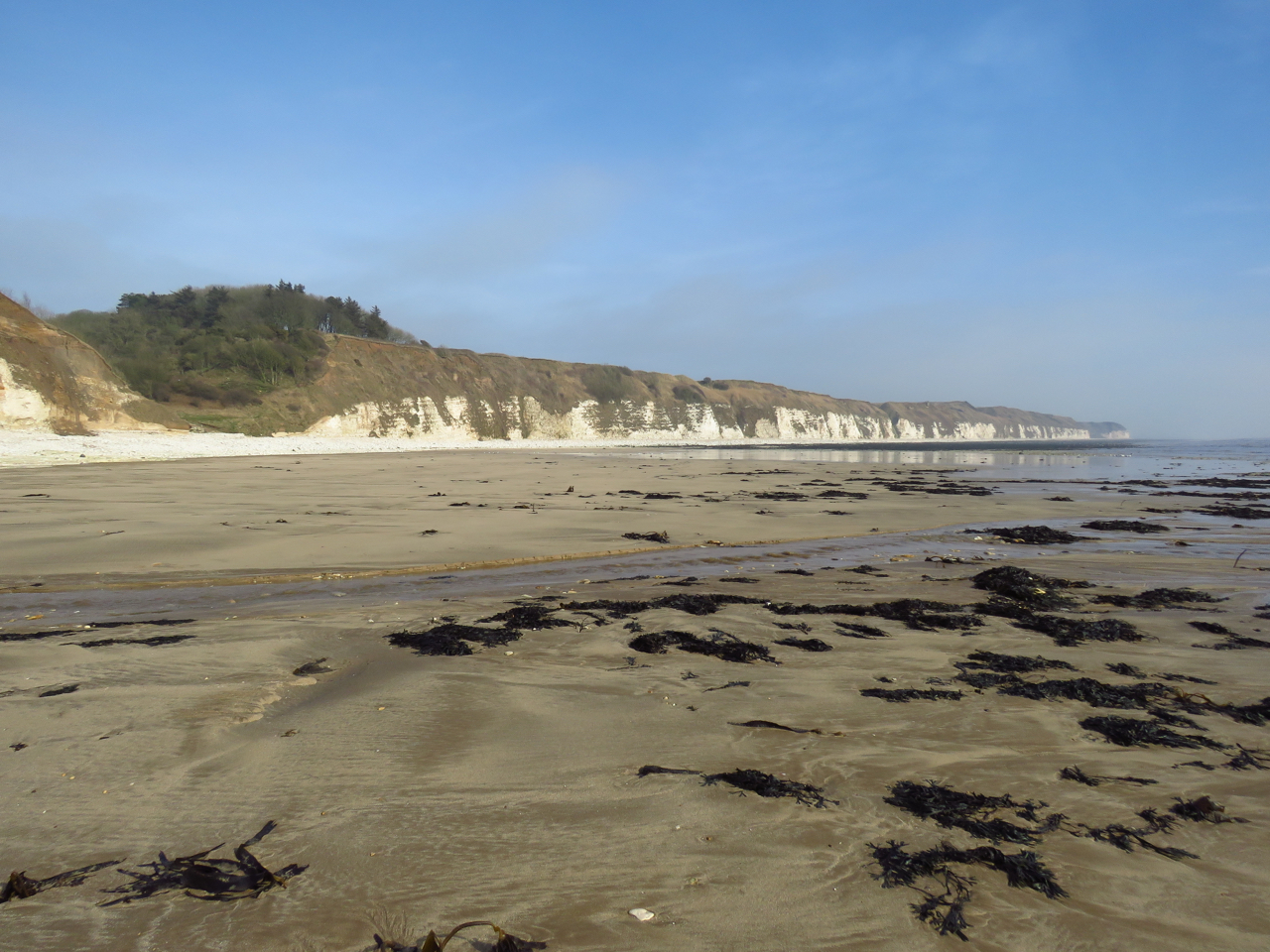
 I drove to Danes Dyke next. I made a long stop at the car park feeders, which were well topped up and very busy with birds. Even a Treecreeper was feeding on the cherry tree. Goldcrest, Coal Tit, Nuthatch, also in attendance. A Great Spotted Woodpecker drummed once. The sun was now breaking the fog and as I walked through the woods and into the beach the cliffs were shining, the tide almost out. As I focused on some distant Fulmars, a Woodcock flew into my field of view and I could follow it as it came in front of me and dove into the Dyke. A Grey Wagtail with a Pied Wagtail and at least 23 Fulmars in the cliffs were the highlights. I returned to the carpark on the nature trail, the signs of spring strong with the wild garlic, lords and ladies and bluebell foliage greening the ground.
Tree creeper the right way up.
The wild garlic and bluebells greening the ground.
The shining white chalk boulders at the top of the beach.
A non-conformity on the west side of the cliffs by the dyke.
Fossil sea urchin?
Icicles still remaining.
Danes Dyke at low tide.
Fulmars.
Danes Dyke from the beach.
Starfish.
Grey Wagtail on the white boulders.
Periwinkle.
Rock Pipit. An individual was singing and displaying today. 
Waterfall onto the beach.
The beck at the bottom of the dyke.