A mild day with light cloud and sunny spells, I take the but 24 to Skirlaugh. My route today takes me from Skirlaugh to Hornsea via the Hornsea Railway Trail, on the former railway line from Hull to Hornsea that now also serves as the last stage of the Trans-Pennine Trail. Unfortunately the bus stops are quite away from where the A165 crosses the trail, and this road is too busy and lacking a footpath, so I opt for taking Mulberry Road and Ellerby Road to join the trail. The route today takes me through farmland, mostly arable, except for the Lambwath valley SSSI, where hay is grown in traditional meadows. This section of the Lambwath is quite innaccessible, with few public rights of way, but I will devote more space to the Lambwath in another walk.
The trail is sound and even underfoot, some small sections tarmacked, and only a few muddy stretches. The banks have been mowed so it's wide enough. I meet some dog walkers, walkers and cyclists along the way, a loud group in the finishing stretch of the Transpennine Trail. The trail doesn't always run on the railway track, weaving sideways in sections, leaving the embankment on one side. Small copses and old hedgerows, today adorned with flowering dog roses, elder and honeysuckle, all adding to a wonderful fragance, line the way.
A Pied Wagtail collects insects on Silverhall Farm, near Skirlaugh.
I'm pleased to see good numbers of Small Tortoiseshells along the way.
Ellerby Road, between barley and rapeseed fields.
A Reed Bunting singing from the ripening rapeseed.
Skylark calling from a bare patch in the field.
I take a short detour to look for Twayblades and after some searching I'm rewarded with a single spike.
Whitethroat.
Linnet.
I cross the road at New Ellerby, a hamlet that was serviced by a station on market days. The platform and station remain, the latter now a private residence. In the wooded, more sheltered areas, Yellow-barred Longhorn moths gather and males dance flying up and down, occasionally resting on nearby leaves.
Large Skipper.
A good day for insects, a patch of Hedge Woundwort yields a Rhingia campestris, a hoverfly that likes tubular flowers.
I'm now descending the Lambwath valley. I climb the bank on the side of the trail and look across the bare field looking for hares. No hares, but I find a Buzzard gliding over the valley. I stop at the sound bridge over the Lamwath Stream. The water is clear, a couple of Azure Damselflies mate on the Reed Sweet-grass.
Buzzard.
Bridge over the Lambwath stream.
Lambwath stream, looking West.
Azure Damselflies.
Lamwath Meadows SSSI.
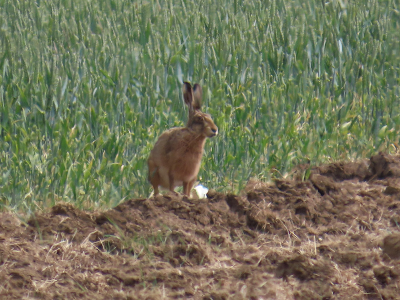
I climb the valley towards Whitedale, a hamlet that was also served with a station (top shot), now a private residence. A Swallow sings from the wires and House Sparrows are busy on its roof. After a little while, I find a spot with a nice view and I sit on the verge for lunch, a Yellowhammer and a Brown Hare for company.
Swallow at Whitedale.
Orange Tip, the only male I saw today.
Yellowhammer.
Reed Bunting.
Brown Hare.
It's time to carry on. A Marsh Harrier is quartering the fields in the distance, the Withernwick wind turbines as a backdrop. Another road crossing, this one between Little Hatfield and Great Hatfield, although the station itself is called Sigglesthorne. A small Local Nature Reserve has been designated along the trail, just north of the station. It has a wetland character, with reeds, willows, aspen and bracken. Soon I'm near Hull Bridge, a brick bridge where the Hull Road crosses the trail. The area is waterlogged and there are sedges, brooklime and ferns. There are records of Twayblade here, but I find none.
Marsh Harrier.
Dog Rose.
Hull Bridge near Hornsea.
I'm now in Hornsea. Some Swifts fly over. On a field after crossing Stream Dyke, two crow Fledglings beg to one of their parents. I reach the final station of the trail and the promenade. The grassy area nearby is busy with a large flock of Starlings, with many young, and a pair of Linnets. A group of high school students are led along the promenade. This is a typical geography day trip spot to highlight coastal erosion and defences, so it's rare to miss a school trip on a visit to Hornsea. The tide is rising fast. On one of the end groynes, a pair of Sandwich Terns preen. Small parties fly past chirruping. Sand Martins pass over I'm ready for a rest, so I get an ice-cream and a coffee and sit on a picnic table by the new landscaped promenade gardens and fountain. My rest doesn't last long, as a feeding frenzy starts offshore. This is a high point in the promenade, offering a great view. A cloud of Herring Gulls surrounds small parties of Razorbills and Guillemots, which are very successful taking small fish. Two Gannets appear out of nowhere and dive bomb. As fast as it formed, the birds disperse and I'm glad to have watched this unexpected spectacle just before my bus back home is due.

Swift.
Feeding frenzy with Herring Gulls.
Guillemot.
Razorbills.
Gannet.