Showing posts with label Kilnsea Wetlands. Show all posts

Saturday, 31 October 2026

A trip to Spurn on Halloween


The last day of October is Halloween, but it is also the last day in the season for the Spurn Explorer bus I've been using quite a bit this year. It is a foggy start with a promise of sunny weather later and the sun does start shining when I alight at Easington Caravan park. It is still cold, but with barely any wind it becomes mild as soon as the sun starts shining. I walk along the beach exploring the dunes and shingle. Two Stonechats feed on the bushes at the northernmost Beacon Lagoon, with some Redshanks also in attendance. A large flock of Linnets are picking seeds from dry Prickly Saltwort plants just above the tideline

Male Stonechat
Redshanks.
Stonechat.
Linnets.
A view of Beacon Lagoon.
I find the six Shore Larks by the lagoons, feeding on seeds of the Sea Asters and other low growing saltmarsh plants. They are staying together in a loose flock.

I next walk to the Beacon Pond hide and flush a Clouded Yellow from the path. A flock of 27 Twite fly calling over the hide. I have an early lunch and watch the good diversity of birds, with the tide still being quite high: Dunlin, Knot, Ringed Plover, Grey Plover, Shoveler and Wigeon. Afterwards, I head to Long Bank to try to spend more time watching the Shore Larks.

Reed Bunting.
Little Egret.
The path to Beacon Ponds hide.
Male Red-weined Darter. I see a hawker size dragonfly which dips behind the reeds and I can't find it again. Later I spot some Common Darters.
Pink-footed Geese with a Barnacle Goose.
Kestrel.
Grey Herons.
Shore Lark.
Three Shore Larks, there is a fair amount of chasing and squabbling, but the birds tend to move loosely together.
Grey Plover.
After Beacon Ponds, I head to Kilnsea Wetlands. There is only a little bit of water, and some Lapwing and gulls are on it. After, I head to the Discovery Centre for a hot drink. In the afternoon, I walk around the triangle and up Beacon Lane up to the hide. 
A Greylag flock at Kilnsea Wetlands, which has only a little bit of water.
One of the highland cattle grazing the wetlands.


And one of three highland cattle grazing the borrow pit.
The bus leaves back for Hull as the sun sets. The combination of winter birds, migration and the dragonflies and other insects in the lovely weather will be something I will remember from this day.

Sunday, 7 November 2021

Kilnsea and Spurn Triangle in November


What a difference a day makes. Contrasting to yesterday grey gales, today was cold, but sunny and still. I drove to Spurn and parked by the visitor centre. A flock of Starlings fed on the car park. After a short stint in Canal Scrape hide, where I failed to see a Water Rail but caught up with Bethan, I started my walk about the triangle. The tide was out, but coming in fast.
Cormorants.
A group of Shelduck on the mudflats.
One of the several Little Grebes on the Borrow Pit.
A Robin just by the Sandy Beaches.
One of two Stonechats by Beacon Lane.
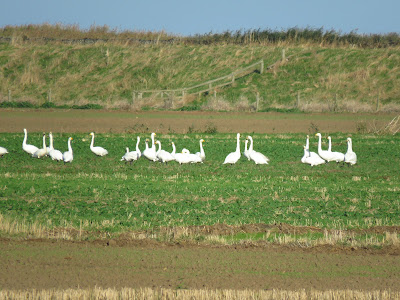
I had lunch at the KIlnsea Wetlands hide. I had it to myself all the time I was there, which was great. The family of Whoopers and the large number of Brents were highlights. I walked to the high on the road at Long Bank to check the fields, and there is where I counted the 60 Whoopers with just the one Mute Swan.
Black-tailed Godwit, Wigeon and Teal.
Lapwing.
A Whooper Swan family, Pintail, Wigeon and Brent Geese.
More Brent Geese.
Shoveler.
One of 7 Pintail.
Brent and Greylag flushed out.
Whoopers in flight.
More Whoopers!
Roe Deer.
This guy walking along the field edge got the Whoopers up.
Alert Whoopers.
Tree Sparrow.
Magpie.
A small skein of Pink-footed geese over.
The last bird. Three Ringed Plovers landed on the Kilnsea Beach with beautiful light.

Tuesday, 31 August 2021

A walk to the Spurn Lighthouse


Yesterday I travelled to Spurn with family. It was expected to be cloudy all day, although, in the end, we had some wonderful sunny spells (and a couple of drizzly showers). It was an hour before high tide when we got there. We started in the Spurn Discovery Center and walked to the lighthouse and back.

The last high tides had removed large chunks of the cliffs north of the seawatch hide and flattened the vegetation. We had to walk away from the path at times as it looked close to collapse.

We went down the steps by the warren. Some lovely clumps of sea mayweed.

In the wash over, a large mixed flock of sanderling and dunlin were roosting. A small raptor, a Merlin, caused panic and flocks spiralled like starling murmurations on the Humber side. 

Eventually they settled on the spit. A Knot was with the flock and there were several Ringed Plovers about too.


From the other side of the wash over the land rises and there were great views of the estuary. The flock of Sanderling painted a white band on the spit.
The view framed by a metal post. Looking North towards the wash over.
Sea Holly.
It is on this area that we found some Sea Aster bees, feeding on rocket flowers.

This one appeared to be marking a stick.
Common Field Grasshopper.
From the Chalk Bank hide, we counted 42 Curlew roosting. There were a few terns, usual gull mix and Cormorants.
This sad and gruesome photo is just part of the contents of a drinks can that had been discarded by the path to the Chalk Bank hide. It contained dozens of carrion beetles, including Silpha tristis, Tanatophilus rugosus and Nicrophorus vespillo. Discarded drinks cans and bottles are traps for insects
We loved the wire butterfly sculpture by the lighthouse.
A sunny spell brought out more invertebrates.
Dune robberfly.
Sea Aster bee on cat's ears.
Small heath butterfly.
After the sun, a dark, ominous cloud. We were near the high tide refuge when the rain started. A Pied Flycatcher landed on the path ahead of us, a migrant on it's way back to its winter quarters.


At the car park, this trio of Lesser Marsh Grasshoppers, a female and two males.