A sunny, still day that started cool but ended quite warm, I headed to Alkborough Flats. I was hoping for a good walk around the reserve and wasn't expecting anything in particular. As I approached the first tide, a birder was photographing some birds on the ground. As I kept my distance and focused with the binoculars, I realised they were Bearded Tits. At this time of the year, they switch from an insect to a seed diet and need grit to help them digest the reed seeds that will be their staple in autumn and winter. Early in the morning, they gather on the paths of the reserve to get some grit. About two dozen Bearded Tits were gritting. I have never seen this before, a true spectacle, they kept coming and going, with constant 'pinging', not 10 m away from three people taking photographs of them. Alkborough is a stronghold of Bearded Tits and one of the places in the upper Humber where you are most likely to see this stunning species.
I count 20 Bearded Tits in this photo.
A Cetti's Warbler emerged from the reeds and landed on the fence to check what all that pinging was about.
A group of Swallows flied East over the reserve. The Bearded Tit flock dispersed and I got in the hide. There are great views now that the reed have been cut and there are many waders: Redshank, Black-tailed Godwit, 9 Curlew, 2 Snipe, a Dunlin, 120 Avocets, about 200 Lapwing, 2 Ruff and a single Spotted Redshank. As for ducks, a dozen Pintail upend in the distance, Shoveler and Teal are also about. There are many geese, a skein of Pink-footed Geese, Barnacle Geese and Greylag. Two Water Rails make an appearance. Two Marsh Harriers flush the waders several times.
A skein of Pink-footed Geese.
Water Rail emerging from the reeds.
Avocets.
Black-tailed Godwit.
I did a counter-clockwise circular walk around the Trent, but first I walked to the end of the public footpath on the old floodbank near the breach.
Grazing cows. The Humber and the Wolds in the background.
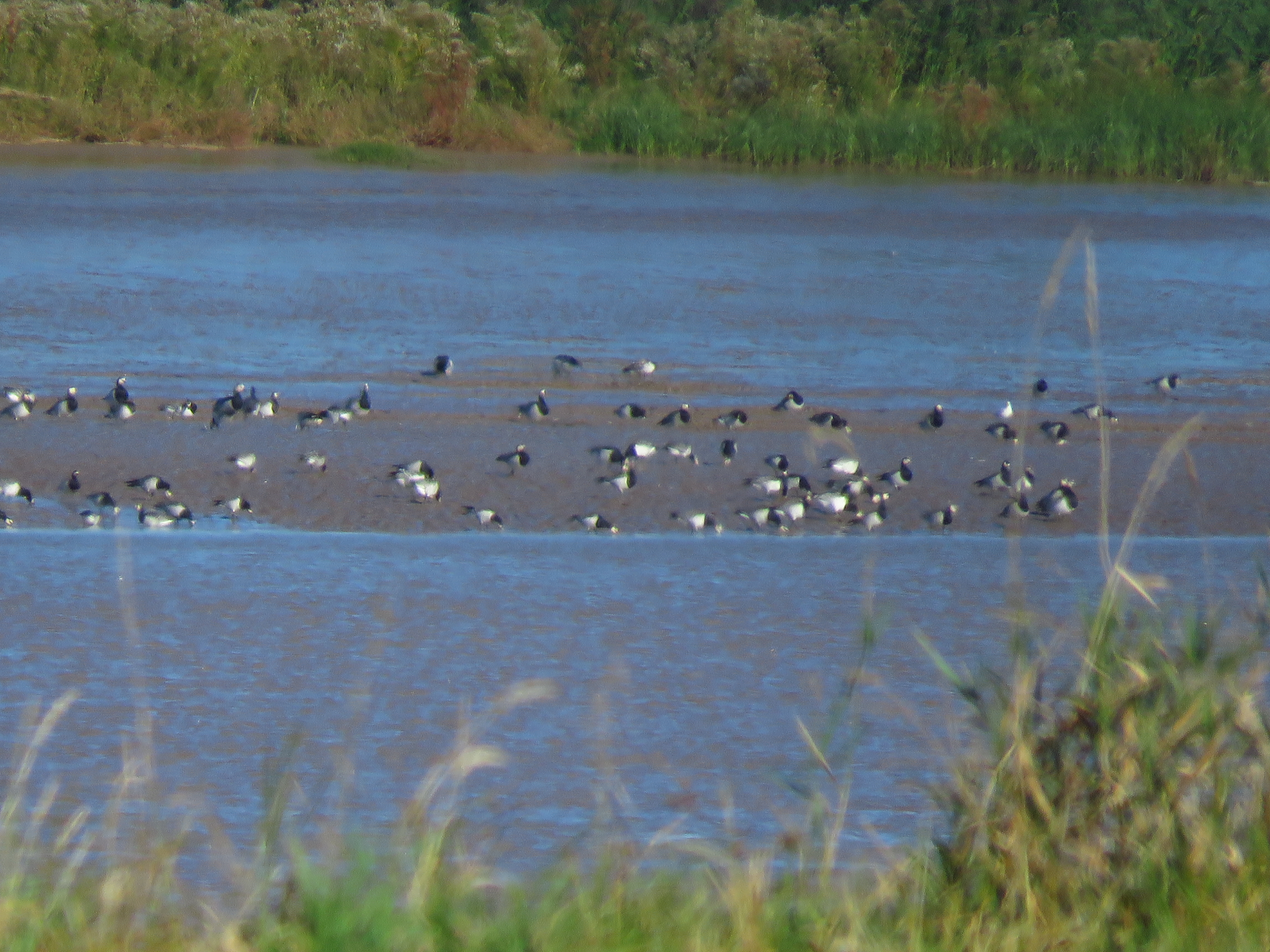
A large flock of Barnacle geese visible on the Humber mudflats.
Lovely to watch a flock of Curlew.
Pink-footed geese.
Stonechats.
The shallow pool where the Glossy Ibis and many egrets were feeding last time was much dryer. Many geese, including Pink-feet were resting on it.
As I walked towards the Trent, it felt quite warm. Dragonflies started being more obvious. A Ruddy Darter posed for a while. A Brown Hawker was patrolling on the low crossing, which was passable, if a bit muddy today.
Ruddy Darter.
Bulrush Bug, Chilacis typhae
This was one of my highlights today, a Common Hawker, despite the odd angle, the yellow costa (the vein on the front of the wing) is visible.
Common Darters ovipositing.
This almost dry pool had several pairs of Common Darters ovipositing.
Sheep graze some of the wet grassland of the flats.
I returned to the hide for lunch. A pale wagtail landed in front. I thought it might be a White Wagtail, but no, a Pied Wagtail for me.
Pied Wagtail and Redshank.
Spotted Redshank.
Snipe.
Curlew, Redshank and Black-tailed Godwit.
In the next stage, I'm hoping to walk from Alkborough village to Whitton.

 A sunny, still day that started cool but ended quite warm, I headed to Alkborough Flats. I was hoping for a good walk around the reserve and wasn't expecting anything in particular. As I approached the first tide, a birder was photographing some birds on the ground. As I kept my distance and focused with the binoculars, I realised they were Bearded Tits. At this time of the year, they switch from an insect to a seed diet and need grit to help them digest the reed seeds that will be their staple in autumn and winter. Early in the morning, they gather on the paths of the reserve to get some grit. About two dozen Bearded Tits were gritting. I have never seen this before, a true spectacle, they kept coming and going, with constant 'pinging', not 10 m away from three people taking photographs of them. Alkborough is a stronghold of Bearded Tits and one of the places in the upper Humber where you are most likely to see this stunning species.