Showing posts with label industrial. Show all posts

Tuesday, 6 December 2022

Urban birds at Hull. 32. Black Redstart


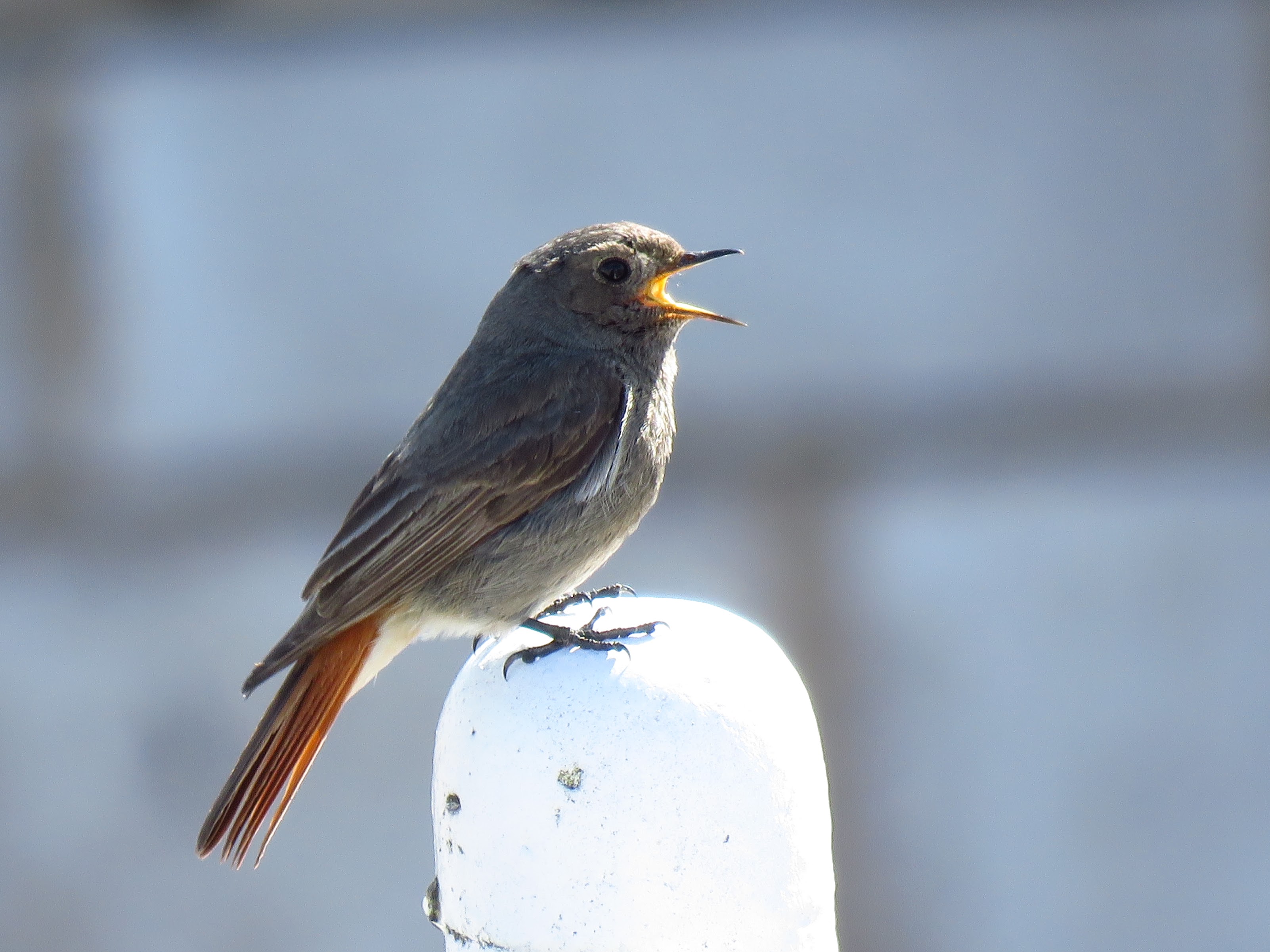
Black Redstarts are robin-sized birds. In all plumages the tail is brick red with darker central feathers. Adult males are slate grey, with coal black face and chest, with a white wing panel. Subadult males and females are greyer, with a plainer head and no wing panel. They are a scarce migrant, winter visitor, and rare breeding species in the UK. They have an unusual history as a UK breeding bird. The first record of breeding in the UK was in 1926 in the Wembley Exhibition Centre, London. It is a bird of uplands in rocky sites, slope screes and cliffs, all dry, exposed habitats with little vegetation cover. In the 1850s the species started to colonise urban environments across Western Europe, taking advantage of suitable nest sites in walls and buildings and abundant dry slopes in roofs offering enough feeding habitat. Today, Black Redstarts breeding habitats include cathedrals, museums, power stations, train stations, warehouses, dock depots, demolition sites, railway yards and industrial waste grounds, making this species a truly urban bird! Just a few territories are in coastal cliffs or quarries. Black Redstarts feed on small insects, woodlice and spiders that picks from the ground, seeds and berries. Towns and cities also provide suitable tall singing posts.
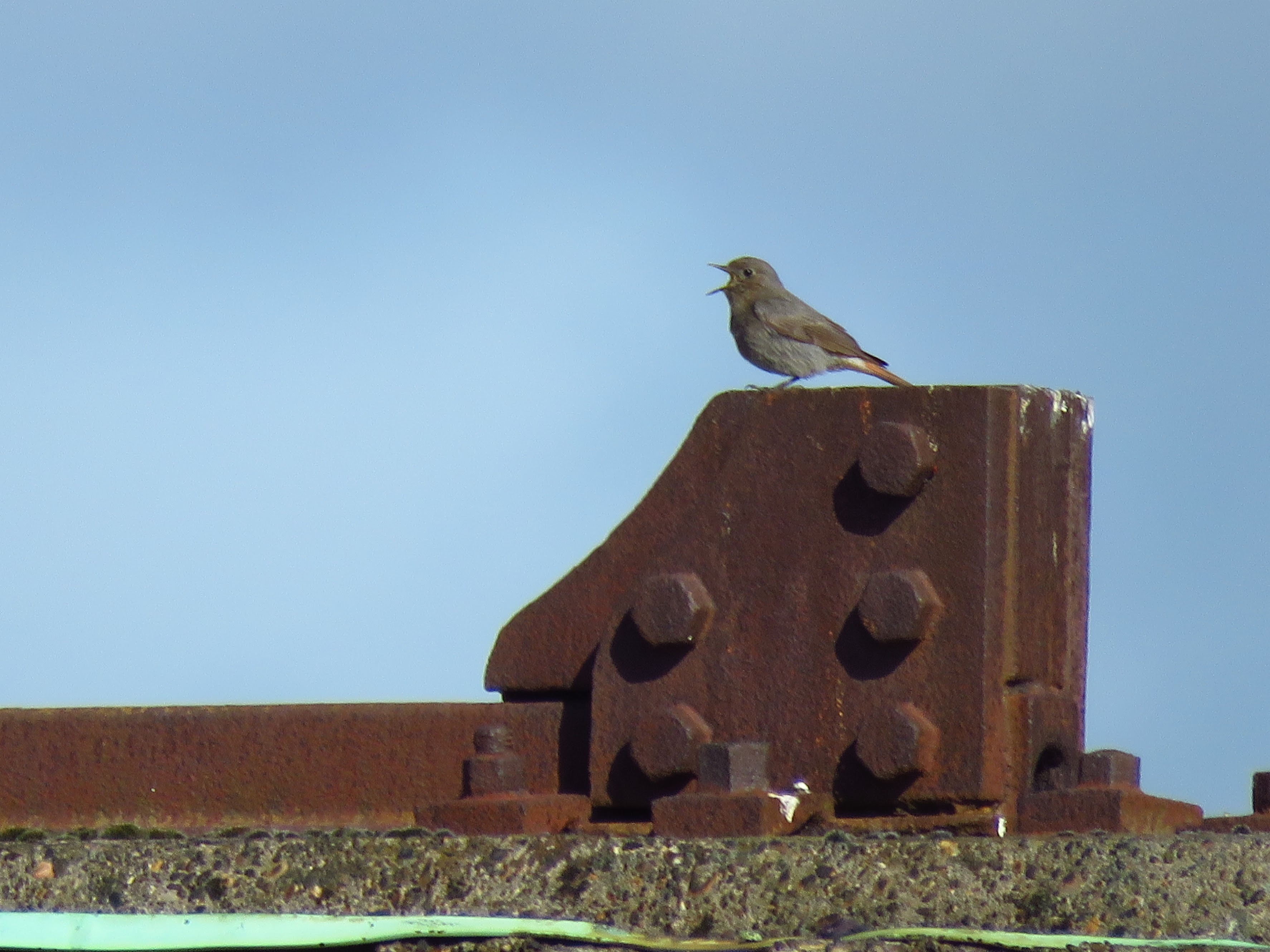
A male singing from a perch atop a building.

Distribution and status in Hull

As in other large cities in the UK, the Blitz of World War II created favourable habitat in Hull, and the Black Redstart colonised bombed sites. The first Hull record, a possible breeding pair and two males singing at High Street, were in 1949. The first confirmed breeding was in 1973 at a boat on a dry dock. It is an irregular rare breeder in Hull, but records of passage migrants are more frequent. Breeding was confirmed at Saltend in 1986. In the last 10 years they appear to have bred at the Hull docks. Given that their usual habitats are not regularly visited by birdwatchers, some pairs might have been missed. Sightings are from March to December. Black Redstarts tend to migrate south in winter, with a preference to winter at coastal sites.

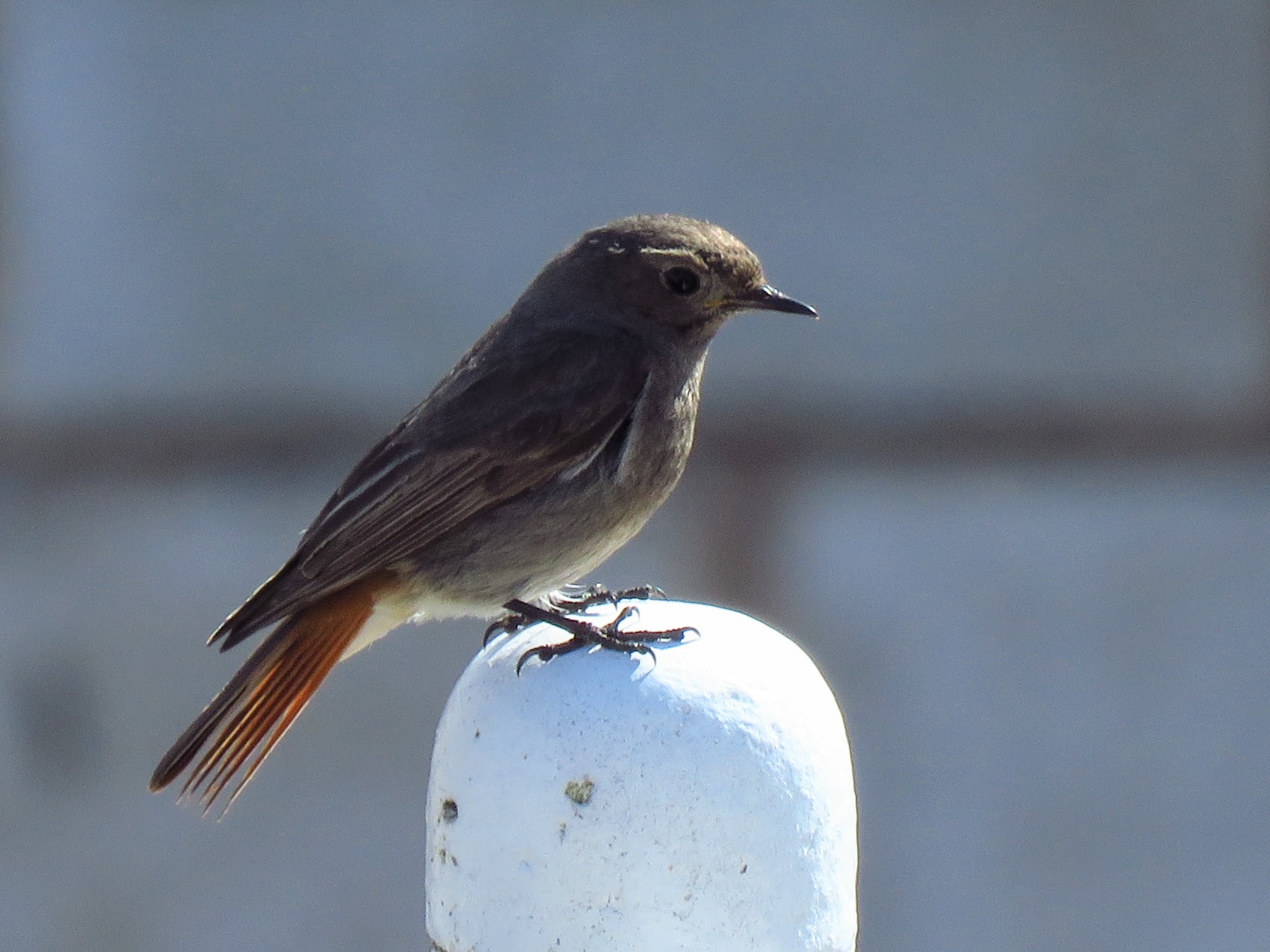
A Black Redstart on its habitat, with the Humber on the background.
Redstart on metal railing. Black Redstarts quiver their tails quite often, usually after landing, showing their red tones.

Conservation

The Black Redstart is fully protected by the Schedule 1 of the Wildlife and Countryside Act 1981, therefore any disturbance to nests or near nests is illegal. There are currently less than 100 breeding pairs in the UK, with between one and four pairs breeding in Yorkshire in the last decade. After a spell as Red listed due to a breeding population declines, populations have recently increased that they are now Amber listed (Birds of Conservation Concern 5, 2021).

A migrating adult male Redstart at Kilnsea Wetlands, 31 October 2019.

A recently fledged Black Redstart in Hull. 2021
Black Redstart, Hull, October 2021.

Management

It is unusual to think about managing a bird that thrives in habitats that we usually dismiss as not valuable for wildlife or are termed 'derelict' or 'abandoned'. Gentrification and site redevelopments appears to be the Black Redstart's main threats in the UK, where the bird mainly uses urban habitats. Preserving or mitigating against feeding grounds and known nesting sites should be the main management strategies. 
  • Building Work. It should be avoided between March and July (inclusive), within 300 m of a suspected nest site. Singing males usually chose posts near nest sites.
  • Provision of nest sites. These could include ledges on inner walls or integrated nests holes build onto walls.
  • Maintenance of pioneer vegetation communities. Redevelopment often results in planting grassland, or trees and bushes, removing the open feeding habitats needed by Black Redstarts. The creation of green roofs on light aggregates on new or existing buildings might mitigate loses of suitable habitats, as it is difficult to recreate the mossy, lichen and light plant cover characterising its natural habitats. Alternatives would be to create gravelly gardens or a light cover of gravel on flat roofs, to be recolonised naturally.
A gravelly bed by a footpath is naturally recolonised by weeds and sea pink.
  • Retain wooden structures, including derelict boats, when redeveloping sea walls.
Black Redstarts were seen feeding on these wooden posts, the remains of an old pier.
  • Survey work. Protection of existing breeding pairs can only be achieved if their nesting sites and foraging areas are known. Potential breeding sites should be surveyed, with singing males, nesting pairs and successful breeding recorded. Any records during the breeding season should be submitted to local county bird recorders.

More information

Birdguides. Black Redstart. Species profile.
Broughton, Richard K. Birds of the Hull Area.
Black Redstart, Phoenicurus ochruros. Bird monitoring methods. RBBP .
Mark Holling and the Rare Breeding Birds Panel. Rare breeding birds in the UK in 2017.
Holloway, S.J. and Glue, D.E., 1999. Site Action Plan for Black Redstarts Phoenicurus ochruros in the Deptford Creek Area, Greenwich, London. BTO Research Report, n. 212. 31 pp.
Black Redstart Biodiversity Action Plan, London.

Acknowledgements
Thank you to Nick Cutts who told me about Hull's Black Redstarts.

Monday, 16 November 2020

Urban birding at Hull: a walk to Albert Dock

An industrial walk today, including walking along Albert Dock by the Humber. It was cloudy and a little drizzly, with a constant westerly wind. I walk towards Spring Bank and the Infirmary, taking Rawling Way and then joining the end of Hessle Road. From there I walk by Strickland street to take the pedestrian bridge over the A63, then to English Street to the public right of way to Albert Dock near the Ice Arena.

A blooming Mahonia, a bush of North American origin that flowers in winter and is worth checking for winter active insects, particularly bumblebees. Unfortunately none seen today.
The drizzle stops and the clouds become lighter. The wooden groynes from the old dock look like giant skeletons by the Humber. Other than the usual gulls and feral pigeons, I don't see many birds on the estuary, despite the tide being half way.
Herring Gull near Fisherman's walk.
One of the newest brown-field sites in Hull, already colonised by buddleia.
A cotoneaster laden with berries atop a derelict wall.
Young Woodpigeon eating rowan berries.
The view east from the Albert dock lock 
Another dock skeleton by Albert Dock.
A long straight path by the Humber.
Rock Pipit atop the sea wall.
From the point where the pipit was onwards, recent flood defence works have resulted on a raised the flood wall, which, for a short person like me means that the views have been noticeably reduced!
Distant shots of two Redshank.
Feral Pigeon on the wall.
Derelict dock buildings.
A line of Black-headed gulls at St Andrews dock with the Humber Bridge in the horizon.
This young common gull had a piece of plastic attached to its bill.
A beautiful Feral Pigeon at Coltman Street, with plumage similar to the wild Rock Dove.

Saturday, 9 May 2020

Urban birding at Hull: City Centre and Albert Dock


A warm day with barely any wind and clear skies. I take an early morning walk to Albert Dock, via the City Centre, Queen's Gardens and the Hull Marina. At Queen's Gardens ponds I'm surprised there are still two ducklings left, now well grown, that have survived Herring Gull predation. I hear a soft call and find a fledgling Mistle Thrush. A passer by flushes it inadvertently, and it is still unable to fly well. It is surprisingly speckled.

 There is also a Blackbird fledgling in the same area.
 Two Feral Pigeons are doing some courtship feeding. They mate and then they stand next to each other, their plumage all fluffed up, like posing.
 A male Pied Wagtail looks for insects on the lawns.
 After a walk around Queen's Gardens, I move onto Princes Quay. While searching for wagtails I notice a fishing Cormorant and manage a shot in the few seconds that it surfaces between dives.
 I walk around the city centre, to the Minster, Princes Street and then move to the Marina and towards the right of way entrance to Albert Dock. There are lots of insects in the air, and there is a spectacle of starlings hawking for them. An abundant resource pushes them into an unusual way of feeding. Judging by the insects landing on me there seems to be a mixture of them including flies and beetles, maybe brought in by the warm air.
 As I cross the lock, I notice the busy House Martins hunting, and then, from the elevated bridge, I watch them collecting mud from the only puddle in sight.

 A Shelduck flies along the Humber, and then two Black-headed Gulls, taking the list of urban birds since lockdown to 60 species.
 My heard skipped a beat when this robin landed on a truck as I had been searching for Black Redstarts, but no luck.
Two House Martin nests under the eaves of the buildings by the entrance to the dock.
Linnets are more common around town than I expected. This male was singing from a traffic sign in a car park in front of the Bonus Arena.
 On the way back, the first House Sparrow fledgling, begging to its parent.


Bird list
  1. Black-headed Gull
  2. Blackbird
  3. Blackcap 
  4. Blue Tit 
  5. Buzzard 
  6. Carrion Crow
  7. Chaffinch 
  8. Collared Dove 
  9. Cormorant 
  10. Dunnock 
  11. Feral Pigeon
  12. Goldfinch 
  13. Great Spotted Woodpecker 
  14. Greenfinch 
  15. Greylag Goose 
  16. Herring Gull 
  17. House Martin 
  18. House Sparrow 
  19. Lesser Black-backed Gull
  20. Linnet 
  21. Magpie 
  22. Mallard 
  23. Mistle Thrush 
  24. Moorhen
  25. Pied Wagtail 
  26. Robin 
  27. Shelduck 
  28. Sparrowhawk 
  29. Starling 
  30. Stock Dove 
  31. Whitethroat 
  32. Woodpigeon 
  33. Wren

Sunday, 9 April 2017

River Hull. Stage 7. Weel and Grovehill

A warm day with a South-Westerly breeze I drive over the river by Weel or Grovehill Bridge, which has a narrow single lane. The stage, is a short one and skirts Beverley between Figham and Swinemoor. I start the walk on Weel, a small village with a single access road, protected from flooding by a metal embankment. I walk on top of the embankment to make the most of the view. A Small Tortoiseshell and a Peacock butterfly fly past.

A few long boats and abandoned barges are tied to jetties on the west bank after Beverley Beck lock, from where I couldn't find a public right of way by the river. Grovehill is an industrial state in Beverley, but on the other side of the river there is farmland, and a couple of Skylarks were in full song. As I stand on Weel Bridge, a Swallow flies by, just my second this year.

 As I see the flat expanse of Swinemoor with its pools, a couple paddles by on their kayaks, which looks like a very fun way to going up river (top shot).

The village of Weel and its embankment, looking east.
A large patch of Marsh Marigolds.  
A friendly pony tethered to the bank comes to greet me. 
Singing Linnet. 
Weel Bridge. 
Looking SE from Weel Bridge.
Towards the end of the stage. Swinemoor in the background.
Hovering Kestrel near the recycling centre.