Showing posts with label North York Moors. Show all posts

Thursday, 14 August 2025

Whitby to Robin Hood's Bay walk

I've been walking the coastal section of the Cleveland Way in stages and I was looking forward to doing this section. We were staying in Whitby for a few days, so we decided to walk to Robin Hood's way and catch the bus back. A mostly bright day with some cloud and barelya breeze, with a falling tide. We started the walk proper at the bottom of the famous 199 steps to Whitby Abbey. The walk ascends slowly until near Hawsker, with some ups and downs on steep ravines, then descends to Robin Hood's Bay. During the walk we're treated to stunning views and some otherworldly landscapes. A bare stack, Saltwick Nab, black, flat-topped rock with a light cover of guano, and peppered with Herring Gulls and Cormorants was one of the best (top shot). The path follows the coast closely, with some light detours when erosion has affected the old path route. The haunting three note begging calls of Guillemot chicks calling their parents on the water are the soundscape.

Looking back towards Whitby at the top of the steps.

Saltwick Nab.
Saltwick Beach. The beach can be accessed by a steep footpath.

Looking back to Saltwich bay, Whitby Abbey in the distance.
A flock of Oystercatchers at roost.
Curlew at roost.
Black Nab. 
Fulmar circling over the clifftop fields.
Whitby Lighthouse. The cottages are now on rent.
A small colony of Kittiwakes between the fog horn and the lighthouse.

One of many styles.
Wall Brown Butterfly.
Common Blue.

You get the feeling of how dry the spring and summer have been. Dry, golden grass.
A group of Bottlenose Dolphins just north of Robin Hood's Bay. We saw dolphins every day from the coast. Apparently, they come close to the coast to feast on mackerel breeding.
Descending to Robin Hood's Way.
Robin Hood's Bay.

We get to Robin Hood's Bay at low tide. A broad expanse of rocks is exposed across the bay. We get a coffee and icecream at the National Trust visitor centre. Afterwards, it's time for a picnic in the beach before getting the bus back to Whitby. It took us four hours to walk this section of about 11 km.

Saturday, 14 September 2024

Train trip: Around Robin Hood's Bay


A long trip including a train ride to Scarborough and a bus drive to Brow Top to walk from there to Robin Hood's Bay. Brow top is in moorland, which appears to be managed for grouse as there are very obviously burnt patches. I fail to find Mossy Mere, a name that suggests a boggy area, but there are no paths and the heather is woody in many places. A Stonechat sits on a gorse bush and meadow pipit flocks fly off. I reach the trig point marking 220 m, and then it's mostly downhill, meandering alongside country lanes and minor roads. I have taken my Echo meter detector to check for bush crickets. The views are wonderful, the day mild, with no wind.

The trig point and the sea in the distance, looking north.
Robin Hood's Bay.
A cottage outside wall has many Wall Pennywort dry seed heads. No leaves to be seen. This is a plant of humid walls and cliffs, more at home on the west coast.
Badger latrine.
The most common orthopteran of the day, Field Grasshopper.
The view from Robin Hood's bay, looking north. I have a picnic on a bench and it is balmy, i have to take my fleece off.

Small Tortoiseshell.
After my lunch, it's time to search for Dark Bush-crickets. I leave the village and take the steps for the Cleveland way. Atop the steps, on the sunny side of the hedge, my ultrasound device picks the scratchy calls of dark bush-crickets, unfortunately, a barbed wire fence prevents me from seeing where they are so I have to content myself with the recording. A Lizard scuttles behind a clump of grass further on the coastal path and as a consolation prize I spot a singing Roesel's, the Northernmost I've seen.

Looking back to Robin Hood's Bay and the hedge.
Roesel's male calling.

Whilst trying to spot the calling Dark Bush-crickets, I see these bugs. Later, I find out they are Boat Bugs, Enoplops scapha, a local species in the UK, which is found in dunes and coastal cliffs.

Basking Peacock.
I quickly walk up the steep street to catch the bus and have to sprint for it.

Friday, 16 August 2024

Bog-trotting. 6. Cropton Forest

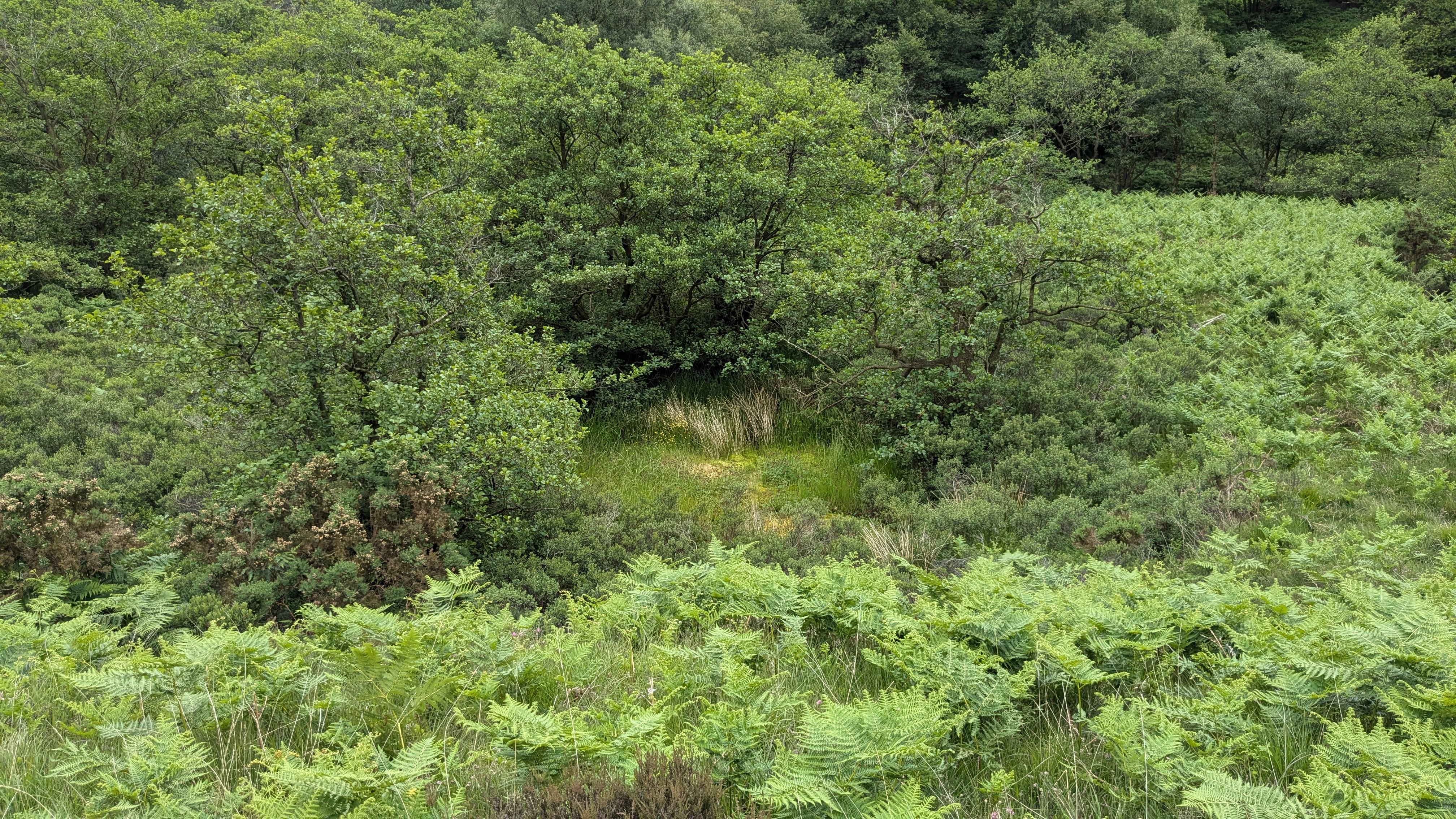
Cropton is a Forestry England plantation in the North Yorkshire Moors, NW of Pickering. It is best known for hosting a family of Beavers since 2019, the result of a reintroduction trial in an enclosure which led to the first Beavers being born in Yorkshire in several hundred years. On first sight, Cropton forest might appear an unsuitable habitat to find Bog Bush-crickets. However, there are records, new and old, from Bog Bush-crickets in three afforested areas in Yorkshire: Cropton, Wykeham and Harwood, the more recently planted forests. Across the UK, Bog Bush-cricket appear to hold on to plantations, and small populations survive along rides and clear-felled areas which preserve the original wet heath vegetation (top shot, a naturally regenerating plot with recovering heath). There are three Bog Bush-cricket records, scattered across the forest in three different years: 2005, 2009 and 2012, so we included this forest in the recces for the project. We were encouraged to see that the records were present in or next to open areas and designed a 6 km route to explore the forest ans survey for any Bog Bush-crickets. As bog bush-crickets are now mostly adult, we used our acoustic monitoring device to find them. 

One of the rides across the forest.

The wood was planted during the last century, mainly in the 1950s and 1960s. Lines and lines of conifers of the same age, growing close together creating a dark high wood. Progressively, and particularly in recent times, the management has become more biodiversity friendly, with removal of sections of dense woodland, thinning and allowing natural regeneration and increasing broad-leaf tree cover and also retaining low intervention plots for biodiversity benefits.
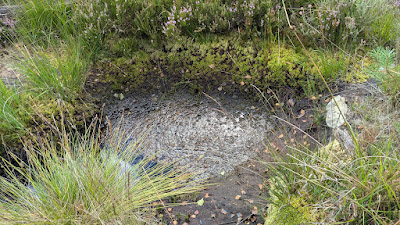
Small boggy pools with Sphagnum moss were dotted along the forest.

Two species of Sphagnum mosses.

Blanket bog and heathland are UKBAP Priority Habitats. During our walk, it became obvious that there there are scattered patches of blanket bog and wooded heath covering clear felled areas or access tracks and rides. Deep peat areas will not be replanted, but are allowed to regenerate naturally. From the management plan:

'This plan will continue the management and development of heathland and wooded heath where this will improve habitat networks across Cropton forest. Maintaining a mixed resource of temporary and permanent open space with heathland flora will provide suitable habitat for Nightjar, Tree pipit, Woodcock and other priority species including Small pearl-bordered fritillary and large heath butterfly and adder.'

Today's was the last of the the recces. In future trips, we will carry out the acoustic surveys. We meet up with Clare and Matt, who are collecting water samples for a Beaver environmental impact project in the enclosure where the Beavers have been reintroduced, and get a lift with them. It is a mild day with a breeze and sunny spells, briefer than we would have liked.

We start the walk and we are accompanied by flurries of Peacock butterflies, looking very fresh. They feed on knapweeds and other flowers and bask on the ground.

Peacocks were plentiful.
The Bog hoverfly, Sericomya silentis. The larvae develops in boggy pools and ditches.

This open area looked like it had good Bog Bush-cricket habitat. We heard several individuals and managed to locate a singing male, our first and only sighting of the day.

Singing male Bog Bush-cricket.
The large tracks of Red Deer.
Bog Bush-crickets called from the heath along this path.

When overcast, conditions appear not suitable for calling bush-crickets, and they were silent. We were surprised to hear Roesel's from a ride with long tussocks of grass by a main ride. Later we spotted a long-winged male.

A calling Roesel's Bush-cricket.
Female Emerald damselfly.
Common Lizard.

We identify possible transects for the acoustic survey and head towards the cafe, where we will meet Clare and Matt for lunch before heading back home.

A House Martin chick looks from a very dishevelled nest at the cafe building.

 More information

Cropton Forest Management Plan. Here.

Tuesday, 25 June 2024

Bog-trotting. 2. Fylingdales and Harwood Dale

Almost a year to the day, I'm back at Fylingdales, on the North Yorks Moors NP, this time with Sarah, for a Bog Bush-cricket recce. We even take the same circular walk. Fylingdales moor is very extensive and scattered records of Bog Bush-crickets are found over a large area, so by necessity we can't survey the whole area. No Bog Bush-crickets at the car park. Instead, a frog and a small heath have to do. We do catch up with the first one soon enough on the wet heath at the left hand side of the main track down to the Jugger Howe. There is plenty of cross-leaved heath and purple moorgrass, with wet boggy patches.

Common Frog
A curious lamb briefly straying away from mum.
This lizard came up to me as I was looking for bush-crickets.
One of the first Bog Bush-crickets. It jumped to my phone, and before I could do anything about it, it was onto the heath again.
The view towards the east from the path.
Cross-leaved Heath.
Small Pearl-bordered Fritillary.
Thyme.
We start descending the valley to Jugger Howe beck. On the bare path, we come across several Green Tiger Beetles. We find more Bog Bush-crickets on the lush heath by the side of the beck. After a quick lunch, it's time to follow the path by the beck to complete the circular walk.
Green Tiger Beetle.
Bog Bush-cricket.
The Jugger Howe valley
And another Bog Bush-cricket nymph. They were really plentiful.
A very pregnant lizard on the boardwalk.
A Bog Bush-cricket on Bracken.
Bog Cinquefoil and Golden-ringed Dragongfly. 
Small Heath.
A small bog by the beck.
Keeled Skimmer, by a flush by the boardwalk.

It is less humid at the top as we return to the car for our next stop, Harewook Dale, just a short drive away. This is a conifer plantation, but a recent bush-cricket record on the side of the track by a clear-felled area prompted us to visit.

There are ditches by the track, with some cross-leaved heath and purple moorgrass, but we see no bush-crickets.
A dark pool which held several species of dragonfly and damselfly.
Emperor Dragonfly.
Four spotted chaser
Large Red Damselfly in copula.
Sphagnum moss

Large skipper.