A wonderfully calm day, sunny to start with then cloudier with sunny spells, but mild and no rain. A huge flock of starlings fly over the car as we get into the car park. We arrived at the Discovery Centre when a flock of over 20 Jackdaws and some Rooks flew over south. Meadow Pipits displayed around the car park, Skylarks singing. We walked on the clifftop to Beacon Lane. A Reed Bunting is busy hawking for midges or gnats - I had never seen them catching insects- while a Linnet sings.
Reed Bunting.
Linnet.
After Beacon Lane we move onto the beach, where we walk all the way to Easington, with short stops along the way to watch Beacon Ponds. The tide is high, but falling. The cliffs are almost non existent alongside Beacon Lagoons, with dunes on the upper beach level. At some points the high tide has reached the lagoons. Behind the lagoons, the low lying land is protected with New Bank and Long Bank. The dunes have Marram grass, with patches of Sea Buckthorn in places. There won't be dunes on the walk until Wilsthorpe, south of Bridlington.
A patch of stabilised dunes with sea buckthorn.
Looking North towards Easington.
Dunes and new sand at the top of the beach.
A patch of reedbed at the beach.
Beacon Lagoons Nature Reserve
A series of saline lagoons, fringed by sand dunes and shingle on the seaward side, and by the New Bank on the landward side and with some coastal marsh. In early Ordnance Survey maps the site is marked with the word ‘saltings’ so it is likely that at least temporary salt water lagoons have existed south of Easington for over 100 years. The modern lagoons were created as borrow pits to strengthen long bank in the late 1970s. They have been also called Easington Lagoons or Beacon Ponds. The area was bought in 1991 by the
South Holderness Countryside Society. This is the only place in Yorkshire where Little Terns breed, and therefore is protected as a
SSSI and an Area of Special Protection between 1st April and 31st August. The colony is wardened by the Spurn Bird Observatory during the breeding season, with a low electric fence that defends the ground nesting birds from land predators and disturbance from beach users. Ringed Plover, Avocet and Oystercatchers also breed. The Little Tern colony was
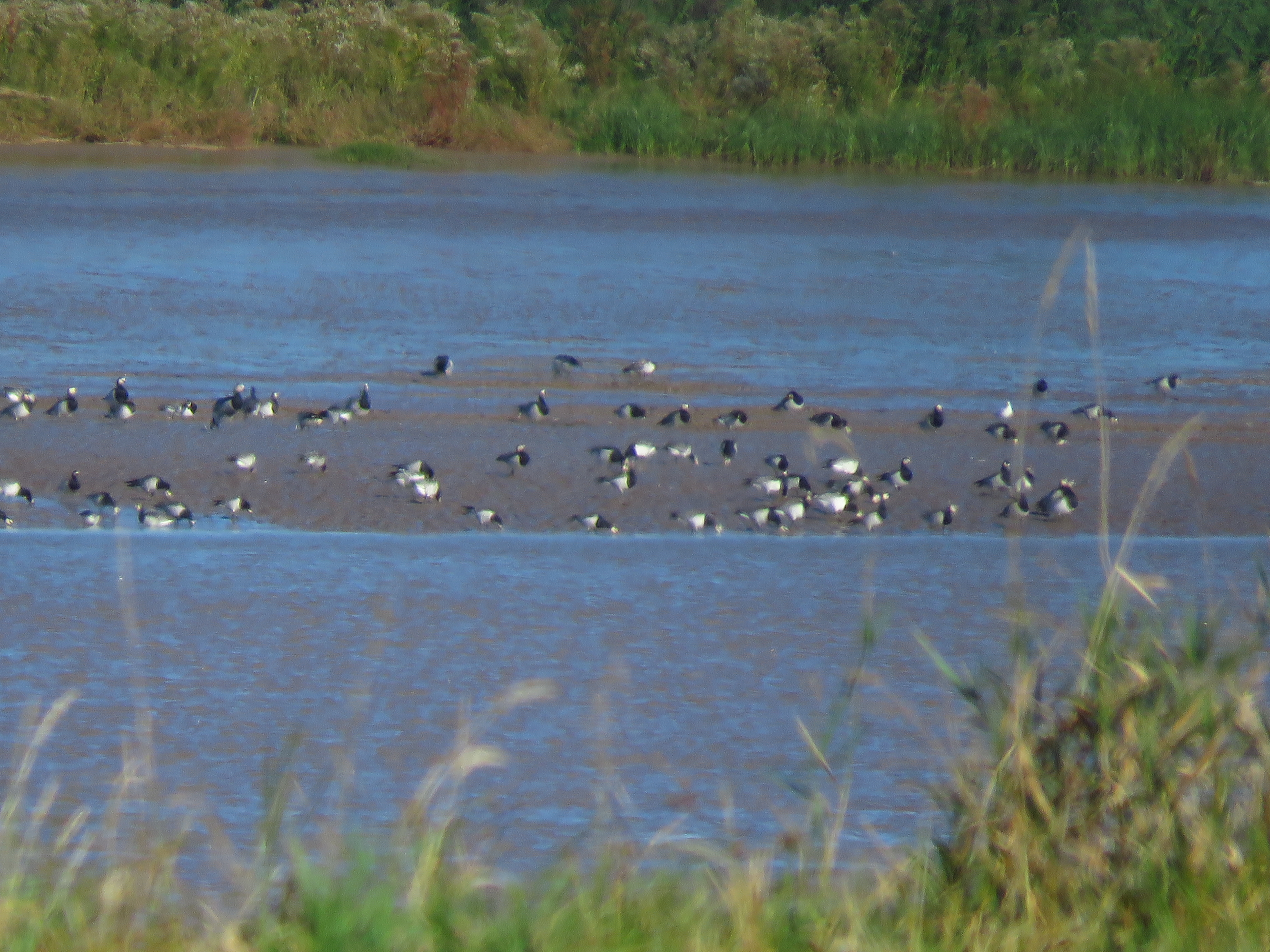
very successful last year, with 39 chicks fledged by 25 pairs. Common and Sandwich terns are also regular in the reserve. Beacon Ponds is also an important roosting site for migratory waders from July to September, as they move from the Humber at high tide. Brent Geese, grebes and ducks use it in the winter. Wintering Snow Bunting and Shore Lark are also notable.
Roosting Oystercatcher, Ringed Plovers and Dunlin at Beacon Lagoons.
Ringed Plovers have a disruptive coloration that makes them almost disappear when they are on shingle.
Two Common Gulls in summer plumage rest on the beach.
We arrive to Seaside Lane at Easington. Some fishermen at the beach. On the cliff by the caravan park, a wonderful patch of Colt's Foot, with male mining bees (Andrena nigroaenea, thank you to Steven Falk for help with ID) awaiting a sunny spell.
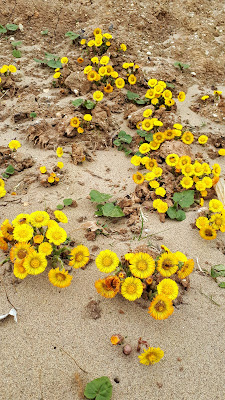
A close up of mining bee to ID.
The base of the cliff in this area appears sheltered from the sea, with some Marram Grass and other plants growing on the sand. The reason becomes apparent when we reach the public footpath at the end of Vicar's Lane: the sea wall with a rock revetment protecting the Easington Gas terminal. Vicar's Lane makes for a pleasant walk. Many birds are singing, including Skylark, Song Thrush, Greenfinch and Chaffinch.
Song Thrush.
Greenfinch singing.
It is almost midday. We walk back along the road on Easington straight. Four Roe Deer feed by a ditch.
We get to Kilnsea Wetlands hide for lunch.
Kilnsea Wetlands
A reserve managed by the YWT since 2012, built to compensate for erosion and encroachment of Beacon Lagoons. It has quickly become established as one of the highlights of a visit to the Spurn Area. It includes coastal grassland, wetlands, wet meadows, scrapes, managed with sheep; lagoons and small scrapes. There are currently two hides, the main one overlooks the main wetland, the other one sits opposite long bank marsh. As we are settling in the hide we hear Brent Geese flying over and the flock settles on the water for a few minutes, in front of the hide washing. Then they start calling a few times and the whole flock leaves towards the Humber. Four Whooper Swans are about, and plenty of ducks.
A Curlew with plastic rings. Note to self: Must report it.
Whooper Swans.
Brent Goose.
After lunch we are back on the road and along Canal Bank. I finally have a good luck and identify a Marsh Harrier that we've been seeing all morning as it slowly moved south along the peninsula.
A view towards the lighthouse, with Brent Goose.
Marsh Harrier flying south.
Featured bird: Avocet
Today one pair of Avocets was present at Beacon Lagoons and another at Kilnsea Wetlands. This Amber listed wader, is mainly a summer visitor in the area, although they can return quite early. There is a stablished breeding colony at Kilnsea Wetlands and Beacon Ponds.
Walk information
13.3 km, circular. Start:
YWT Discovery Centre TA416154. Finish at Easington Vicar’s Ln Road. Parking, Pay and Display, free to YWT members, just display your membership card. Toilets available at the Discovery centre and at the Blue Bell car park.

 A sunny, still day that started cool but ended quite warm, I headed to Alkborough Flats. I was hoping for a good walk around the reserve and wasn't expecting anything in particular. As I approached the first tide, a birder was photographing some birds on the ground. As I kept my distance and focused with the binoculars, I realised they were Bearded Tits. At this time of the year, they switch from an insect to a seed diet and need grit to help them digest the reed seeds that will be their staple in autumn and winter. Early in the morning, they gather on the paths of the reserve to get some grit. About two dozen Bearded Tits were gritting. I have never seen this before, a true spectacle, they kept coming and going, with constant 'pinging', not 10 m away from three people taking photographs of them. Alkborough is a stronghold of Bearded Tits and one of the places in the upper Humber where you are most likely to see this stunning species.