Showing posts with label goosander. Show all posts

Tuesday, 22 November 2022

A walk to East Park in November


A walk to East Park in calm, mild conditions, with occasional showers, which explained the wonderful full rainbow over the Beverley and Barmston drain at Sculcoates. Walking along Stoneferry Road, the sun shining, I check the old building where the Kestrels like to bask and the male is there, in his little south facing alcove.

Male Kestrel.

However, the best raptor sighting today happens shortly after, when a male Sparrowhawk dashes by me like a shadow, and flies around above a front garden, where some House Sparrows were feeding on a bird feeder. The sparrows seem to have hid in a bush and the Sparrowhawk flies over the bush and then lands on the roof. I'm out of sight of it, behind a tree, and I get closer. There it is, what a sight! I take some photos, I'm barely moving, the Sparrowhawk is too focused on House Sparrows to notice me. I always count myself lucky to watch a Sparrowhawk at close quarters, what stunning birds they are!


Male Sparrowhawk.
The view of Rockford Fields.

There is a group of mixed gulls on the model boating lake, one of the Black-headed Gulls is ringed. TC68 gull from a Polish ringing scheme. Update: This was TC68 first recovery, gull ringed as an adult May 2021 at a breeding colony in Wymysłowo, nothern Poland.

The pair of a family of three Mute Swans. Between 9 and 13 individuals were present, I could have double counted this family as they were mobile. On the eastern side of the lake there was a family of four. No signs of the Black Swan. After yesterday's sad news at Oak Road it was nice to see so many Mute Swans at the park.

The only Pochard seen today.

I was surprised to see a young crow still begging (note the red mouth), presumably to one of its parents. It was mostly feeding on its own near the adult, but it couldn't resist begging when the adult got a worm.


Three Mute Swans were enticed out of the water by a passer by. Fortunately they all returned safe and well shortly after I took their photo.
A single Great Crested Grebe was near the Zoo island. A Little Grebe was on the central island.
Great Crested Grebe.
.
There were half a dozen Shovelers at the lake today, this one moved away from the others, quietly quacking.
As I approached the bridge, a line of alert Goosanders stood out of the water, a most unusual occurrence, as they often rest on the islands. The reason became clear shortly after: the Great Crested Grebe was chasing them and attacking them on air and under water. One chased drake Goosander escaped by running on the water at full speed, wings closed, like a speed boat, really awesome to watch! Goosanders are river birds in the breeding season and are powerful swimmers. The speed of a duckling running upstream can be seen on the video linked here. I'm not sure why this Great Crested Grebe was so territorial, but defending their area from other fish-eating birds seems a possible explanation.

A line of alert Goosanders.
The aggressive Great Grested Grebe chasing over water.

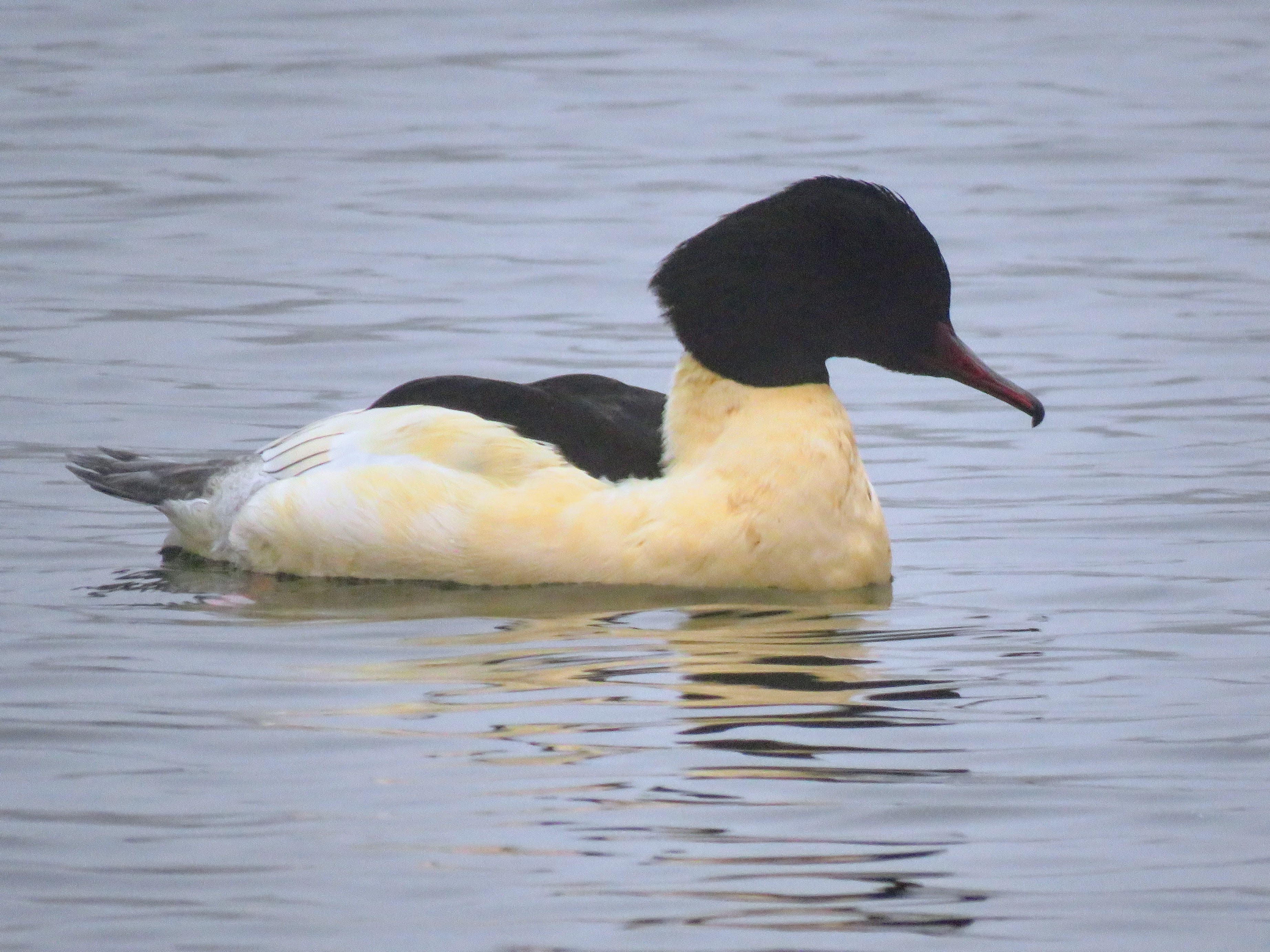
Drake Goosander.

One of the Goosanders out of the water. This is a 1st winter male, note the black feathers growing at the margin of the brown neck.

The cycle/pedestrian track to Hornsea (also part of the Trans Pennine trail).

Tuesday, 8 December 2020

Urban birding at Hull: December at Pickering Park

 I realised yesterday I had never been to Pickering Park in December, so that was the perfect excuse for a trip there. That, and the Goosanders! It was very cold and the very light southerly breeze made me keep my gloved hands in my pockets most of the time, especially when walking around the exposed lake.

As I got to the lake I saw the Mute Swan family gathered on the north edge of the lake. The adult pair had their two yearlings, born in 2019, and three young born in spring 2020. Usually swans chase their young away from their territory in the autumn, but this pair tolerates their young for much longer, probably because of the large size of the lake and plentiful food. The cob, however, was all fluffed wings and lowered head, a behaviour called 'busking' to one of the two older young. After a short chase, the young started flying, followed by a younger sibling and dad, and all three flew to the other end of the lake. I watched this happened three times while I was there. The swans only needed to drift on the wind to the top of the lake, and then take advantage of the gentle head wind for an easier lift. They yearlings might be getting ready to finally leave their natal lake, practicing taking off and landing.

Mute Swan family. A wing stretch.
The cob in busking position.
Two of the three young of this year, moulting into their white feathers, approach me in an area of the lake where the shore is very low, allowing for almost level photos of the swimming wildfowl. The single Pochard got very close too (top shot)
The cob at Pickering Park.

There were 15 Goosanders, with seven adult drakes and eight females and first winter males.

Most of the Goosander flock.
This could be a first year male.
Adult male.
Two of the females sat on the shore. Taking advantage on how quiet the park was today.
Drake Pochard.
To end, this grey squirrel, looking quite rotund, sat on a rock watching me.

Monday, 7 December 2020

Urban Birding at Hull: December Freezing Fog at East Park

A short drive to East Park today to check on the waterfowl. Thick freezing fog, the hoar on the trees and grass makes the park look magical. A lost Canada Geese calls regularly, trying to reconnect with the flock. Flocks of Goldfinches feed on the Alder catkins around the park.

A young Goosander drake, still some dark feathers on its chest and a female (above) preen on the main lake.

Female Goosander.
Drake Goosander.
Drake Goosander looking under the water.
I scan the central island, which is a sheltered area, away from disturbance. A Teal hides under overhanging ivy, five drake Pochards slumber with a drake Wigeon and a Great Crested Grebe.
Pochard and Wigeon.

Many Black-headed Gulls, keeping an eye on anything that dives. They are not disappointed as the Goosander flock that winters in the park is growing in size. 


Greylag flock grazing.
Several Goldfinch flocks on alder cones.
This Black-headed gull came right up to me.
Goldcrest.
Mistle Thrush.
The regular Grey Heron on the central island.
At least 11 male Goosanders and three females on the eastern side of the main lake, they were first fishing, pestered by Black-headed gulls, which await when they are fishing in case they can snatch a catch, as they do to Great Crested Grebes. Afterwards, the Goosanders decided to do a bit of preening (above). They are quite social and often dive in synchrony, the wing flapping was also done one.


Tufted Ducks.
Red-crested Pochard.
There is a pair of Mute Swans on the boating lake, the fog has lifted and the weak winter sun shines. The female swan starts bobbing slowly, the feathers at the top of her neck erect, then she preens her back, then shakes her head. The male follows her slowly, his neck straight, occasionally flicking its head up and uttering a soft snort.  

Monday, 10 November 2014

Who's a pretty bird?

After some thought, I decided to head to East Park today, as there were two bird species I hadn't seen this year that I wanted to watch. Week days are always quieter there and I guessed the chances of good views would be greater. The day was overcast, with dark clouds, and a light breeze. As I was locking the car in the main entrance car park I heard the screech of a jay, but was unable to locate it.

 A pair of blue tits were hunting on the shrivelled leaves of a small horse chestnut. They proved tricky to photograph, as they often hung nimbly from underneath the umbrella-like leaves and it was hard to see what they were after, although the chances are that they were hunting horse-chestnut leaf miner pupae (Cameraria ohridella).

 Swan 775 spent the whole morning by the lake landing, grooming.
 I heard Jackdaw calls, like last week, and this time I saw them too, on top of the ticket office building. There were three of them, and this is the first time I see them in the park.
 There were good numbers of Pochard, mostly males, I only saw one female
A pair of Great Crested Grebes were present at the East side of the lake
 The first pretty bird was the Goosander, four females and two males, were snorkelling near the large island, still nervous of people getting too close.

 I heard the call of the parakeet. I hadn't seen it for quite a while, but here he was, the lone male in a garden by the park, eating an apple. Isn't he a pretty bird too?


 A Mistle Thrush guarding a Whitebeam. It must be out of habit, as there were few berries left on the tree.
I heard the call of a wagtail, and managed to see it landing by the bridge, a Grey Wagtail it was.
In the mini zoo, a very large young wallaby nursed
On the skate park, another Grey Wagtail, this one with a paler chest than the other.
And then I heard the Jay again. This time I found it on a tree. I hid behind the exercise machines and watched it feeding on the ground for a while.

I lost it when it flew to the hollies, but just as I was leaving, it flew over and landed on a horse chestnut tree by the car. This was the best and longer jay encounter I ever had. Who's a pretty bird indeed?

Bird List
  1. Black-headed Gull
  2. Blackbird
  3. Blue Tit
  4. Canada Goose
  5. Carrion Crow
  6. Chaffinch
  7. Coal Tit
  8. Collared Dove
  9. Common Gull
  10. Coot
  11. Cormorant
  12. Dunnock
  13. Feral Pigeon
  14. Goldcrest
  15. Goldfinch
  16. Goosander
  17. Great Crested Grebe
  18. Great Spotted Woodpecker
  19. Great Tit
  20. Greenfinch
  21. Grey Wagtail
  22. Greylag Goose
  23. Herring Gull
  24. House Sparrow
  25. Jackdaw
  26. Jay
  27. Long-tailed Tit
  28. Magpie
  29. Mallard
  30. Mallard (domestic)
  31. Mistle Thrush
  32. Moorhen
  33. Mute Swan
  34. Pochard
  35. Ring-necked Parakeet
  36. Robin
  37. Starling
  38. Tufted Duck
  39. Woodpigeon
  40. Wren