Showing posts with label December. Show all posts

Monday, 7 December 2020

Urban Birding at Hull: December Freezing Fog at East Park

A short drive to East Park today to check on the waterfowl. Thick freezing fog, the hoar on the trees and grass makes the park look magical. A lost Canada Geese calls regularly, trying to reconnect with the flock. Flocks of Goldfinches feed on the Alder catkins around the park.

A young Goosander drake, still some dark feathers on its chest and a female (above) preen on the main lake.

Female Goosander.
Drake Goosander.
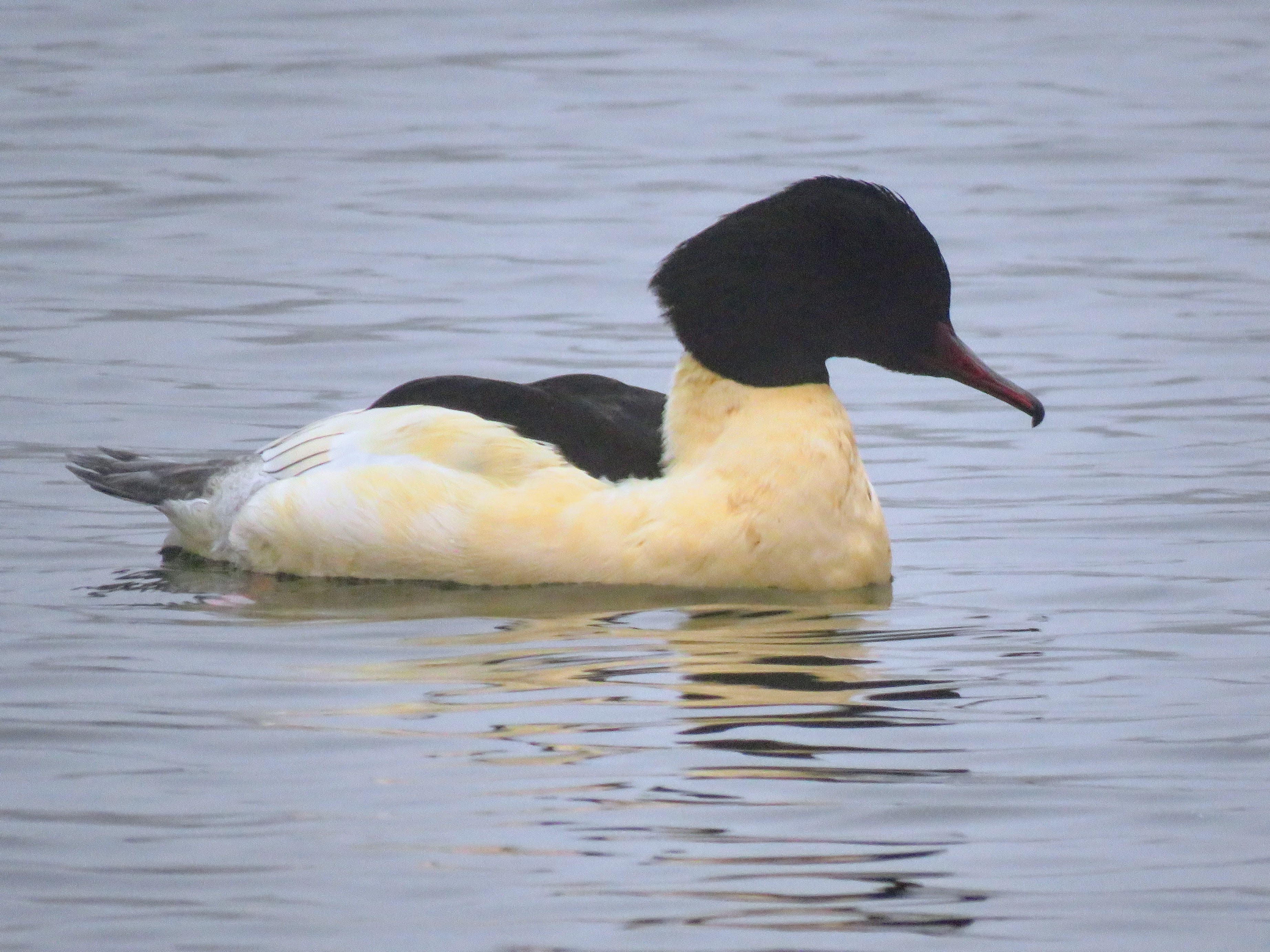
Drake Goosander looking under the water.
I scan the central island, which is a sheltered area, away from disturbance. A Teal hides under overhanging ivy, five drake Pochards slumber with a drake Wigeon and a Great Crested Grebe.
Pochard and Wigeon.

Many Black-headed Gulls, keeping an eye on anything that dives. They are not disappointed as the Goosander flock that winters in the park is growing in size. 


Greylag flock grazing.
Several Goldfinch flocks on alder cones.
This Black-headed gull came right up to me.
Goldcrest.
Mistle Thrush.
The regular Grey Heron on the central island.
At least 11 male Goosanders and three females on the eastern side of the main lake, they were first fishing, pestered by Black-headed gulls, which await when they are fishing in case they can snatch a catch, as they do to Great Crested Grebes. Afterwards, the Goosanders decided to do a bit of preening (above). They are quite social and often dive in synchrony, the wing flapping was also done one.


Tufted Ducks.
Red-crested Pochard.
There is a pair of Mute Swans on the boating lake, the fog has lifted and the weak winter sun shines. The female swan starts bobbing slowly, the feathers at the top of her neck erect, then she preens her back, then shakes her head. The male follows her slowly, his neck straight, occasionally flicking its head up and uttering a soft snort.  

Tuesday, 13 December 2016

Tophill Low in December

I took a trip to Tophill Low today. There was the promise of a lovely diving trio: a Long-tailed Duck, Smew and Black-necked grebe were at the reserve. As soon as I left Hull I realised it was really foggy, and the fog got thicker as I approached the river and Tophill Low, not the best day for photography.
The old south hide is now gone and the new hide/visitor centre looks almost complete, with the glass panels being fitted today.
Many coots at D res, with Goldeneyes, Wigeon, Shoveler, Gadwall, Great Crested Grebes and Cormorants, even a few Teal flotillas. At some point groups of common gulls, herring gulls and a couple of Great-black Backed gulls started to bathe, joined by a cormorant and a great-crested grebe. Bathing is quite contagious!
Coots.
After several scans, squinting hard due to the poor visibility, I moved on to the woods. The feeders were being used by Goldfinches, Chaffinches and Great, Blue and Coal tit. Eventually, a Marsh Tit made an appearance.
Hovering Chaffinch.
Coal tit, goldfinch and Chaffinch.
Marsh tit and Goldfinch.
The usual tranquility of North Marsh was broken by the burst of a Cetti's warbler song. The sound came from the reeds at the back of the hide, so there I moved. Eventually, I spotted it and the edge of the reeds, always under cover and close to the ground. I even managed a few poor shots (top shot and below), the firsts I take of this elusive species.

 The view from the north hide, once the fog started to lift. I reached the middle hide and scanned again at the south side, where the long-tailed duck had been seen yesterday. There it was, diving repeatedly. A nice thing about them is that they bubble all the time they are under water, so it's easy to predict where they will emerge. Still, the views were very distant and still misty, so these record shots is the best I managed.

 Noth much at N lagoon and N marsh so I went to O res to check for the Black-necked grebe. There were indeed many Great Crested Grebes about...
and courting Goldeneyes...
 ...but a birdwatcher spotted the Black-necked grebe, right at the other side of the reservoir, so again, just record shots.
 With so much reservoir scanning I run out of time and didn't get to Watton for the Smew, but I was most pleased with the visit.

Saturday, 19 December 2009

Holly Days

Female Blackbird picking a Holly berry
In the last few days I have watched a pair of woodpigeons and a Blackbird feeding on holly berries. This time of the year, Holly berries are an important source of winter food for of all British thrushes, including the Blackbird; robins, blackcap and woodpigeons also regularly feed on them. It is Holly tree defence by Mistle thrushes to feed on the berries that has the highest ecological significance. Holly berries keep very well even after strong frosts, and this makes them ideal trees for Mistle thrushes to defend. Mistle thrushes defence of the tree can be overwhelmed by flocks of hungry birds on periods of frost when the tree can provide emergency food than otherwise wouldn't exist. Berries on successfully defended trees can last until July, whereas undefended ones are already devoid of berries in January.
Holly berries
A bush or small tree, Holly can reach up 10 m of hight, it flowers in May and June and it is dioecious, which means that there are male and female trees and only female ones produce berries.
A large female Holly growing on a street in Hull
Holly male flowers and buds in early May
Hollies are pollinated by bees and bumblebees. Holly Blue butterflies also visit the flowers and in April the females of the Holly Blue can be seen laying their eggs on young shoots and buds at the tip of the branches.
Female Holly Blue laying eggs
Given that they are evergreen and well defended by their hard, spiky leafs, Holly is also used for shelter and as a good nesting tree by many birds.
Sources: Snow, B. and D. Snow (1988) Birds and Berries. T&AD Poyser, Calton.