Showing posts with label Alkborough Flats. Show all posts

Monday, 26 January 2026

Alkborough Flats with Hull Nats


A gloomy, windy and cold day, but at least we missed the rain. Six of us met at the bottom car park of Alkborough Flats and did a circular walk though the flats and then along the flood bank on the Trent. As we were about to enter the hide, a Raven flew high above us, my first of the site. Flocks of Lapwing and Golden Plover wheeled constantly on the horizon, flushed by the numerous Marsh Harriers on site. We counted 6 flying together, maybe assembling to roost. The tide was high and there were plenty of ducks on the main pool in front of the hide, Shovelers, Gadwall, Tufted Ducks and a pair of Pintail.

Raven.
Shoveler.
Tufted Ducks.
Gadwall.
Pintail.
Lapwing.
Male Marsh Harrier.
Golden Plover.

We carried on and waded on the flooded stretch of path, my wellies just high enough to keep my socks dry. Then we have lunch out in the Trent hide. It's been a while since I've had lunch in a hide and I wish I brought a thermos with a hot drink. A male Kestrel appears to follow us along the flood bank, staying just ahead and dropping in several occasions. Several Mute Swans fly over. We are very exposed and the wind is relentless, but we are compensated by a large flock of Whoopers on the Trent (top shot and below), they are distant but I count between 40 and 50 with a small group of Mute Swans. Little else of interest on the way back to the car park. A hot chocolate at The Paddocks cafe put a lovely end of a challenging day.

Kestrel.
Marsh Harrier.
Kestrel.
Shelduck.
Whooper Swans.


A group of Whooper Swans with several juveniles.
Mute Swan.

Monday, 20 September 2021

Humber South Bank. 2. Alkborough Flats

 A sunny, still day that started cool but ended quite warm, I headed to Alkborough Flats. I was hoping for a good walk around the reserve and wasn't expecting anything in particular. As I approached the first tide, a birder was photographing some birds on the ground. As I kept my distance and focused with the binoculars, I realised they were Bearded Tits. At this time of the year, they switch from an insect to a seed diet and need grit to help them digest the reed seeds that will be their staple in autumn and winter. Early in the morning, they gather on the paths of the reserve to get some grit. About two dozen Bearded Tits were gritting. I have never seen this before, a true spectacle, they kept coming and going, with constant 'pinging', not 10 m away from three people taking photographs of them. Alkborough is a stronghold of Bearded Tits and one of the places in the upper Humber where you are most likely to see this stunning species. 

I count 20 Bearded Tits in this photo.
A Cetti's Warbler emerged from the reeds and landed on the fence to check what all that pinging was about.


A group of Swallows flied East over the reserve. The Bearded Tit flock dispersed and I got in the hide. There are great views now that the reed have been cut and there are many waders: Redshank, Black-tailed Godwit, 9 Curlew, 2 Snipe, a Dunlin, 120 Avocets, about 200 Lapwing, 2 Ruff and a single Spotted Redshank. As for ducks, a dozen Pintail upend in the distance, Shoveler and Teal are also about. There are many geese, a skein of Pink-footed Geese, Barnacle Geese and Greylag. Two Water Rails make an appearance. Two Marsh Harriers flush the waders several times.
A skein of Pink-footed Geese.
Water Rail emerging from the reeds.
Avocets.
Black-tailed Godwit.

I did a counter-clockwise circular walk around the Trent, but first I walked to the end of the public footpath on the old floodbank near the breach. 


Grazing cows. The Humber and the Wolds in the background.
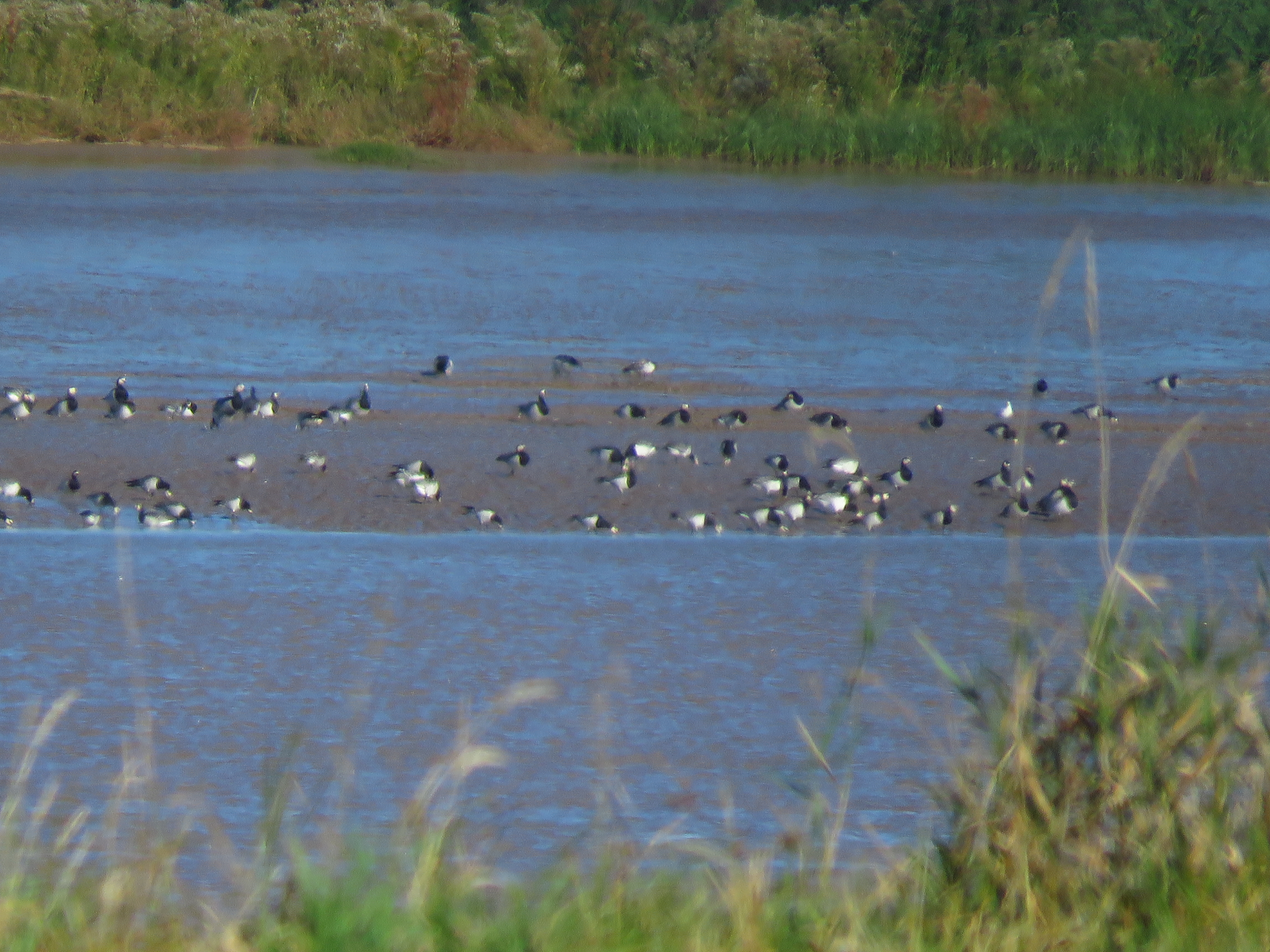
A large flock of Barnacle geese visible on the Humber mudflats.
Lovely to watch a flock of Curlew.
Pink-footed geese.
Stonechats.
The shallow pool where the Glossy Ibis and many egrets were feeding last time was much dryer. Many geese, including Pink-feet were resting on it.

As I walked towards the Trent, it felt quite warm. Dragonflies started being more obvious. A Ruddy Darter posed for a while. A Brown Hawker was patrolling on the low crossing, which was passable, if a bit muddy today. 

Ruddy Darter.
Bulrush Bug, Chilacis typhae
This was one of my highlights today, a Common Hawker, despite the odd angle, the yellow costa (the vein on the front of the wing) is visible.
Common Darters ovipositing.
This almost dry pool had several pairs of Common Darters ovipositing.
Sheep graze some of the wet grassland of the flats.
I returned to the hide for lunch. A pale wagtail landed in front. I thought it might be a White Wagtail, but no, a Pied Wagtail for me.

Pied Wagtail and Redshank.
Spotted Redshank.
Snipe.
Curlew, Redshank and Black-tailed Godwit.
In the next stage, I'm hoping to walk from Alkborough village to Whitton.

Monday, 2 August 2021

Alkborough Flats in August

 I made a morning trip to Alkborough with my son. He has superpowers that I don't. A few years ago I stopped hearing the sound of crickets and grasshoppers, while for him they are hard to ignore and that helps spotting them, especially crickets. There was also the lure of another attempt to see the Glossy Ibis that has been settled there since the middle of May.

We got to Alkborough about 9:30. On the walk to the first hide, Marsh Harriers and Bearded tits were in evidence. I was very pleased that the reeds have been cut in front of Prospect hide. A group of waders and ducks were assembled in front. Water rails 'peeped' and squealed. Two people in the hide informed us that several water rail chicks had been seen. A Spoonbill flew and landed to the right of the view, but it didn't stay long.

Avocets and Black-tailed Godwit.
Redshanks, Avocets and Black-tailed godwits.
A greenshank woke up and started preening.
Juvenile Bearded tit.
We took the circular walk that includes the Trent bank. Plenty of fresh Peacocks were feeding on teasels, with them skippers. I got some Small Skipper and possibly an Essex Skipper too.
Small Skipper.
Roesel's Bush Cricket. I would have never spotted this species without my son coming along as he zoomed on it following its song.
Female Great Diving beetle. It waddled on the path, it was lucky that I didn't step on it!
Eristalinus sp. very noisy and numerous in a damp patch by the path.
As we joined the Humber bank, we spotted the Glossy Ibis on the pool, feeding with about 40 Little egrets and Black-headed gulls. The views weren't great, with the sun behind it, but it wasn't too far and we were content with having seen the ibis.
Glossy Ibis feeding.
Rudy Darter. Many Ruddy, Common Darter, a Brown hawker, an emperor and Black-tailed skimmer and a blue-tailed damselfly comprised the Odonata list.
Conehead cricket sp.
Essex Skipper.
View of the River Trent.
Greylags, mallards and a few Black-headed gulls rested on an island.
Flowering rush.
View of the pool with the flowering rush.