Showing posts with label parks. Show all posts

Wednesday, 12 November 2025

Urban birds at Hull. 57. Goldcrest

The Goldcrest is the smallest bird in the UK. They are most often heard (if your hearing is good!) than seen, their calls and song are very high pitched, the latter sounding like a tiny violin, up and down for a while with a final flourish. It favours dense-canopy trees such as conifers and ivy-clad trees, where they feed on tiny insects and spiders, but in the winter it can be found more widely, often joining mixed flocks of tits, always active. Goldcrests have a greenish-grey back, warmer head and paler underneath, with white wing bars and black wing patch. The eyes are big and dark and the bill thin. Its most distinctive feature is its crest, a bright stripe lined with black, yellow in females and with a central orange stripe in males, often flat and thin, but open and erected when the bird is excited. Goldcrests have a very compact shape, without a discernible neck, and a short tail, but their legs are relatively long.

Goldcrest in hedgerow. The Avenues. 13 November 2021.
A singing Goldcrest. Pearson Park, 17 April 2016.
Fledgling Goldcrest at Pickering Park. Sculcoates, 4 June 2022. Note the lack of 'crest'.
Another fledgling at Pickering Park,12  June 2022.

Status and Distribution in Hull

Goldcrests are widely distributed in Hull, although they are never common. They can be seen year round, but in the autumn and winter, when numbers swell with migrants they are more obvious and widespread. It is amazing to think that they fly across the North Sea away from the cold continental winters. Mature yew trees in cemeteries are a favoured breeding spot, but they can also be found in garden and park conifers. Locations where breeding has been proven include Pickering Park rock garden, East Park Khyber Pass, Pearson Park and the cemeteries. It may seem surprising that they used to be quite rare in Hull, as described by Richard Broughton in his 'Birds of the Hull Area'.

Goldcrest being ringed at Spurn Bird Observatory, 31 October 2019.

Conservation and Management

The Goldcres is a Green Listed species. Although Goldcrest numbers drop after harsh winters, the population size has remained stable since the 90s. The species might benefit from climate warming and milder winters. The species is more abundant in urban environments than in other natural habitats (except woodland, especially conifer woodland). Fashion for gardening with conifers benefits the species in urban environments as do mature wood in churchyards and cemeteries. 

More information

BTO Bird Facts. Goldcrest.

Broughton, R.K. 2002. Birds of the Hull area.


Sunday, 19 March 2023

Sunday morning walk to Oak Road Lake


Unexpectedly mild and sunny morning, I head to Oak Road Lake via Pearson Park. I'm hoping to catch up with breeding toads and the weather bode well, although it wasn't to be, maybe the recent cold spell has slowed things down.

The Jackdaws in the Lakeview House by the park are nest building, I manage a photo against the strong sun.

The female Greylag was standing next to her nest, now holding an egg. A different pair of Greylags was mating, and I wonder if we'll have two breeding pairs this year.
The Moorhen abandoned its wicker basket nest for a short while. Two eggs were visible inside.
As I got to Oak Road Lake, a Chiffchaff was singing enthusiastically, although I only managed a record short. This was the second Chiffchaff singing of the year, as I had my first one at Sculcoates yesterday.
Two Herons flew over the lake, but they didn't land.
Another songster was this Reed Bunting by the lake.
The cob Mute Swan had a preening session on the shore. His partner was on the lake. I saw no signs of nesting.
Cob Mute Swan.
A flotilla of Tudted Ducks.
A Magpie by Pearson park pond showing its metallic colours.
My first frog of the year, just at Pearson Park Pond.
I think this Moorhen is also nesting. It kept looking up, to the Sparrowhawk displaying overhead.
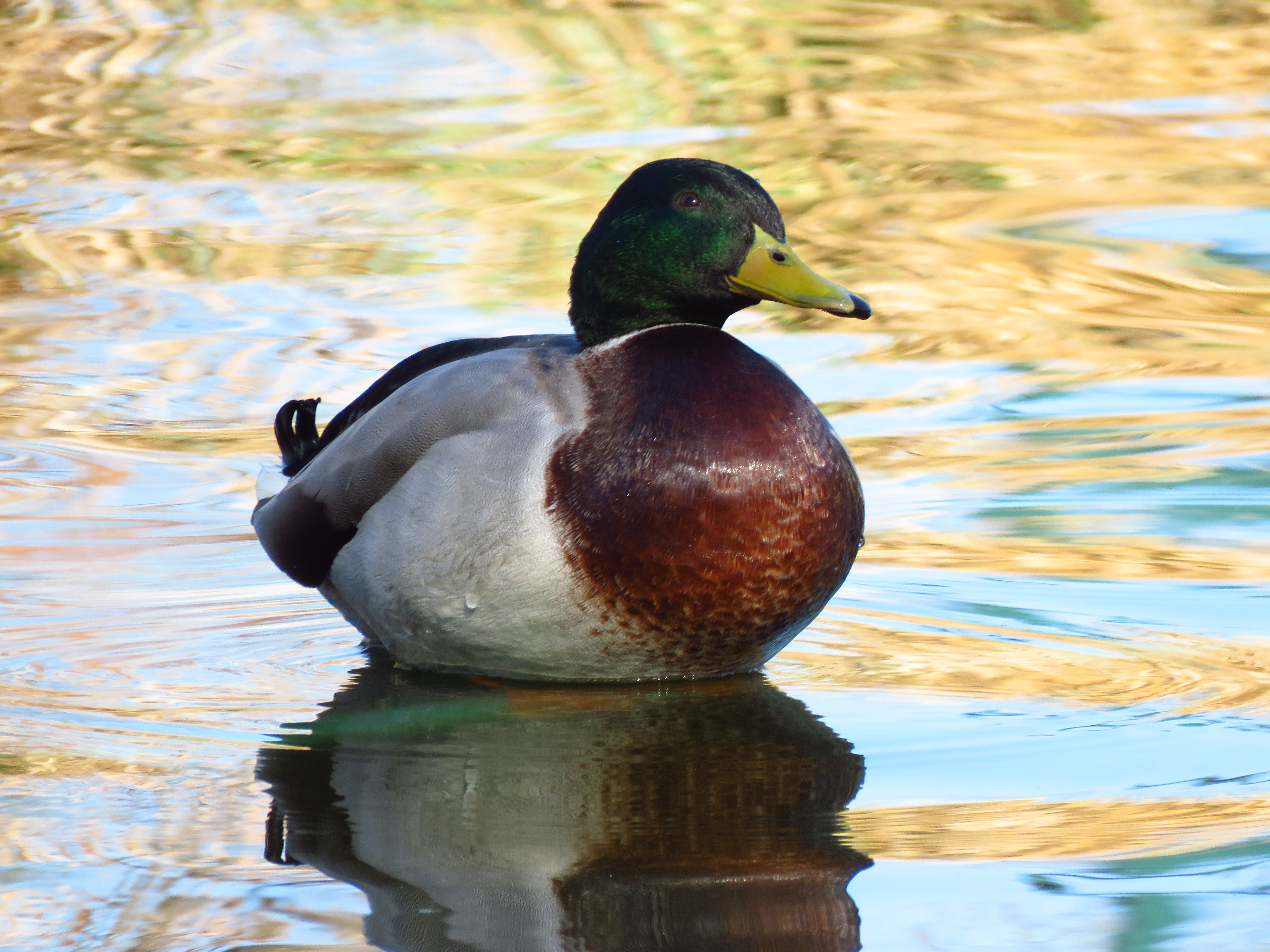
Mallard looking up.

Friday, 23 December 2022

December walk to East Park

The last walk to East Park for the year, the forecast announced drizzle and rain later in the morning, so I got up in the dark to make the most of it, but, fortunately, there was no rain in the end, although it was overcast all morning. There were 7 Mute Swans on the lake, three pairs, one of them with a juvenile, with one cob doing a lot of busking (top shot).

There were a minimum of 16 Goosanders, although a local said earlier someone had counted 60 (!), many Tufted Ducks, three Shovelers and two drake Pochards sleeping under the willows of the central island. I was lucky to spot a Little Grebe in between the willows. The tame Gadwall has stayed and was being fed with ducks and gulls.

A very nice surprise was a Treecreeper travelling with a mixed tit flock. Later on,

One of at least 5 Goldcrests near the cafe. It was chasing another individual, with crest all erect, with the other individual keeping it flat.

Two Mistle Thrushes were on the rowan bushes at the east end of the park, with Blackbirds and at least a single Redwing. This one was very watchful and flew to a high tree rattling. A Sparrowhawk passed over shortly after.

Redwing
The tide was almost low when I returned via Wilmington Bridge and 7 Dunlin were feeding in two groups with one Redshank.

Dunlin.
A total of 41 species for the visit, matching the highest number in a visit this year.

Tuesday, 5 October 2021

East Park in October

 I took a walk around East Park, taking advantage of a morning of sunny spells and mild weather in between rain showers. Despite the sun, it was too cold for active dragonflies to start with. But I checked the branches of willows and alders for oviposition scars of the Willow Emerald. I was only successful on al alder near where I saw a male las month.

Oviposition scars of Willow Emerald on Alder. 

They were found in the alder in the centre of the photo.

Four young swans flew together. They are the surviving offspring of two pairs that bred in the park this year, although only three adults were present.

The pale Red-crested Pochard was also present.

While Woodpigeons fed on Whitebeam berries on the tree, two Greylags ate the fallen ones underneath.

The main lake from the bridge.
I moved to the boardwalk. A single Common Darter and several Migrant Hawkers were present. The three juvenile Mute Swans had joined their mother and started upending near the boardwalk. I noticed that the swans can upend while keeping one of their feet tucked under their plumage.
The lake from the boardwalk.

Female Mute Swan with her three young.

The female upending using only its right leg for balance, the other leg is tucked under the plumage.

I spot a Gadwall at the other side of the lake, but I can't refind it. I only have 6 records of Gadwall at East Park, concentrated between August and December.
There are some Jackdaws about, hanging around a tree. I remember that I often see Jackdaws in this particular area and I see one of them leaving the tree with what it looks like nest material, so I pay more attention and see a Jackdaw entering a hole in the tree. It takes a little while, but it ends up peeking out, allowing me to take its photo.
As I watch the family of swans moves under some willow, I notice a small bird flying onto a willow branch, it's a Kingfisher! It sits on the brach for a while and makes some sort of display, but I can't see another individual. It moves around and even makes a fishing attempt, calling every time it changes perch.
Kingfisher display?


Friday, 10 September 2021

Willow Emerald's lunchtime hunt at East Park

 The forecast was for a warm sunny interval at lunchtime, and I decided to go to East Park for my lunch break, in the hope to find Willow Emeralds. I parked near the western end and started by walking around the boating lake. I could find two male Small Red-eyed Damselflies perched on the floating vegetation.

At the main lake, Migrant Hawker were in evidence at regular intervals. An adult Great Crested grebe had got a large fish, and it was lucky there weren't any gulls about, as they would have set out to steal it. The grebe manipulated the fish, shaking it under the water, and finally placing it in position to swallow. I took a video as I wasn't sure it it would be able to. 

Great Crested grebe adult.


Juvenile GCG.

Adult GCG with large fish. To find out what happens you might want to watch this clip.

A large terrapin, likely a female, basked on a dead tree branch. A smaller one was on the water nearby.


A Heron was sat on its usual spot on the central island.
A Woodpigeon courtship was going on, the male on the background. The female seemed interested in drinking some water.

I was pleasantly surprised by three Wigeon on the eastern side of the lake in between the two islands. They were upending and feeding on the plentiful underwater plants in this area.
Two terrapins were nearby, basking on the water.
The hybrid goose family had a single young. The female has a strange, coarse call.
A thirsty crow comes to the water to drink.
As usual, plenty of dragonflies and damselflies on the lake. I scan the islands, which have plenty of tree branches overhanging the water. These are the favoured ovipositing sites of the Willow Emeralds. It's warm enough that there should be some activity. But I see none.
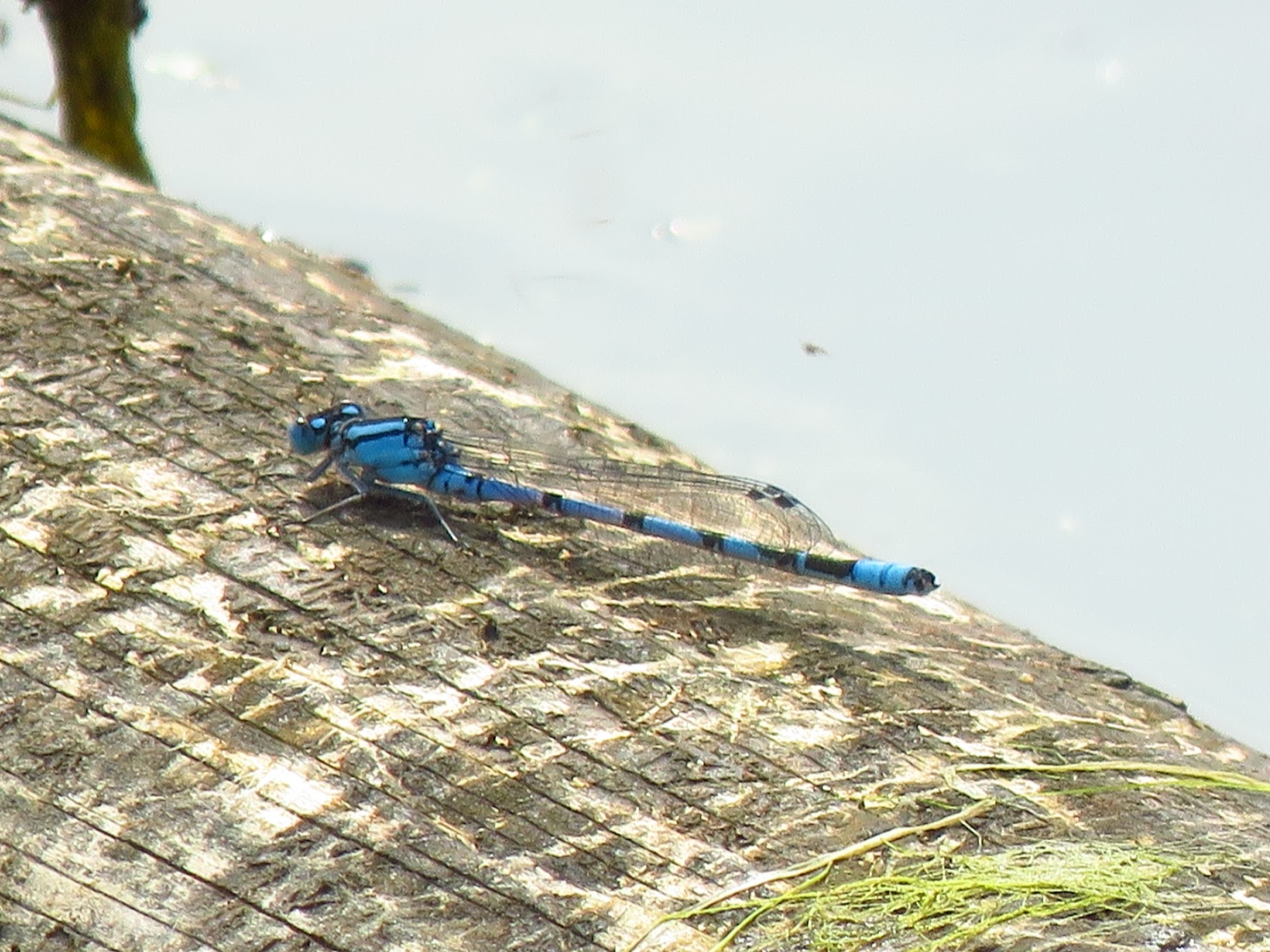
There are still some Common Blue Damselflies about and a single Blue-tail by the boardwalk.

A Brown Hawker is ovipositing on the wooden posts by the shore. There is a family of coots in the area and at some point the hawker almost makes a young coot meal.


This young coot was very interested in the brown hawker.
The area around the boardwalk had several Migrant Hawkers males, with squabbles for position, but I saw no females. A Southern Hawker patrolled the boardwalk, getting very close to me.
Several Common Darters, including a pair ovipositing, were about.
I walk back, returning by the south shore of the lake. As I walk by an elder opposite the central island, the profile of a Willow Emerald becomes visible. As I prepare my camera, a Common Darter chases it and both fly away. I hang about and wait a few minutes. The darter returns to its perch. Then the Willow Emerald, a male, returns too! Very excited to find the species back in East Park, which was first found in Hull two years ago almost to the day, but not seen last year. 

The Alder on the right was where the Willow Emerald was perched.

I take lots of photos of the male, which is nicely settled, and then carry on. And there are more! On the westernmost island, a pair of damselflies in tandem calls my attention. They are Willow Emeralds! They start ovipositing on a willow stem and I scramble for my camera.

The willow on the centre of the photo is the ovipositing site.

Despite trying for a while, I'm unable to find them in the viewfinder or even find them with the binoculars. I take a shot of the general area where I saw them.

Funnily enough, they are there, glistening in the middle of the image, ovipositing! Not the best photo ever, but a record shot of breeding evidence.