Showing posts with label wet woodland. Show all posts

Saturday, 26 August 2023

Hayburn Wyke and Ravenscar

I was very keen to return to Hayburn Wyke after last years visit with Hull Nats, so I got a lift to join a trip by the Fern Group today. The weather forecast was changeable for the weekend, with rain and thunderstorms predicted for the afternoon. We were lucky the weather held on and we enjoyed a pleasant temperature, barely any wind and plenty of sunshine. It was lucky, as my main aim for the day was to record Dark Bush crickets and I had taken the bat detector to check for calling males.

Kite-tailed Robber-fly on the car park.

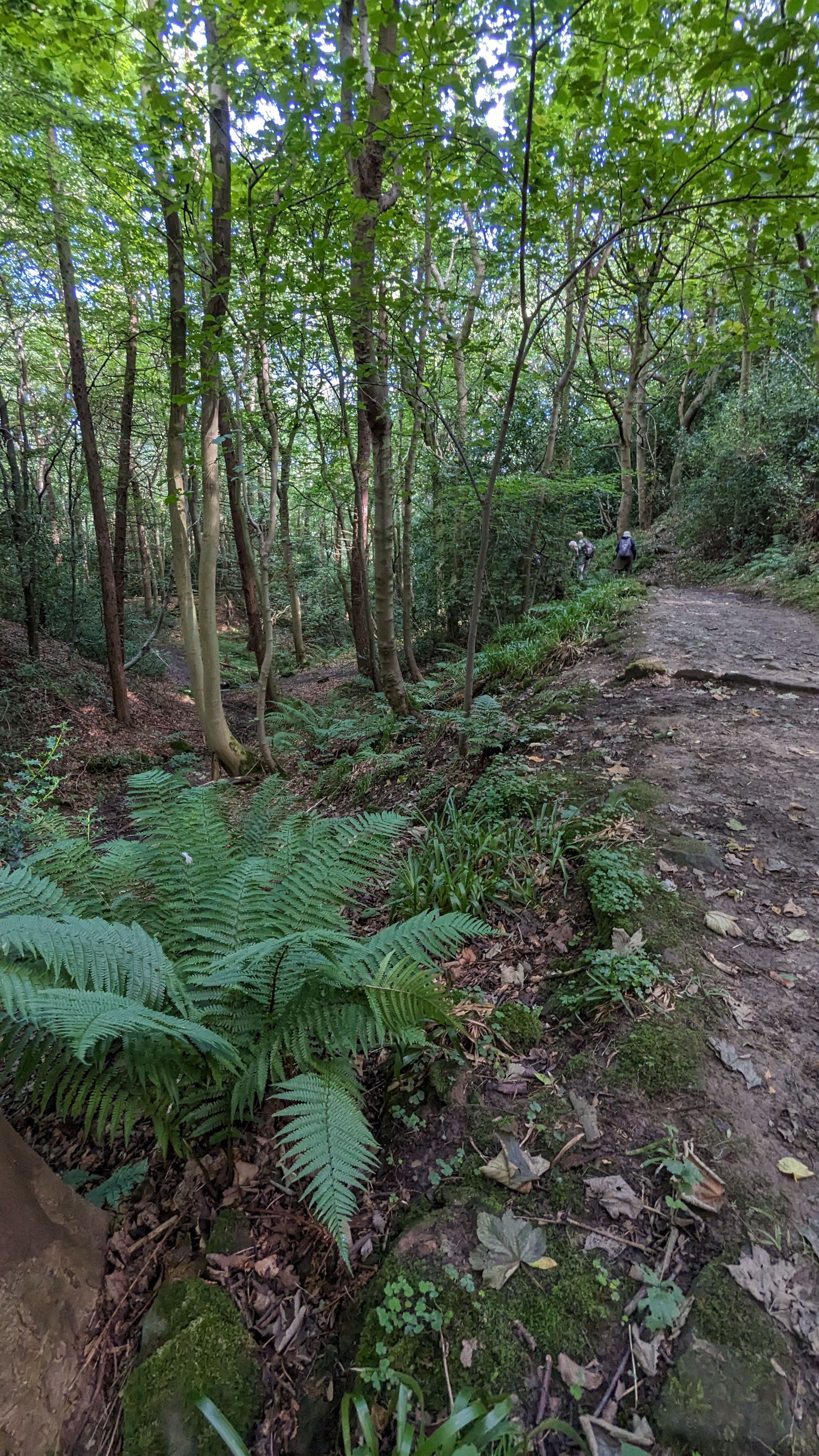
First, we took the path down the ravine. The ferns look magnificent, much larger than the sizes we are used to. Soft Shield Ferns are plentiful, as are Hard Fern. We saw some Lady Ferns too. We didn't come all the way down to the beach, just to the view point near the wooden bridge at the end of the trail. We were supposed to be following a trail along the beck, but somehow we lost it and it was like being in a ferny and boggy jungle. Anyhow, it was a great adventure going 'off piste' within the wood. Hayburn Wyke wood feels like a temperate rainforest. 

Lady Fern.
Soft shield fern.
The path to the beach.
The first viewpoint to the little cove.
A racing pigeon had decided to spend the day at the beach, enjoying the sunshine.
Devil's-bit Scabious with Common Carder Bee.
Spot the Slow Worm.
View of the head.
Slow Worm.

Sericomya silentis, the Bog Hoverfly, a lovely, large hoverfly typical of moorland and woodland clearings.

Female Dark bush-cricket. Three were basking near each other at the base of a south-facing hedge, where males were also calling. On a different field after lunch, also from a hedge, I picked two male calling. It appears the Hayburn Wyke population is doing quite well.

The beck.
Our lunch spot.
Leopard slug.
Ferdinandea cuprea. An uncommon woodland hoverfly. 

After the adventure in the woods, we decided to pop to Ravenscar to enjoy the view and have an icecream. I switched on the bat detector, hoping for Dark bush crickets, but, surprisingly, I picked a Long-winged Conehead calling, which I couldn't locate, in the field just by the car park (below). After a walk to the fantastic viewpoint towards Robin-hood's Bay down the hill (top shot), we returned to the car, but Roland immediately spotted the calling conehead when I pointed the area where it was calling! I check at home and this is the second most northerly record of Long-winged Conehead, and only the second from VC-62.

Conehead field.
Long-winged Conehead.

Common Green Grasshopper.

Monday, 11 October 2021

North Cliffe Wood October sunshine

A visit to North Cliffe Wood in the warm sunshine. It was still and balmy on the south facing areas of the wood by the heath, so I mostly kept there. It was very quiet on the bird front, with little of note, but the insects more than compensated for it.

Dragonflies

I wasn't surprised by the abundant Common Darters, but I wasn't expecting a list of 5 Odonata on the wing. A very tattered male Southern Hawker was near the entrance of the heath, hunting, although it briefly landed on an oak.

Later, another male was actively searching for females on the pond, checking the shore, including the shaded areas. 

A bit later, I found a male Migrant Hawker basking on a post. 

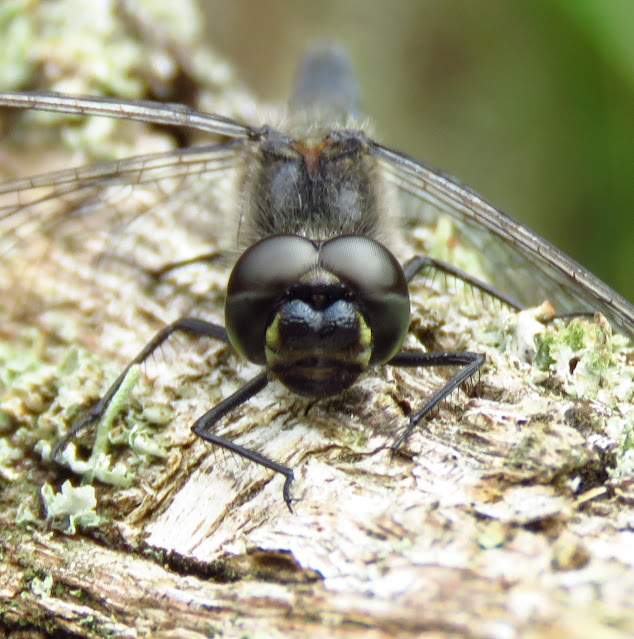
There were a minimum of 4 male Black Darters (top shot and below), which I had never seen in this site. I end up having lunch by one of them. It keeps returning to the same log, which it shares with a common darter, and readjusting position each time it lands to catch the sun.

Male Black Darter.
Black Darter and Common Darter basking.

Black Darter.
When I visit the heathland pond, there are two Black Darters on attendance, which squabble occasionally. Unfortunately I see no females.

There are literally hundreds of Common Darters, individuals are basking on the path, on logs, on the trees, they are everywhere! I see 3 mating pairs and one ovipositing pair on the heathland pond.

Common Darters in copula.
A brightly coloured Common Darter.

I walk back and forth checking the posts, as it offers the maximum exposure for the the insects to the low sun. In the distance, I see a large damselfly, is it possible!? amazingly, it is a stunning female Willow Emerald! Possibly the first for the site and my first out of Hull in East Yorkshire. What are the chances? how many Willow Emeralds are flying over the county? It has a beautiful bronze sheen, particularly on the abdomen, presumably a fully mature female.


Close up of the Willow Emerald.

Beetles

Of note two carrion beetles, a stunning Nicrophorus vespilloides, which flies onto the path. It is very warm and doesn't like to be exposed, and it tries to hide on the grass very quickly, so I need to pot it briefly to take its photo.

I wish I had potted the Black Snail Beetle, Silpha atrata, which runs fast across the path. It is a common beetle in the reserve, which I find puzzling as snails are hard to come by there.

Butterflies

Just two species of butterfly on the wing.
A Comma basking on post.
And one of two Small Coppers on the ground.
A gallery of other interesting insects and other miscellany follows.

Noon Fly, Mesembrina meridiana
Puffball fungus. Not many fungi on the reserve other than the plentiful puffballs, despite the recent rains.
Wolf spider for ID.
Chorthippus parallelus.
Chorthippus brunneus
Field Digger Wasp, Mellinus arvensis.
Robber fly, Machimus atricapillus
And to finish up, as I count the darters in a stretch of fence, I notice a movement by a log, it is a young lizard, also the first one I see in the reserve.
 

Monday, 14 December 2020

Urban birding at Hull: Noddle Hill LNR

It has been raining a lot the last few days, and we've had our fill of dark days, but today it promised to be a sunny, mild day, with southerly wind. I headed towards Noddle Hill, and I decided to walk along Foredyke Stream first.

I must have flushed a Little Egret, not a common sight inside the limits of the city. A flock of Lapwing and gulls are on the flooded fields at the other side of the drain. They were hard to count as there was a hedgerow and trees obscuring them. A few minutes later a Sparrowhawk managed to flush the flock and a photo of the Lapwing in flight revealed 164 individuals. Then, noisy skeins of Greylag started arriving from the North. The banks of the drain were very muddy which made for slow progress, but I got to the pumping station. A Buzzard was sitting on a fence and a female Kestrel hunted nearby. 

Female Kestrel
I search for Stonechats on the field south of the pumping station unsuccessfully, but hearing a calling Water Rail makes up for it. The female Kestrel sits on a hedgerow, the low winter sun silhouetting her. I take the perimeter path. Crows and a couple of Jackdaws raise, but surprisingly no Rooks.

A poor record shot of the Little Egret.
Flooded fields.
Lapwing, gulls and pheasants.

Lapwing flock.
Lapwing flock.
Greylag.

I arrive at the fishing lake, there is a large gathering of Greylag, and at least 50 Mallard. A young Grey Heron is sitting on a branch at the other side of the lake. I approach slowly and it appears oblivious to me. A Little Grebe is also about, which is a site tick. As I leave, a male Kestrel is hunting along the drain. A total of 39 species and some special encounters for a mid December day!

Grey Heron.


Flooded woodland.
A view of the lake.
The drain to the east of the reserve, running fast today.
Little Grebe.
Grey Heron.
Male Kestrel hunting over the drain in beautiful light.