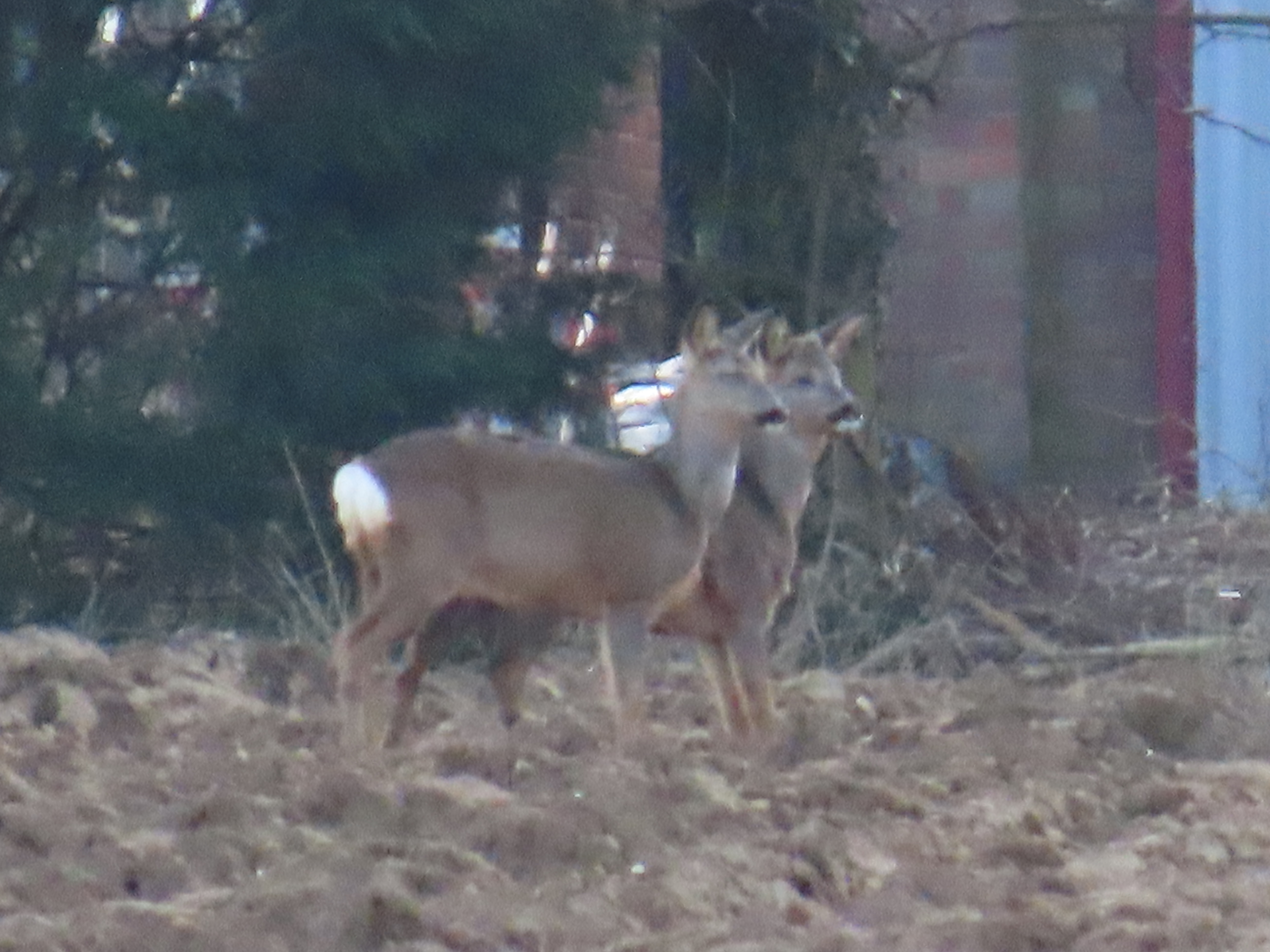
It is a very cold overcast day, but I take the bus to the start point of the second stage of the Last Interglacial Trail at Northgate, Cottingham. The first part of the walk follows Park Lane across Cottingham Parks. It is hard to discern any trace of a cliff on the ground, but the fact that ditches run steeply to the east indicates I'm walking near the bottom of the cliff, not on the chalky old cliff, which is too permeable for running water. Here the old sea cliff lays buried by till and other glacial deposits.

A ditch near Cottingham Parks.
After walking on the surfaced road by a series of greenhouses I get to Burn Park Cottages and then Burn Park Farm, with its gnarled walnut trees. A very confiding Kestrel greets me on the ground and then on the farm sign (above). Chaffinches sing from the hedges.
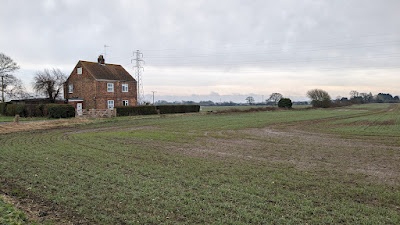
Burn Park Cottages.

Flooded field at Burn Park farm.
I find the first Dog's Mercury of the year growing by a ditch on the eastern side of Jillywoods, together with the abundant Cuckoo's Pint, remnant plants of the northern woods of Cottingham.

A chalky path by Poplar Farm.

At Poplar Farm, seven Pied Wagtails feed on a flooded field. The paths have been very passable, only one section by a flood more muddy.
A road bridge crosses the A1079. Skylarks sing. The area is known as Beverley Parks, as there was parkland and a hall, White Hall.

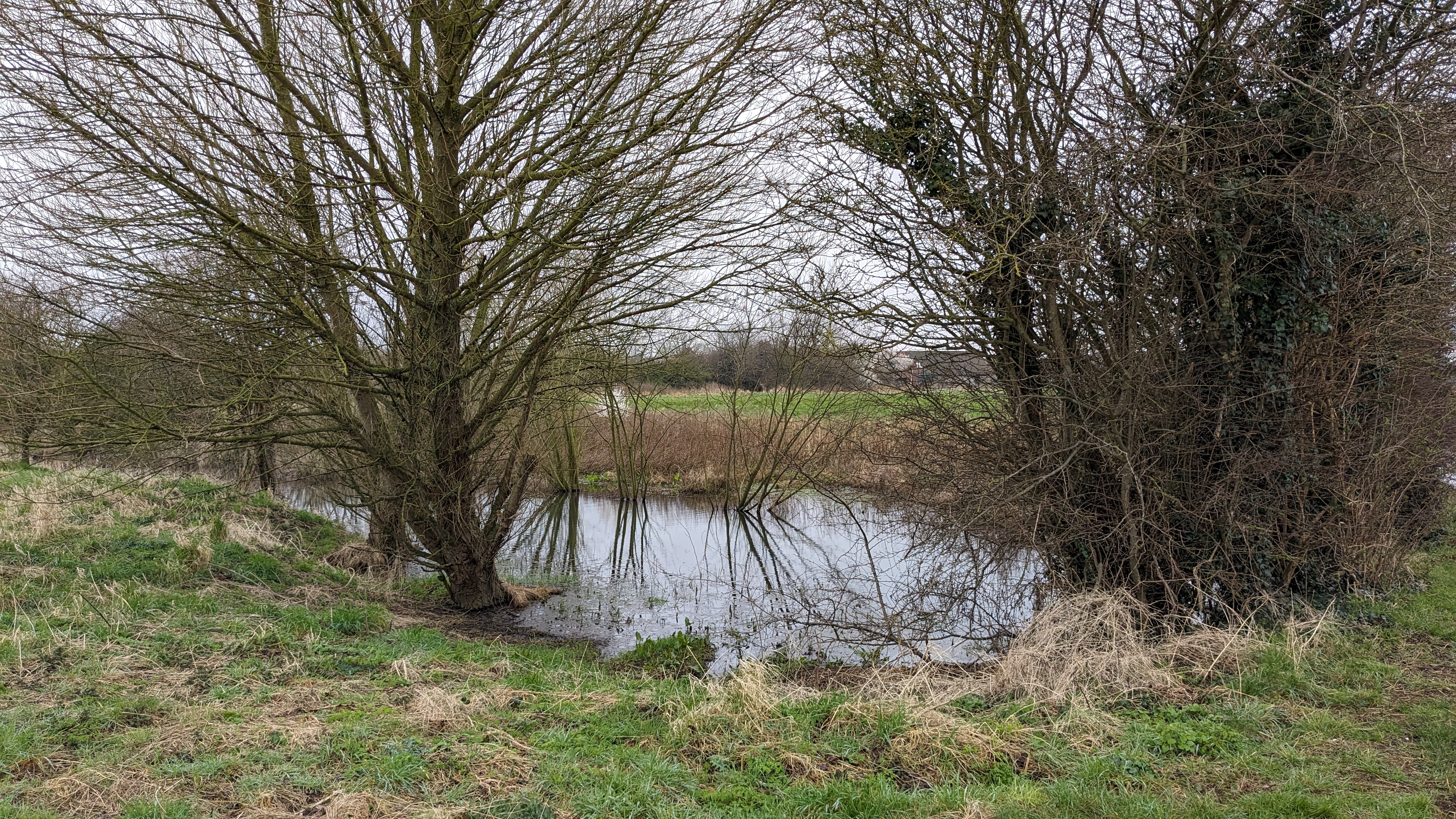
Pond at Beverley Parks. There are scattered ponds in this area that are actually springs. I wonder if these springs would have been under the sea of the Ipswichian or exposed on the shoreline.

A lone oak on the last fields before Beverley by Sheperd's Lane. This is a very rapidly developing area, the new houses in the background.

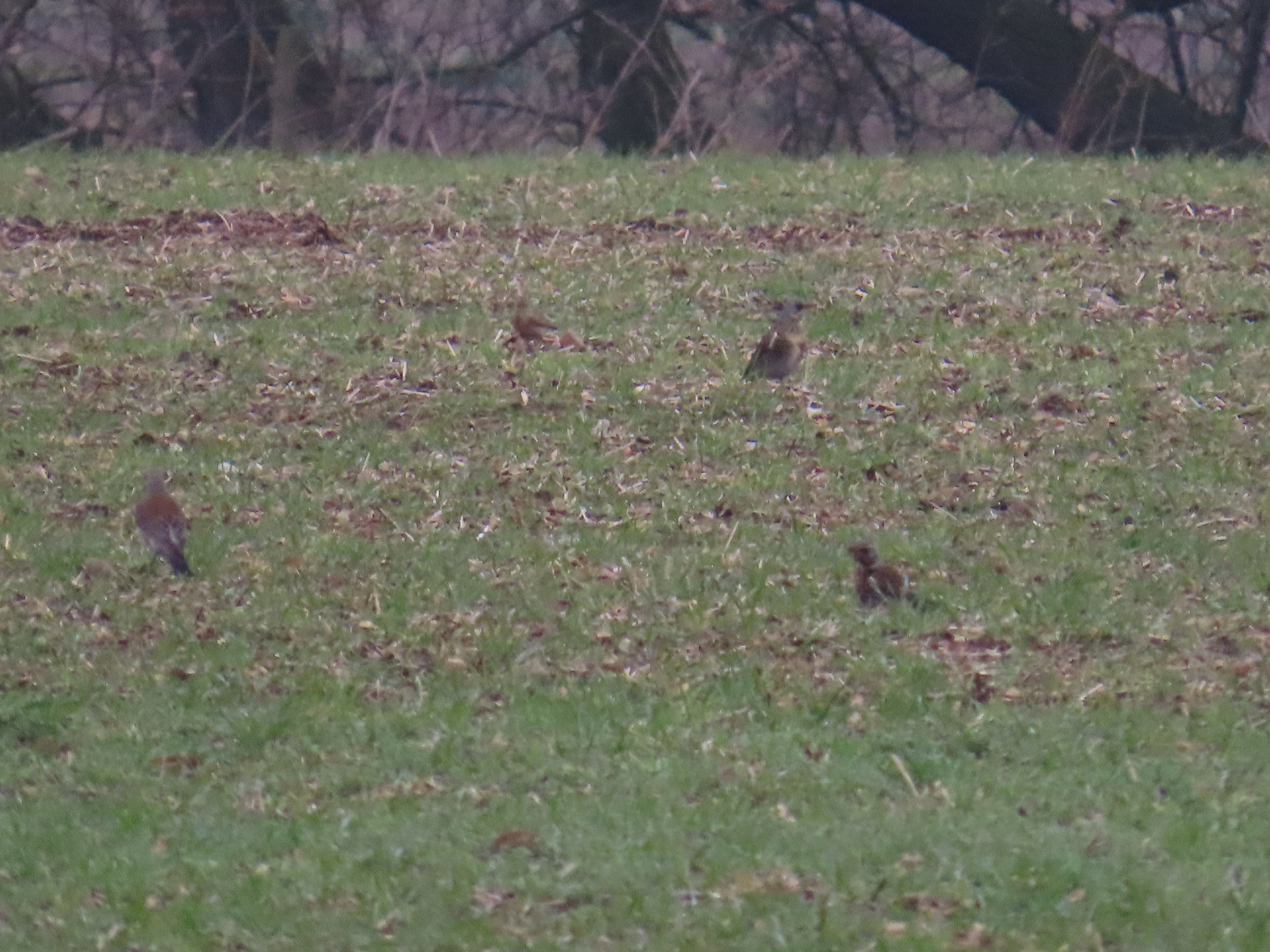
A large flock of Fieldfares

Rooks on roundabout on the edge of Beverley.

Willow Lane.
As I arrive to the end of the walk at Beverley Minster, the bells ring midday (a few minutes early, all to be said!), and I make my way to a cafe for lunch before taking the bus back home.
In contrast to today's quiet and relaxing walk, an amble in this area in Ipswichian times must have been terrifying, not least by the presence of Cave Lions and the other large carnivore of the time: Cave Hyenas.
No laughing stock: Cave Hyenas
Hyenas are an abundant and widespread component of the Ipswichian fauna. One of the key sites for British fossil hyenas is a Yorkshire site with outstanding archaeological and historical significance: Kirkdale Cave, near Kirkbymoorside. The cave was excavated in 1821 by Reverend William Buckland, having been alerted to the presence of fossils in the cave. An eccentric character, the first ever lecturer in Geology, and theologian from Oxford University, he approached the excavation and interpretation with sharp logic and innovative experimental approaches for the time. In a fascinating article on the cave, a brilliant example of paleontological analysis, he made a very good case that hyenas used the cave as a den, and the fragmented bones of a range of animals, including hippo, rhino, deer and elephant, amongst others, represented the remains of prey, having been gnawed by the powerful jaws of the hyenas. Buckland even made some experiments with a captive Spotted Hyena from a travelling zoo to test some of his interpretations regarding the fossilised faeces he found (he went on to coin the term ‘coprolites’ to refer to them). After feeding bones to the captive Hyena and examining its faeces he could conclusively determine that the coprolites belonged indeed to Hyenas. Hyenas had dragged hippo remains into their caves or the remains were found as part of their faeces.
From Buckland:
‘It must already appear probable, from the facts above described, particularly from the comminuted state and apparently gnawed condition of the bones, that the cave at Kirkdale was, during a long succession of years, inhabited as a den by hyenas, and that they dragged into its recesses the other animal bodies whose remains are found mixed indiscriminately with their own; and this conjecture is rendered almost certain by the discovery I made, of many small balls of the solid calcareous excrement of an animal that had fed on bone’
‘I do not know what more conclusive evidence than this can be added to the facts already enumerated, to show that the hyaenas inhabited this cave, and were the agents by which the teeth and bones of the other animals were there collected’

A Cave Hyena partial jaw from Kirkdale Cave at Yorkshire Museum, York. Yorkshire Museum Collection. Licence: CC BY-SA 4.0.
Another Yorkshire cave with Ipswichian deposits, and likely another hyena den at that time is Victoria Cave, near Settle. A similar fauna with Hyena, Hippo and Straight-tusked Elephants, and crucially, no evidence of humans. The time period where the deposits formed at Victoria Cave was dated by Uranium series to 120,000 years ago, similarly at Kirkdale Cave was dated as 121,000 ± 4000 yr BP, confirming their Ipswichian age. Modern hyenas den in burrows of other animals, that they enlarge, so the fact that they used these caves preserved a treasure trove of fossils of the fauna of the time. More exposed sites on plains and river terraces were subsequently erased by the last ice age.
Hyenas are a highly intelligent, social species with females being dominant to males. They live in clans of related females and unrelated males, and hunt cooperatively. Recent studies on Spotted Hyena indicate that they are more likely to hunt than to scavenge and they frequently lose prey to lions, although they also steal prey sometimes from lions too. Cooperative hunting allows them to be able to tackle large prey. Hyenas can commute long distances between their dens and feeding grounds, round trips of 80 km have been documented. So a trip of the Kirkdale clan to the Wolds wouldn't be out of the question.

One of the Spotted Hyenas at Yorkshire Wildlife Park by its den.
Where can I see them?
Cave Hyenas (Crocuta crocuta spelaea) were a subspecies of the Spotted Hyena, which became extinct in Europe c. 29.000 BP. Spotted Hyenas are currently distributed in Sub Saharan Africa. A presumed Spotted Hyena cave painting at Chauvet Cave has been deemed to be a skinny cave bear, although its legs look very hyena-like to me. A clan of Spotted Hyenas can be seen at Yorkshire Wildlife Park. Cave Hyena fossils from Kirkdale can be seen at the Rotunda Museum in Scarborough and the Yorkshire Museum at York.
Walk details. Distance: 8.3 km. Terrain: most of it flat, some on unsurfaced paths that can be muddy, the rest on tarmac. Maximum height 15 m, minimum 8 m. Start at Northgate, Cottingham, near Park Lane, end at Beverley Minster. A mix of town and rural landscapes, with arable and hedgerows and small wooded pockets and some ditches and drains.
My ink drawing of a Spotted Hyena.
More information
Buckland, W. Account of an Assemblage of Fossil Teeth and Bones of Elephant, Rhinoceros, Hippopotamus, Bear, Tiger, and Hyaena, and Sixteen Other Animals; Discovered in a Cave at Kirkdale, Yorkshire, in the Year 1821: With a Comparative View of Five Similar Caverns in Various Parts of England, and Others on the Continent. Philosophical Transactions of the Royal Society of London 112, 171–236 (1822).
Barnett, R. The Missing Lynx: The Past and Future of Britain’s Lost Mammals. (Bloomsbury Publishing, 2019). 352 pp.
Kruuk, H. The Spotted Hyena: A study of predation and social behaviour. (Echo Point Books & Media, LLC, 2014).
Boylan, P. J. A new revision of the Pleistocene mammalian fauna of Kirkdale Cave, Yorkshire. Proceedings- Yorkshire Geological Society 43, 253–280 (1981).
The discovery of the kirkdale cave. Natstand.