Sunday, 3 September 2017

River Hull. Stage 13. Brigham and North Frodingham Beck

A warm day with light cloud and a soft breeze, I get up early to take on the next stage of the river Hull. River bank between the metal footbridge at Emmotland and Corpslanding bridge is not a public right of way, although the river itself is accessible by boat. I had tried to hire a boat from North Frodingham, but in the end it wasn't to be. Plan b was to walk along the footpath by the main tributary of the Hull, Frodingham Beck and the stretch of Driffield canal from Brigham. I added also a walk from Brigham to Corpslanding, which allowed me at least to look at the river from the bridge.
 I start on the swing bridge over Driffield canal at Brigham. Driffield canal is navigable, but I only see a couple of canoes all day. There are also a few sailing boats moored on the canal. The area being flat and exposed despite being inland makes it possible to sail. Other than following a straight course the canal looks very wild, with plenty of marginal vegetation, including Reed sweet-grass, Marsh woundwort and some Himalayan balsam.
Driffield Canal.
Carder bee feeding on Marsh Woundwort
Driffield canal with Brigham in the background, perched atop a mighty of 20 m of altitude.
I was expecting a wet walk on long grass, but the farmer had some cows feeding on the bank, so it ended up being easier until Emmotland.
An ichneumon wasp, Pimpla sp.
The area is prone to flooding, and is crisscrossed by wide ditches. The cows are on the background on bank of the river Hull.
Wheatear.
I look longingly at the grazing cows, who can walk on the Hull riverbank where I'm not allowed.
Emmotland farm on the left, and the metal bridge on the junction between Frodingham Beck and the river Hull.
Water Forget-me-not.
On the way upstream the sun shone in brief sunny spells and several butterflies, especially Red Admirals, came out to feed on a patch of creeping thistles. I flushed a pair of Snipe from a wet patch on a field.
Small Tortoiseshell.
This is the point where Frodingham beck joins Driffield canal.
Frodingham Beck with North Frodingham in the distance.
There are a couple of ponds in the fields, one of them is surrounded by trees and this Grey Heron sat on one.
Steps on the gate welcoming the walker.
Common Darter.
I get back to Brigham and take on the next stage of today's trip, Corpslanding bridge. A Mistle Thrush rattles flying away onto a tree. Flocks of loafing gulls, including many Great Black-backed gulls rest on the ploughed fields. The walk is over a small rise in the land. In the distance, I see a ribbon of trees flanking the river, the closest to a gallery forest I've seen by the river.
A bridleway cuts across a wheat field towards the river.
As I get close to the river, I walk by a flowing, clear water stream that runs parallel to it. I flush the fleeting turquoise arrow of a Kingfisher, and a little later, two Wood Sandpipers, which fly away alarm calling.
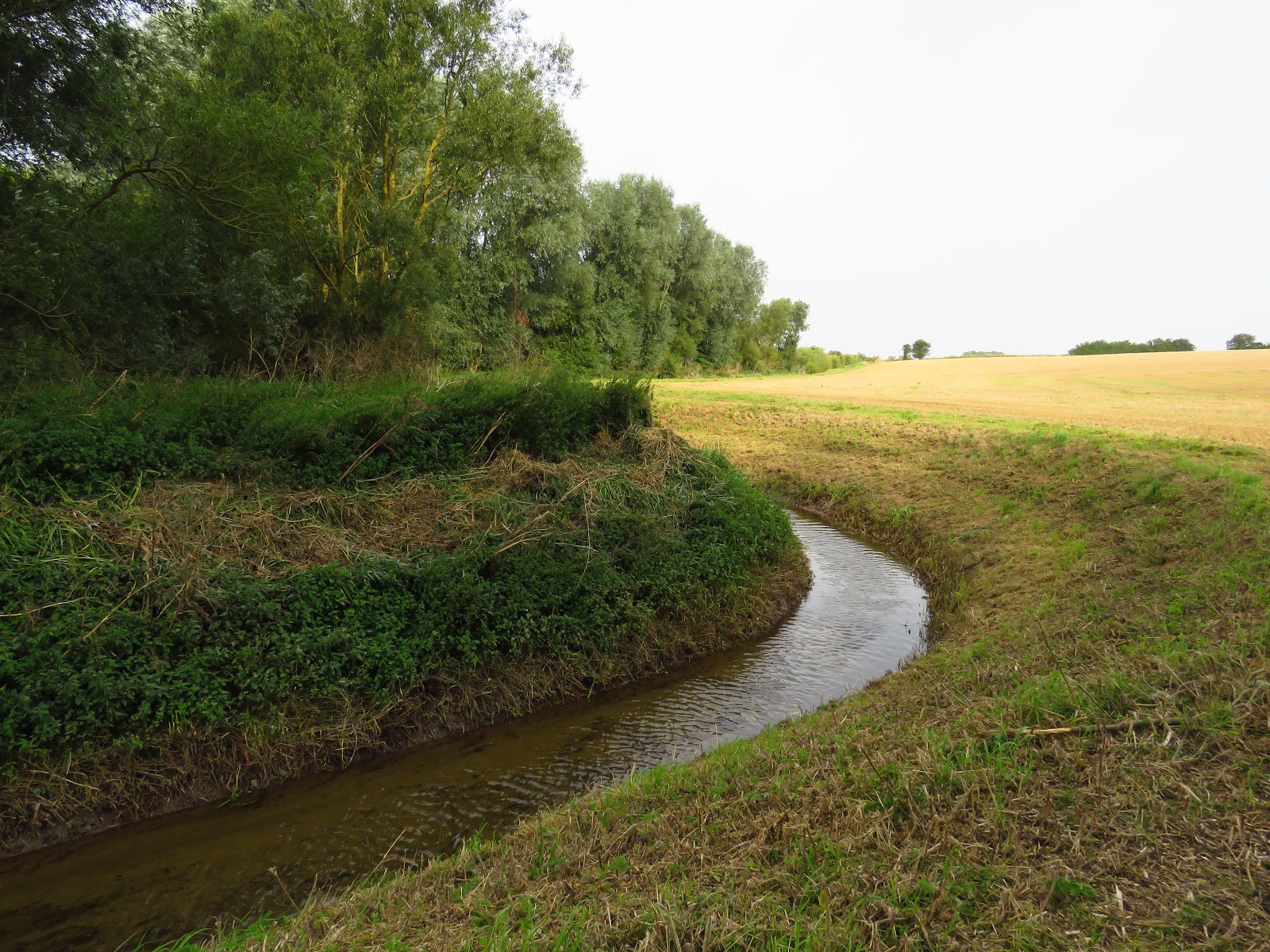
Flowing stream by the river Hull.
A lone Swift feeds over the white poplars and willows
Corpslanding bridge, made of railway sleepers.
This is the view of the river upstream from the bridge.

Thursday, 17 August 2017

Bridlington Harbour

A trip to Bridlington with the kids today, a hot summer day with long sunny spells and barely any breeze. We had a plan to join the 2.5 h Yorkshire Belle trip to Bempton, but finally gave up on it and had a wander in town, around the harbour and on south beach. It was high tide.
Kittiwakes are expanding their breeding locations around town. These regularly spaced nests with young on some of them were on the corner of a slate roof. 
Turnstones wait for low tide on the harbour wall.
Kittiwakes on the outer harbour wall. 
Another urban kittiwake location. 
Starling singing on aerial. 
The resident barnacle goose. 

Long-calling Great black-backed gull. 
More roosting Turnstones. 
Common Gull juvenile on the beach. 
The Yorkshire Belle returning from her trip to Bempton...
...and entering the harbour. 
A view of the popular South Beach. 
The harbour wall with plenty of people crabbing. 
Herring Gull. 
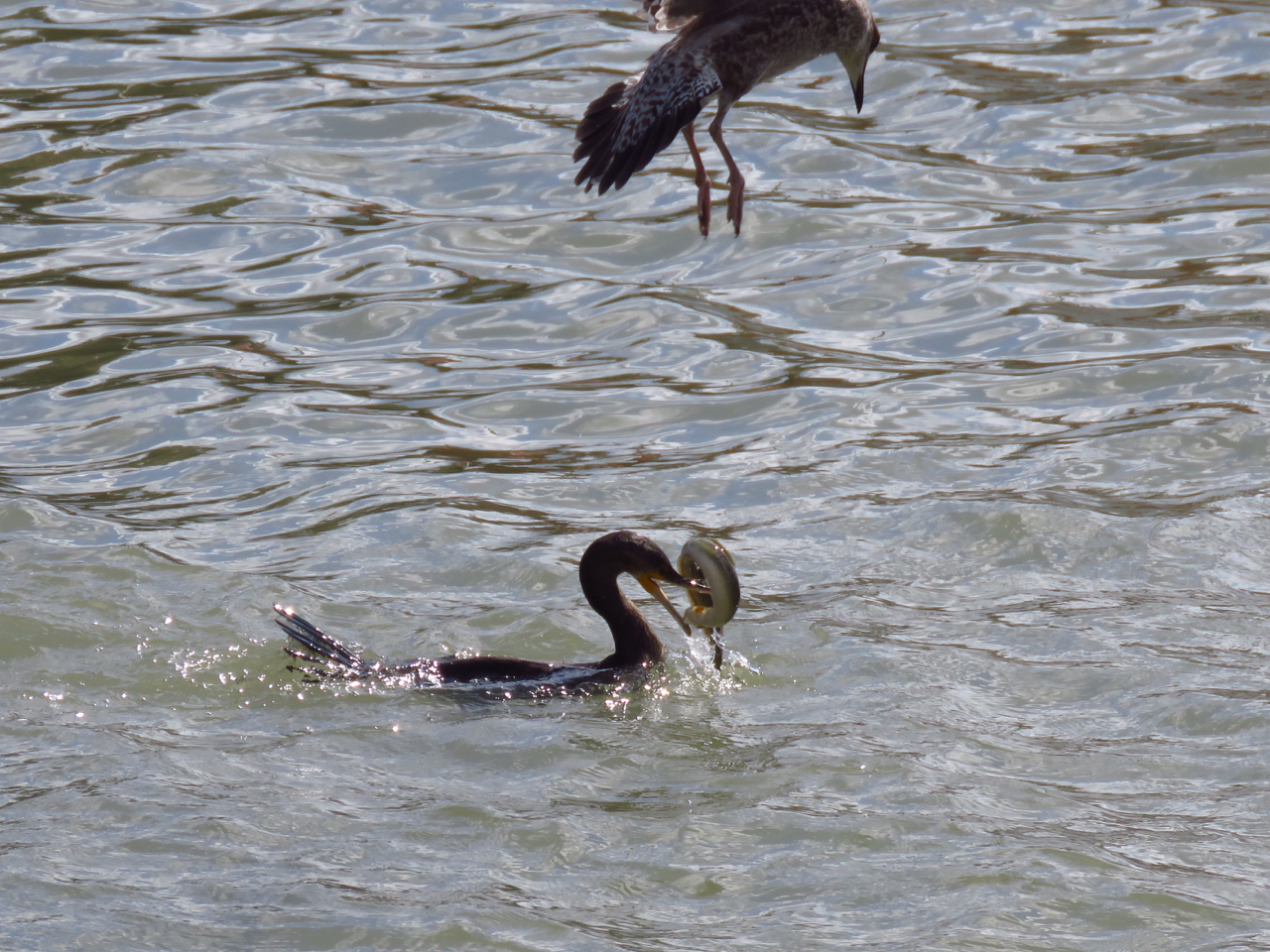
This cormorant caught an eel on the harbour. The eel squirmed and young herring gulls pestered the cormorant, who dived with its prey. When the cormorant emerged again there was no eel. It looked like a prey hard to subdue.
Cormorant trying to balance on a rope. 
A Great Black-backed gull dwarfing a herring gull (also top shot).

Monday, 17 July 2017

Wykeham and the Derwent

I drove to Wykeham forest today for a chance to see the regular Honey Buzzards there. I was relieved when I saw the raptor viewpoint sign as I thought I had got lost. I arrived around 8:30 am and there were already several birdwatchers on site with large telescopes, but little else. No raptors or many other birds about other than a few gulls soaring on the thermals. I decided to walk down the river Derwent to try and see a Dipper, which would be my first of the year. I walked down the hill by the steep Moor Lane, with the path dotted with cracked snail shells left behind by Song Thrushes. A Chiffchaff sung, groups of young Robins and Chaffinches fed on the path. At the bottom of the hill I crossed Troutdale beck and joined the road. By the bridge I walked down onto a footpath and sat on a wooden step on the fence overlooking the river. The place looked like the perfect dipper spot, rocky bottom, rapidly flowing water. The shrill calls of two disturbed Kingfishers distracted me for a while. After they had disappeared I realised that there was actually a Dipper just in front of me. It behaved like it hadn't spotted me, dipping its head under the water every few seconds, facing the current, lifting leaves like a blackbird to fetch little critters underneath, stopping to preen a little. I spent about 20 minutes watching it and taking videos and photos until it carried along downstream.
 I followed the narrow path downstream too. A large dragonfly, dark with paler marks, probably a Golden-Ringed dragonfly, flew along the middle of the river. I didn't see it settle unfortunately, as it was my first.
It was time to head back up the hill. I spent another hour on the viewpoint. Some birders had seen a pair of distant honeybuzzards, but other than buzzards, there was nothing else to report.
Raptor Viewpoint sign.
Panoramic across the Raptor Viewpoint. 
The dipper had a metal ring.

View of the stretch of the Derwent where I saw the Dipper and the Kingfishers. 
Watching underwater. 

Swallowing something. 
A short clip of the dipper feeding.

Another stretch of the river. 
Nice gate, but no cranes about. 
The snail hunter. Song Thrush. 
Small Skipper. 
Speckled Wood.