Monday, 15 July 2019

Hull Dragonfly best spots: Noddle Hill LNR

A trip to Noddle Hill on a morning with at least an hour of sun forecast. The sun is shining and the temperature steadily rises, with barely any wind. Sightings start early as I flush a male Black-tailed Skimmer in one of the first fishing platform. It flies about but doesn't settle back, but it makes the first record for the site this year. Then, a Southern Hawker was hunting by the lake perimeter path. It checks me out - in good southern hawker fashion - only to go and rest on a poplar nearby. I manage to spot it settled, catching the sun. It is an immature male, its colour is not yet fully developed, olive eyes and lacking the beautiful apple-green of the mature adult.
 A little further ahead, a pale damselfly catches my attention. It is a teneral Red-eyed Damselfly female. A sign of successful breeding in the lake.
 A Common Blue Damselfly male basks on the path.
 I check the water surface in search of Red-eyed damselflies. The anglers have removed a lot of floating vegetation, which is piling by the shore. I return some swan mussels back to the water. On a floating leaf I find the first male Red-eyed. There are 5 in total about.
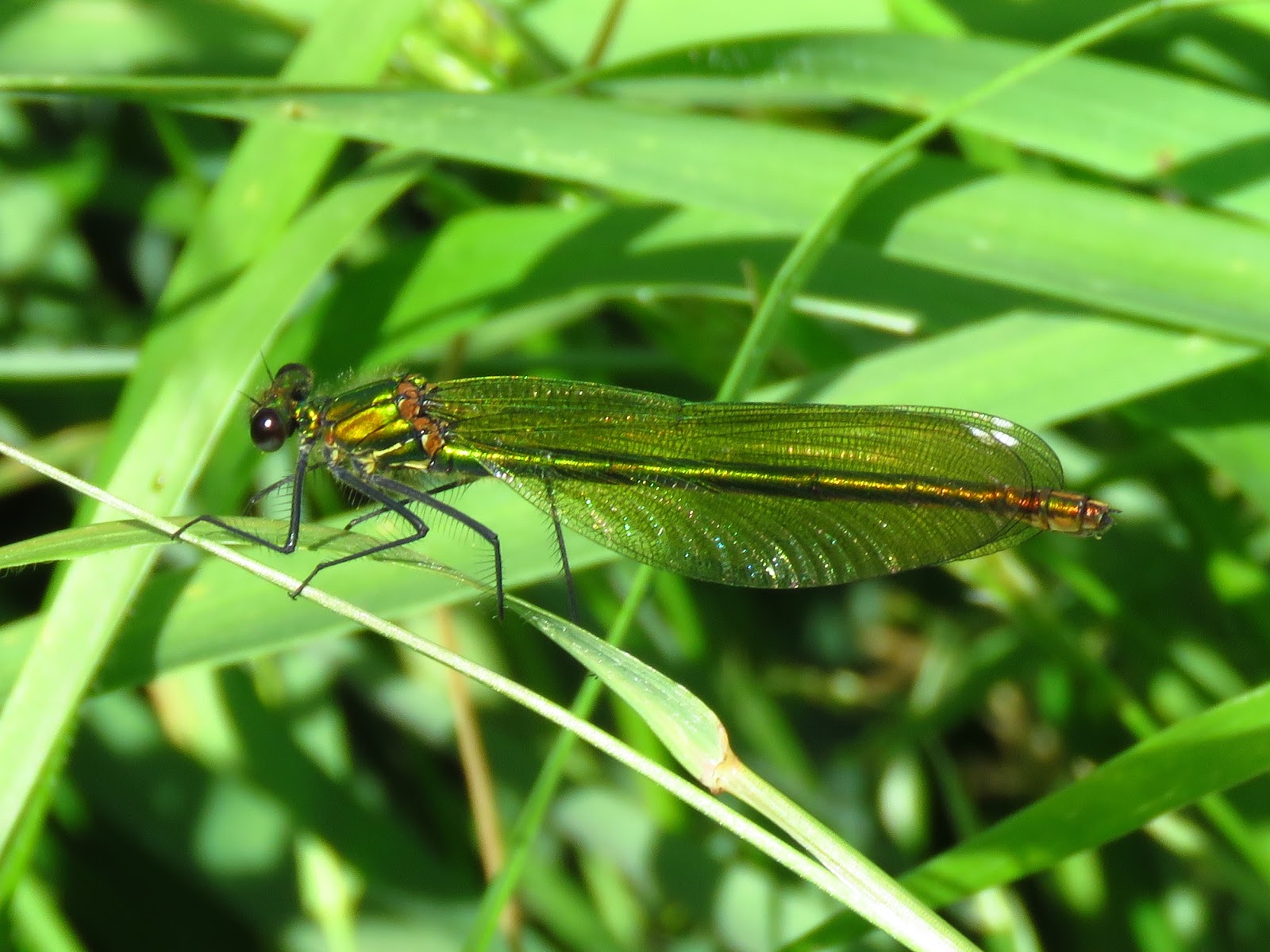
 I walk around the reserve towards a long pond which is overgrown with vegetation. On the same spot where I found a male last year there is a female Emerald Damselfly (top shot). She is very approachable and lets me take several photos. On the same area a hawker flies over my head, but I can't refind it. This happens a couple of times today.
I am more lucky with this Black-tailed skimmer, who basks on the mowed path.
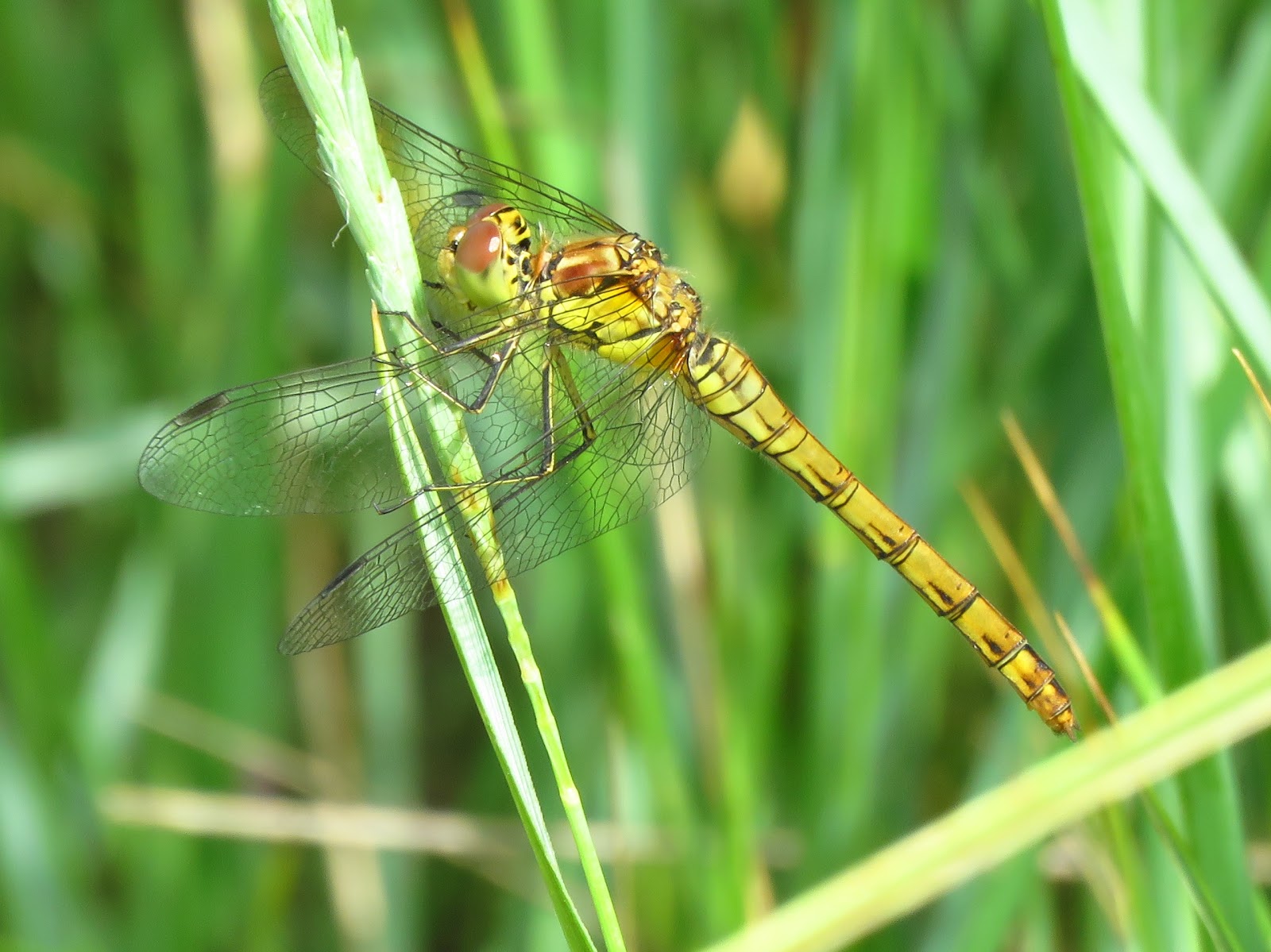
A Ruddy darter sits on a leaf. While I take this photo a deer fly bites my arm!
I do another circuit of the lake, this time spotting a mating pair of Azure Damselflies, who fly high onto a willow to escape another male.

I watch a Southern Hawker hunting on a clearing by the lake, clashing wings with another individual. 
The sunny spells become shorter and shorter. It has been a good session, with 8 species recorded for the site this morning: Common Blue Damselfly, Blue-tailed Damselfly, Red-eyed Damselfly, Azure Damselfly, Southern Hawker, Emerald Damselfly, Black-tailed Skimmer and Ruddy Darter. 

Noddle Hill is a great site for dragonflies as it combines a diversity of wetland habitats: ditches and drains (which surround the site), wet meadows, permanent ponds and a large lake. There is a woodland surrounding the lake, which offers shelter during windy conditions and rides with plenty of insects. Some of the aquatic sites are well vegetated too, a few of them becoming overgrown.

A total of 16 species have been recorded in the site overall. In addition to those seen today these are:

Common Darter. Record from 2002. UPDATE, 2nd September 2019
Migrant Hawker. Since 2002. Present, 2nd September 2019
Emperor Dragonfly. Since 2002, where larvae and adults where present. Territorial male (2018)
Four spotted Chaser. Since 2002. Territorial males (2018)
Banded Demoiselle. Single record (2015).
Small Red-eyed Damselfly (2006)
Large Red Damselfly. Unclear when record/s were obtained.
Brown Hawker. Recorded in 2002 by Andrew Ashworth.

More information
For previous Wild at Hull posts on Noddle Hill click here.
Noddle Hill at the Yorkshire branch of the British Dragonfly Society website.
Noddle Hill management plan.
Skimmer. 2004. Article by Andrew Ashworth detailing the presence of 9 sp in the lake and pond, with 3 of them with evidence of breeding in the form of larvae.

Thursday, 4 July 2019

A walk by the river

I walked from Oak Road to the Ennerdale new ponds by the river this morning. It was sunny, warm and breezy. A walk around Oak Road Lake gave me my first Small Skipper of the year.
Small Skipper.
Large Skipper.
The river was reaching its highest level with the tide and starting to ebb. The banks had just been cut so I walked at the bottom of the bank, by the edge of the riverside vegetation.
The River at high tide. Looking downstream towards the Croda turbine.
Sutton Bridge.
The marginal vegetation by the River Hull.
Mowed down.
Tractors mowing the bank opposite.
I flush a Brown Hawker from the bank, my first this year, who quickly disappears amongst the trees. After crossing Sutton Brdge, and very close where I found the female Banded Demoiselle a couple of weeks ago I found another one (or the same?!) This time I could get closer and take a clearer shot.
Female Banded demoiselle.
 I went straight to the Ennerdale new ponds. The north pond had lost a lot of water and I couldn't see much on it, but the south one looked promising.
The South Pond. 
Teneral common darter (above and below).
Several teneral Common Darters flew away from me, first for the year too. 
A couple of Emperor dragonflies were patrolling the pond, clashing occasionally and chasing, sometimes almost brushing my hear. A third one joined them at some point.
Male Emperor.
A female Emperor oviposited on the emergent vegetation, rejecting a suitor by curving her abdomen underneath her.
Suddenly, I spotted Black-tailed Skimmers: a female ovipositing and a male behind or over her, guarding and fighting off the male Emperor away from her. 
Female and Male Black-tailed Skimmers.
After the bout of egg laying, the male went to bask at the edge of the water, on a bare patch of shore...
Male Black-tailed skimmer.
While the female preferred to bask amongst vegetation, away from the water.
There were also ovipositing Blue-tailed and Common Blue damselflies. I spent a good hour leaning on the perimeter fence of the pond, watching the action, and there was lots of it!

Monday, 1 July 2019

A blustery warm afternoon along the Leven Canal

It is a warm, but windy day with plenty of sunny spells. I had an overdue trip to Leven Canal to check out its dragonflies. The canal was looking stunning with both yellow and while lilies in bloom. We walked from the village bridge first east and then retraced our steps and carried on until the aqueduct of Holderness drain.

Overall, 6 species of odonates, with the most common being the Common Blue, followed by Blue-tailed. We spot a couple of Red-eyed Damselfies.
3/4 blue-tailed damselfly, most of the abdomen is missing.
Red-eyed Damselfly bending it's abdomen.
Blue-tailed Damselflies mating.
Four-spotted Chaser resting by yellow water lilies.
At least 3 ovipositing Emperors today.

Mating common blue damselflies with the ripples caused by the wing.
Common Blue damselfly.
The stars of the show: Hairy Dragonflies mating. Several more on the wing on the last stretch of the walk.

Birds
A relatively low list total of 26 species. Singing Reed Warbler, Willow Warbler, Reed Bunting, Skylark and Yellowhammer. A Crow mobbing a buzzard and making it mew.
 The resident pair of Swans with two cygnets.
 And the best, a Hobby, hunting along the canal.

In other invertebrates...
...several Black-and-yellow Longhorn Beetle (Rutpela maculata) feeding on thistles and bramble.
A beautifully marked running crab spider from Leven Canal, found by Robert, identified by Matt Prince on twitter as a likely Philodromus cespitum.
Many more Red Admirals and Small Tortoiseshells than Painted Ladies on the wing today.

Saturday, 29 June 2019

Kilnsea Wetlands and Spurn Triangle

A very pleasant day at Kilnsea Wetlands and Spurn triangle, which got better as the day progressed. It started cloudy and with a cool breeze at the wetlands. A Spoonbill was around, but after a brief grooming session it had a long nap. There were plenty of gulls, including Herring, Common, Black-headed, Lesser Black-backed, Great Black-backed and later, 4 Little Gulls, which were new for the year for me. There were quite a few adult Avocets but no young. The only visible young were 7 Mallard ducklings.
Preening Spoonbill.
Adult Little Gulls amongst more common companions.

Butterflies
There were hundreds of Painted Ladies between Kilnsea Wetlands and Spurn Triangle, gorging on thistles, brambles and privet. There was a mix of worn and quite fresh individuals. Also Red Admirals, Small Tortoiseshells, Small Heaths, Common Blue, Meadow Browns, Ringlets, Large Skipper and Speckled Wood
Painted Lady, on thistle.

Large Skipper.
Mating Meadow Browns.
Small Heath. Another plentiful species in the Triangle.
Ringlet.

Beacon ponds
I move onto Beacon ponds to tick the Little Terns. On the way there I come across these mating red-tailed bumblebees. 
Then I see my first dragonfly, an Emperor patrolling a ditch, which disappears in a few seconds. As I jump to the other side of the ditch to pick up a tangled balloon, I disturb a large Grass Snake, which slithers into the grass, a site tick for me. The walk alongside Beacon Lane is peppered with more Painted Ladies.
A Dune chafer by the Blue Bell borrow pit.
Silver Ys feeding on Red Clover.
 Dragonflies
It is quite warm and sunny by 11, when I get to the Clubley scrape area. Dragonflies become quite evident, with a patrolling Emperor and several darters, including common, Ruddy and a stunning male Red-veined.
Common Darter.
Red-veined darter
Four-spotted chaser.
Blue-tailed skimmer male.
Common Darter.
Female Black-tailed skimmer, resting on some driftwood by the saltmarsh.
An Emperor resting.

I have my lunch at Canal Scrape hide. There is a pair of Swallows in residence. One of them sits on a post just by the hide, preening.
 and then starts sunbathing, opening it's bill and leaning to one side, feathers fluffed, I had never seen a swallow sunbathing before, but it makes sense as the sun is shining after many dull, cloudy days.

The view from the hide.
 I continue my walk alongside Canal Scrape bank, the Discovery centre is merging more and more with its surroundings.