Saturday, 11 March 2017

Up the River Hull. 5. Thearne

A quick stage today, up and down the right river margin between Ferry Lane at Thearne and the southern entrance to Figham Common. Woodpigeons, Pheasants, a Stock Dove and four Fieldfares feed on a field by the Ferry crossing. The river runs very high. It's cloudy, but mild and calm. The river, lined by grassy banks is occasionally fringed with reeds and a few willows, meanders by farmland with the occasional copse.
 By Kenley Reach Farm a group of Lapwings takes flight with their squeaky calls. I spot a black rabbit, which are not that unusual in the area. Cormorants, Coots and a few Mallards and Moorhens can be seen from the bank on the fishing pond. I hear the first Yellowhammer song of the year by the entrance to Figham Common, which will be the next stage.
The Ferry Crossing on Thearne side, looking south.
Male Lapwing.
These cows objected to me walking on the riverbank.
Carr Plantation.
The bend in the river by the fishing lake. Two Moorhens crossing.
Cormorants resting on the fishing lake.

Entrance to Figham Common. 
Cormorant flying over the river.
Stage 5 aerial view. 1.8 km each way.

Bird List
  1. Black-headed Gull
  2. Blackbird
  3. Blue Tit
  4. Carrion Crow
  5. Chaffinch
  6. Collared Dove
  7. Common Gull
  8. Coot
  9. Cormorant
  10. Dunnock
  11. Fieldfare
  12. Goldfinch
  13. Great Tit
  14. Greenfinch
  15. Greylag Goose
  16. House Sparrow
  17. Jackdaw
  18. Lapwing
  19. Magpie
  20. Mallard
  21. Mistle Thrush
  22. Moorhen
  23. Pheasant
  24. Robin
  25. Feral Pigeon
  26. Rook
  27. Skylark
  28. Song Thrush
  29. Starling
  30. Stock Dove
  31. Tree Sparrow
  32. Woodpigeon
  33. Wren
  34. Yellowhammer

Wednesday, 8 March 2017

Up the River Hull. 4. Kingswood to Wawne

The weather forecast for today was of no rain and sunny spells, so I drove to Kingswood by the bridge over the River Hull to walk to Wawne. This stage goes through the last of the farmland in the Hull city council area, which is disappearing fast to development, and enters the East Riding of Yorkshire. The twin bridge carrying the A1033 road is the last in a long stretch, as there are no bridges until Grovehill Bridge, north of Weel. There used to be a ferry at Wawne, which stopped by 1946. Indeed, the still called Ferry Lane at Wawne was the end of the stage.
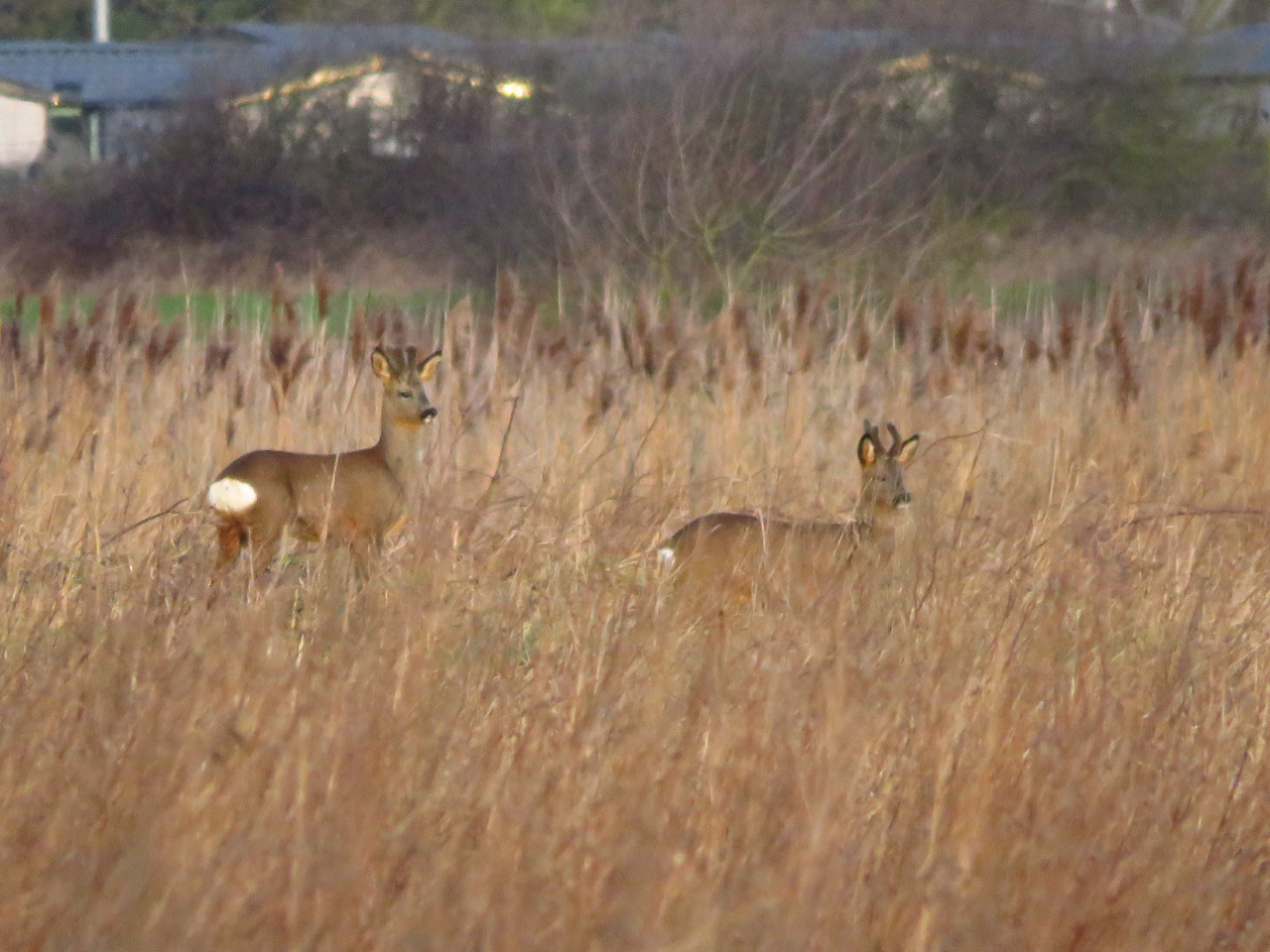
 I join the bank after going through the underpass under the twin bridge. The grassy bank is not as muddy as I was expecting. As soon as I start, over the noise of the busy road and building construction, I notice the song of Skylarks. Them, and the occasional Reed Bunting song, accompany me through the stage. A few Linnets fly over, they are the first of the year for me. A roe deer feeds on the other side of the river. Overall, a relatively long stage, given the return by the meandering river, but quite pleasant and yielding 39 bird species.
Cormorants, posing, all sculptural atop pylons. Every pylon by the river had a few resting. There are few large trees by the river and the pylons seem to suit them. 
Floodlights are used in the same way by a Kestrel. 
A Greylag sitting on the other side of the river. 
Roe Deer. 
A bend in the river looking north. 
A wetland created a few years ago by the river bank, possibly to compensate for development, I could find no name for it on maps. It is now fringed by reed beds. 
A pair of mute swans, coot, moorhen and mallard were in residence in the wetlands.
Another cormorant on a pylon, this one in breeding plumage.
There are occasional willows, almost in bloom, ash and patches of reedbed by the river side.
Male Reed Bunting.
Linnet 
On a set aside field a large flock of Linnets move about. I notice a couple of Yellowhammers like flaming suns on the ground. When they fly, another one joins them. 
A male Meadow pipit after carrying out its parachute display flight singing away.
A pony tethered to the bank. 
Google Earth view of the 4th stage. 4.16 km.

Monday, 27 February 2017

Wykeham Raptor Viewpoint

We took advantage of a brief window in the weather to head to Wykeham Forest Viewpoint. This is located in a Forestry Commission plantation, on a ridge with great views over Troutdale, and favoured by raptors displaying and passing during migration.
Shortly after arrival a Goshawk gave a brief view as it was mobbed by a crow and two Buzzards soared on the ridge opposite. But a few minutes later, a Goshawk displayed along the ridge in their territorial rollercoaster-like display, climbing up and stooping down repeatedly (the spot on the top shot is a goshawk). Although I've seen Sparrowhawks displaying like this over my street, the setting here was fantastic. A few Crossbills called from the spruce trees and one of them crossed between them. After a short while, the rain started to fall softly, but the dark clouds looked very ominous, so it was time to call it a day. I will definitely be back here, in the summer, where Honey Buzzards can be seen from the viewpoint.
 The viewpoint is 5 min walk from a small car park and there are a couple of benches that double as screens and come very handy to support your arms when using binoculars.
The woodland on arrival. 
View of Troutdale.

An information panel on raptors and other birds you can see. 

More information
Forestry Commission Website. Here. Includes location map and further information on Wykeham Forest.

Bird list

  1. Carrion Crow
  2. Buzzard
  3. Woodpigeon
  4. Common Crossbill
  5. Stock Dove
  6. Brambling
  7. Goshawk
  8. Robin
  9. Pheasant
  10. Coal Tit

New Ings Revisited

An early morning visit to New Ings, a site in the outskirts of Hull where there's been a few sightings of Short Eared Owls. After the rainy, windy day yesterday I was hoping for some hunting owls, and shortly after arrival we weren't disappointed as two Barn Owls were hunting by the tree line. The ditches were quite full. Skylarks and the occasional Reed Bunting were singing. It was nice to see three stonechats, one an adult male, during the walk.
 Under an ash in the middle of the area we find plenty of Barn Owl pellets, and some more under a pylon. 
We then moved to a wetter field with reed patches and shortly after we flush a Short-eared Owl! It flies ahead and settles not far. We end up flushing it again before we can see it on the ground, and this time it flies further, and gets mobbed by a Carrion Crow and Skylarks, so it was forced to fly in a circle around the area until it lost them. 
 We watch a curious phenomenon I keep seeing in the last couple of weeks. A large gull flock circling like they are rising with thermals. These are Common and Black-headed gulls.
A distant shot of a Barn Owl hunting with the Humber Bridge in the background.
Two buck Roe Deer.
Stonechat.
Short-eared owl with the background of greenhouses.
Circling gulls. 
Carrion Crow mobbing Short-eared owl. 


The Barn Owl pellet collection.
Results of the dissection:

Pellet 1. 1 common shrew, 2 field voles
Pellet 2. 2 field voles.
Pellet 3. 3 field voles.
Pellet 4. 2 house mice, 1 field vole.
Pellet 5. 3 field voles.
Pellet 6. half field vole.
Pellet 7. 3 field voles.
Pellet 8. 2 field voles.
Pellet 9. 3 field voles.
Pellet 10. half field vole.
Pellet 11. A few incissors and leg bones.
Pellet 12. no skulls, just leg bones, some undigested stuff.
Pellet 13. 1 field vole.
Pellet 14. 1 field voles.
Pellet 15. no bones or skulls.
Pellet 16. 1 field vole.
Pellet 17. fragments of a skull of 1 field voles.
Pellet 18. 1 field vole.


Tuesday, 21 February 2017

Flooded Snuff Mill Lane

I had a walk at Snuff Mill Lane in the morning. I am glad I took my wellies, as the site was quite wet, the ditches full, paths muddy and scrapes flooded, but it was a very mild, sunny day. As I entered the site, I flushed a Kestrel, which settled again not far away on a hawthorn. The Kestrel watched the meadow intently from a hawthorn. It eventually went to the ground, but disappeared from sight, and then I noticed that a doe Roe Deer was resting on the meadow. She spotted me and stood up, watching me with curiosity (top shot).
 I carried on. Chaffinches were in full song, and Bullfinches called their mournful notes from the Hawthorns. I heard the calls of distant geese flying, Pinkfeet! a neat skein, 50 strong passed overhead. Spring is definitely on its way!
Female Kestrel. 
Flooded meadows. 
Magpie. 
Pink-footed geese. 
A flooded ditch. 
A view of a meadow. 
A pair of Mallards feeding on a flooded meadow.
A pair of Pied Wagtails. 
Carrion Crow mobbing Sparrowhawk.