Tuesday, 28 June 2016

Spurn Head and Kilnsea Wetlands

I took a trip to Spurn Head on Monday, a windy day with sunny spells. I walked the between the Blue Bell car park to the Warren on the coastal path and then back on the road with a stop on the Canal Scrape hide. Although it wasn't warm at all and I saw few invertebrates, the birds compensated, with Linnets, Meadow Pipits and Skylarks busy singing or feeding young. Three Swifts flew south overhead. Several Sand Martins flew over the lagoon.
Little Egret on the pond. It was an egret's bad hair day! (top shot).  
Meadow Pipit with food for young 
Skylark with food for young
Singing Linnet
and Sedge Warbler feeding young.

Two Magpies by Canal Scrape
 As soon as I moved north of Beacon Lane the sunny spells became a bit longer and in the shelter of the hedges many invertebrates came out. Butterflies included Common Blue and Large Skipper, later joined by a Ringlet and a Meadow Brown.
Scorpion Fly, Panorpa sp.
I moved onto the dunes south of Beacon Lagoons. A few dragonflies flew by without stopping, I could only identify an Emperor Dragonfly, which seemed totally undeterred by the wind but didn't settle.
Mating Garden Snails.
A wolf-spider Arctosa perita
A dune chafer Anomalus dubius
A Four-spotted chaser settled for a little while.
A nymph Short-winged Conehead on hawkbit.
A dune robberfly Philonicus albiceps.
This Arctosa perita basked at the entrance of her burrow. It retreated when it saw me, but emerged shortly after.
A female Black-tailed Skimmer on the cliff face.
I returned to the Blue Bell cafe by the beach with little of note. I drove to Kilnsea Wetlands. Another Emperor Dragonfly hunted alongside the ditch by the path. After a short time in the hide, I carried onto Beacon Lagoons. A raptor-like bird flew ahead chased by a small one. I thought it might have been a cuckoo, but I couln't relocated it. A few minutes later, while I watched the Little Tern colony, I heard the cuckoo call distantly a few times. 
Avocets, Shelduck and an Oystercatcher at Kilnsea Wetlands.
A distant shot of a group of Little Terns, some carrying fish on Beacon Ponds.

More information
A detailed site map of Spurn Head and surrounding nature reserves. 
Information on Beacon Lagoons and the history of the site.

Tuesday, 24 May 2016

Kiplingcotes and Goodmanham Wold

I headed for a morning walk at Kiplingcotes NR. The trip started with very brief sunny spells and cooler weather than yesterday. As I got in the reserve, there were plenty of rabbits grazing, most young of the year, and amongst them in the grassy plain there was a flock of Starlings with noisily begging young. Linnets, a Yellowhammer, a Pied Wagtail and a few Mistle Thrushes were also foraging on the grass.
Young rabbit on the look-out.
Mistle Thrush
Pied Wagtail
A male Linnet atop an ash.
The few sunny spells did stir a few insects into activity. I spotted these colourful hoverflies at the bottom of the chalk pit. 
Volucella bombylans, a bumblebee mimic.
and Xanthogramma citrofasciatum, a wasp mimic which was also a new species for me.
I moved onto the top of the reserve, were I found this day-flying moth
Burnet Companion moth, Euclidia glyphica, also a new one for me
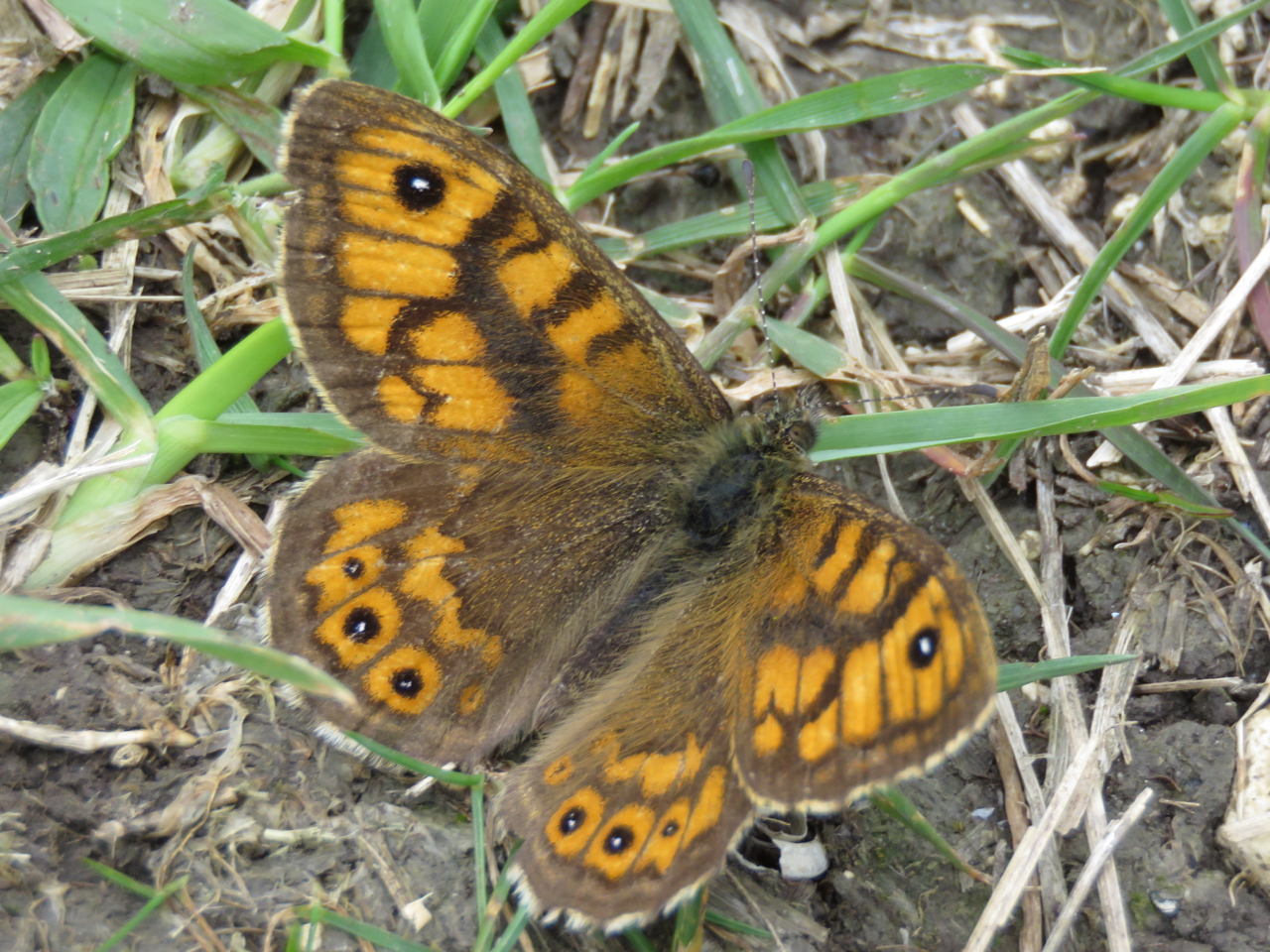
Ot the top path, a Wall Brown butterfly.
and a Soldier beetle, Cantharis rustica.

There was a veritable bird chorus all morning. Willow Warblers, Yellowhammers, Chaffinch, Skylark and Great Tits were particularly vocal.

Male Yellowhammer singing.
After chatting to a pair of botanists that were visiting for the first time, I left the reserve and walked along the Hudson Way towards Market Weighton. The hedgerows were blooming with Hawthorn and crab apple in bloom, and with many wildflowers on the verges and the sunny spells lengthening the insects starting appearing.
This Willow Warbler's mate was collecting nest material and bringing it to the nest site. I was surprised to find that the nest was on the ground, in between grass and nettles of the verge, but this is apparently the usual nest location for this species.
A Speckled Wood settles after a fight with another male, wings a bit tattered.
There was a large patch of flowering brassicas (I'd love to know what they are!) that was teeming with insects. I think this is Halictus rubicundus.
A Rhingia campestris hoverfly, there were more feeding on Dead White Nettle
a green-veined white butterfly,
and many Nomad bees, with males checking females. Here a female Nomada flava,
and a male of the same species, and
a black and red leafhopper, Cercopis vulnerata.
A flowering vetch was briefly visited by a male Orange tip, of which there were many about, I saw four individuals at once, but they were in patrol mode in search of females, checking every other butterfly they encountered along the path. This was the only one that settled.
 A predatory sawfly, Tenthredo mesomela I think.
I heard the characteristic call of a Marsh Tit call and spotted the bird on the hedgerow. It approached me inquisitively when I imitated the call.
But then decided to sunbathe! it adopted a relaxed pose and stretched its plumage like so:
All that would have made for a great day out, but then a passing male Brimstone decided to feed on some Red Campion and then to have a lengthy stop to sunbathe on a cluster of hawthorn flowers. Having both the male Orange Tip and Brimstone sitting in a single morning was much more than I was hoping for.
Brimstone.

Butterfly List (2 km2)
  1. Brimstone
  2. Wall Brown
  3. Large White
  4. Green-veined white
  5. Orange tip
  6. Speckled Wood
Bird list (2 km2)
  1. Blackbird 
  2. Blackcap 
  3. Bullfinch 
  4. Buzzard 
  5. Carrion Crow 
  6. Chaffinch 
  7. Dunnock 
  8. Goldfinch 
  9. Great Tit 
  10. House Martin 
  11. Jackdaw 
  12. Kestrel 
  13. Linnet 
  14. Magpie 
  15. Marsh Tit 
  16. Meadow Pipit 
  17. Mistle Thrush 
  18. Pheasant 
  19. Pied/White Wagtail
  20. Red Kite 
  21. Red-legged Partridge 
  22. Robin 
  23. Rook 
  24. Skylark 
  25. Song Thrush 
  26. Starling 
  27. Swallow 
  28. Swift 
  29. Tree Sparrow 
  30. Whitethroat 
  31. Willow Warbler 
  32. Woodpigeon 
  33. Wren 
  34. Yellowhammer

Sunday, 22 May 2016

Spurn Safari

Today we joined a Spurn Safari, organised by the YWT aboard their Unimog, a large, all terrain military vehicle that allows to traverse the low-lying sand bar that now separates Kilnsea from the point itself. The day was lovely, warm, blue skies, and with barely any wind.
We arrived in the morning and pottered around the dunes near The Warren, before a picnic. I photographed a Nomad bee on the clay cliffs with the hope of identifying it later, it turned to be Nomada goodeniana. 
Nomada goodeniana.
A yellowish, large dragonfly passed by, settling on some the marram grass, a lovely four-spotted chaser, Libellula quadrimaculata.
I collected some brown-lipped snails, there is always a good range of colour variants in the dunes, pink and yellow are not rare.
 This is the temporary visitor centre, a container with a front of boards. The old buildings around the Warren have now been dismantled.

A sand-hopper, Talitrus saltator.
A well marked male wolf spider, kindly identified by Matt Prince at Twitter as Alopecosa pulverulenta.

 After a picnic by the seawatching hide, we met by the Unimog. It is an imposingly tall vehicle and I wondered how we would climb onto it. All sorted! some comfortable steps were pushed alongside the vehicle by our guide Andy. Before we got going, he gave us a brief talk on Spurn. The breach in the autumn storms of 2013, meant that the road was washed away and cars couldn't make the trip to the point, hence the Unimog.
After about 20 minutes of bumpy ride along the sandy spit - with some hair-raising moments where the vehicle wobbled on the sand inclines - we were by the light house.

Since our last visit the lighthouse has been restored and is now open to the public. We climbed the 145 steps to the top, peeping on each window along the way to admire the view.
View from the top of the lighthouse towards Kilnsea, the Unimog visible.
The view towards the point.
 Andy had warned us of the brown-tail moth caterpillars and their irritating hairs. These hairy caterpillars were about in plague proportions, hundreds climbed the lighthouse itself and the sea buckthorn and other bushes were stripped naked of leaves.
Brown tail moth caterpillar
 There were other abundant hairy caterpillars, like the woolly bears, the caterpillar of the Garden Tiger, Arctia caja, which we often saw feeding on nettles. These roll into a ball when disturbed.
Garden Tiger caterpillar.
And several very large final instars of the Oak Eggar caterpillar, Lasiocampa quercus on the move.

 A view from the other side of the lighthouse showing its windows, which allow viewing as you climb it.

Although not as many as caterpillars, there were some butterflies on the wing. A single male Common Blue near the lighthouse, several Peacocks, a Green-veined white and a Large White. We may (or not) have briefly seen a Green Hairstreak.
Male Common Blue butterfly
On the point visitor centre, I was pleased to find a thriving colony of Pholcus phalangioides in the toilets (where else!).
We had a guided walk around the point, which covers a surprisingly large area. Birds were quite scarce all day, but Whitethroats and Lesser Whitethroats were singing. Many swallows about, with a few House Martins and a couple of Swifts.
 Overall a lovely day out, the views from the vantage point of the unimog are fantastic, and there was the bonus of being able to climb to the top of the lighthouse.

More information
Check the YWT events website for dates and times for a Spurn Safari.