Monday, 3 November 2014

Brough Haven and Crabley Creek

From the train to London on Friday morning I spotted a Marsh Harrier flying over the reed beds just north of Brough. So I planned a walk today between Brough Haven and Crabley Farm, a marshy area traversed by Crabley Creek, lying between the Humber and its bank. It was sunny, but breezy in the morning and it was the first trip this season that I wished I have brough gloves. Although it warmed a bit later, the south westerly breeze was relentless. The tide was almost at its lowest as I parked by Brough Haven. A small group of Mallard, a flock of Teal and some Redshank fed on the mudflats. As soon as I pointed my binoculars towards the reed beds, I saw the distant silhouettes of four Marsh Harriers quartering near each other, the highest number I've seen together in East Yorkshire. One or several of them were visible through the morning. A large flock of geese, far too distant to identify, passed over the Humber, as did some small groups of Swans, which I couldn't ID.
 I found the way around Brough Haven onto the flood bank. A male Pheasant flew away landing near a group of Curlew. There were good numbers of Curlew around today.
 The side of the bank was flanked by wet pasture and large reed beds streaked by muddy creeks and ponds. New hedges have been planted, and some mature scattered hawthorns, laden with berries, revealed the position of old hedges. Sheep grazed the bank and the marshland. Meadow Pipits, Skylarks, Pied Wagtails, Reed Buntings and a single Grey Heron flew across the bank.
 I noticed a Marsh Harrier flying nearby and landing in a visible spot by the path. At the same time, two Kestrels appeared to be squabbling over prey on the bank, one of them flying onto the other, which lifted its wings protecting its prey.
 I returned after reaching Crabley Farm. A bright male Yellowhammer flew towards the hedge by the train line. 
 Two Small Tortoiseshell and Red Admiral were flying by the entrance of the Haven. After feeding on the mud and getting a very muddy face, a Curlew started bathing in a pool on the mudflats, putting an end to an interesting outing.
Two Marsh Harriers over the reedbed with Drax and windmills on the background.
Distant swans crossing the Humber
Three Marsh Harriers in a line
Sheep
Ram checking the females
Hawthorn Berries
One of the Marsh Harrier stopped briefly by the reedbed.
Grey Heron
A Kestrel being mobbed by a Meadow Pipit
One kestrel had got a prey and lifted its wings every time the other approached and dived
If you click to enlarge you can spot the prey on the Kestrel talons, with the other chasing it, and two Curlew on the background
Greenfinch
The long straight bank heading towards Crabley Farm
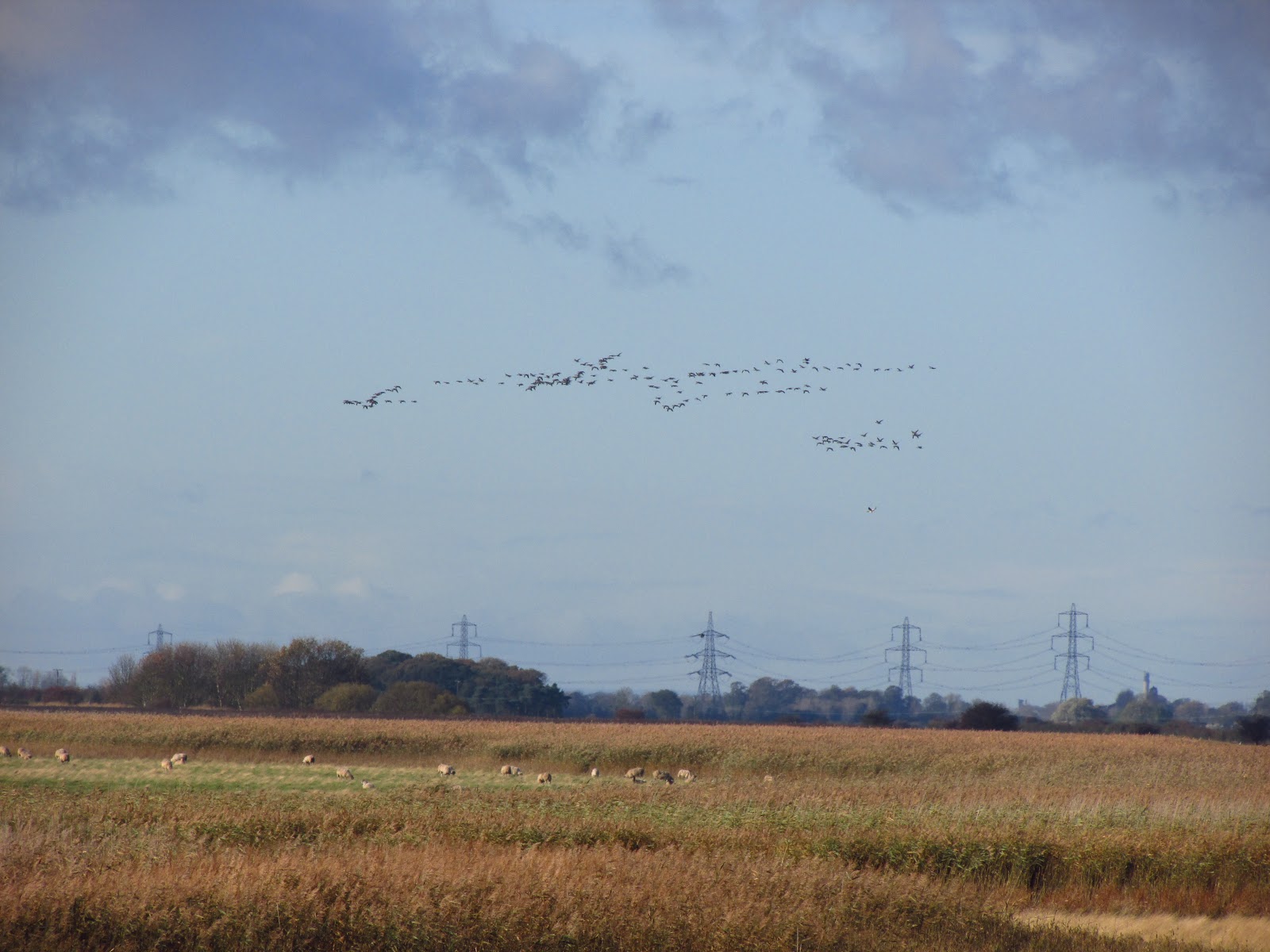
A flock of geese in the distance
Female Reed Bunting
A Hawthorn laden with berries
The yellow spot in the middle of the photo is an almost fluorescent male Yellowhammer
Marsh Harrier
A view towards Lincolnshire 
The russet reed bed of Crabley Creek
Teal feeding in Brough Haven
Brough Haven
Marsh Harrier
Curlew with muddy face...
... and finishing its bath with a lovely clean face

Bird list
  1. Black-headed Gull 
  2. Blackbird 
  3. Bullfinch 
  4. Carrion Crow 
  5. Chaffinch 
  6. Common Gull 
  7. Curlew 
  8. Goldfinch 
  9. Greenfinch 
  10. House Sparrow 
  11. Kestrel 
  12. Lapwing 
  13. Linnet 
  14. Magpie 
  15. Mallard 
  16. Marsh Harrier 
  17. Meadow Pipit 
  18. Pheasant 
  19. Pied/White Wagtail
  20. Redshank 
  21. Reed Bunting 
  22. Robin 
  23. Rock Dove
  24. Skylark 
  25. Teal 
  26. Tufted Duck
  27. Woodpigeon 
  28. Wren 
  29. Yellowhammer 

Thursday, 30 October 2014

Sunny October at East Park

Armed with bike, skateboards and binoculars I headed to East Park with the kids. The morning had a beautiful light, still and mild conditions, ideal for a walk/ride. There were a few large Greylag flocks around the park. As we arrived, a Sparrowhawk flew past, followed by an angry charm of Goldfinches. Two Pied Wagtails called each other from the opposite shore of the lake.
 I failed to spot the Great Crested Grebes and there was still no sign of Goosanders.
Pied wagtail
Sleeping Tufted ducks
Sleeping Male Pochard
Greylags
A single Mute Swan was at the feeding stationon the lake. It had a metal ring and a very new yellow ring marked 775. I reported it to Euring and Dan, from the Yorkshire Swan & Wildlife Rescue Hospital replied the following day with this info: ZY8475 - Yellow 775 - 28.08.14 - Adult Male Mute Swan - East Park, Hull (TA 12107 31393). So it appears it was only ringed this August in the park. I will try and keep an eye on it.
Right leg yellow plastic ring 
At the mini zoo, while the kids played with a surprisingly laid back hen, I spotted a Dunnock, basking on a sunny corner by a bench, I was very close, but it took no notice of me.
As we returned to the car, a lovely Grey Wagtail on the rim of the empty model boating lake.


Bird list
  1. Black-headed Gull
  2. Blackbird
  3. Blue Tit
  4. Canada Goose
  5. Carrion Crow
  6. Common Gull
  7. Coot
  8. Cormorant
  9. Dunnock
  10. Feral Pigeon
  11. Goldfinch
  12. Great Tit
  13. Grey Wagtail
  14. Greylag Goose
  15. Herring Gull
  16. House Sparrow
  17. Jackdaw
  18. Long-tailed Tit
  19. Magpie
  20. Mallard
  21. Mistle Thrush
  22. Moorhen
  23. Mute Swan
  24. Pied Wagtail (yarrellii)
  25. Pochard
  26. Robin
  27. Sparrowhawk
  28. Starling
  29. Tufted Duck
  30. Woodpigeon
  31. Wren

Friday, 10 October 2014

Hornets, kingfisher and a stinky stinkhorn at Tophill Low

I went to Tophil Low with Gui and Jess. Sunny sky and mild weather, just a tiny bit of a breeze. We walked the north side of the reserve. From the car park hide overlooking D-res Jess spotted a small group of Red-Crested pochard, a bird I hadn't seen this year. We could see some shovelers in the distance, and the usual assortment of coot, mute swan, pochard and tufted duck. A Buzzard soared over the trees in the distance and Jackdaws play fighted with a Kestrel.
 We kept an eye on the trees for a Tawny Owl on the way to D-woods, but there was no luck. Goldcrests were everywhere, and we also saw a Treecreeper. In a clearing in the wood near the pond, Hornets crossed the path at full speed. There might be a nest nearby, as there was a lot of hornet traffic there. And on the floor Gui spotted a fresh Stinkhorn (Phallus impudicus), which had just started to attract flies. 
Mature Stinkhorn. The tip is covered by a dark, sticky substance that contains the spores and emits a rotting flesh smell, which attracts flies. The immature fulgal bodies are called 'eggs' and you can see one intact one on the left.
We admired and photographed the fungus and carried on towards North Marsh. The Kingfisher gave us great views: it first landed behind some bullrush leaves, but after catching a fish it settled on a clea branch in front of the hide. After hitting the fish a few times against the branch it proceeded to drop it and wasn't too bothered about retrieving it.
 We waited a bit longer hoping to see an otter, but instead were entertained by two male Migrant Hawkers, Darters, Comma, Red Admiral and a white butterfly. At some point a male Kestrel landed on a tree, and a Wren expressed its alarm at the event. There were quite a number of active invertebrates about in the reserve.
 After North Marsh, and alerted by two kind birdwatchers, we kept an eye for water voles in the pond on the way to Helmpholme Meadows. We spotted them going about their busy lives from the hide and and inside the hide we discovered tens of overwintering lacewings on the roof.
 Helmpholme was quiet. Other than three Commas on the wing and a calling Chiffchaff or Willow warbler that called and didn't sing.
Red Crested Pochard, and Coots
Male Pintail still in eclipse plumage.
Shoveler and Teal?
Kingfisher
Kestrel
Common Darter
Migrant Hawker
Dronefly, Eristalis tenax
Water vole, one of several seen at the pond
Water vole
Red Admiral
Comma
Amber snail
Bug still to ID
A cluster of overwintering Lacewings, Chrysoperla carnea inside one of the hides.
The same stinkhorn two hours later. Many bluebottles, green bottles and other flies clustered over it. The black spore containing substance pretty much gone.

Caddis fly.
Bird List
  1. Black-headed Gull
  2. Blackbird
  3. Buzzard
  4. Carrion Crow
  5. Chaffinch
  6. Coal Tit
  7. Common Gull
  8. Coot
  9. Cormorant
  10. Gadwall
  11. Goldcrest
  12. Great Black-backed Gull
  13. Great Crested Grebe
  14. Great Spotted Woodpecker
  15. Great Tit
  16. Jackdaw
  17. Kestrel
  18. Kingfisher
  19. Lapwing
  20. Long-tailed Tit
  21. Marsh Tit
  22. Moorhen
  23. Mute Swan
  24. Pheasant
  25. Pintail
  26. Pochard
  27. Red-crested Pochard
  28. Robin
  29. Shoveler
  30. Swallow
  31. Treecreeper
  32. Tufted Duck
  33. Wigeon
  34. Woodpigeon
  35. Wren