Sunday, 14 February 2021

Urban birding at Hull: Pickering Park WeBS

An icy, freezing 11 km walk to PickeringPark to carry out the Wetland Bird Survey for the BTO. I have just taken over this site, which I visit quite regularly anyway. Counting was made easier by the fact that 70% of the lake was iced over. 

Mute Swans

One of the locals commented that one of the young Mute Swans was lost as it collided with a house when flying away, so only 6 Mute Swans. Two of the young swans, an almost 2 year olf brother and his younger sister from last year years, were engaged on courtship displaying, with the top of their necks ruffled up, and much bowing, snorting and copying each other's movements. Swans don't normally breed until they are 4 or 5 years old, but young swans often 'practice' their courtship display to each other. I once saw a young swan displaying to a Canada geese.


Some of the mirror movements of the displaying swans.

Gulls

The usual gull roost is on the ice today. After counting the gulls (136 Black-headed Gulls, 10 Common Gulls and 2 Herring Gulls) I scan their legs. The only one I can see ringed is a Black-headed gull with white ring from Dutch ringing scheme. It was rung for the first time as an adult in 2012. The plastic ring with code E2TC  is a bit damaged.


Eight tufted Ducks, 41 Coots, 22 Moorhens and 54 Mallard completed the count. 


No Goosanders, but one flew over my street on the way back.

Of note was a small flock of Redwing feeding under the trees on the cemetery. 

Redwing.
The following are some photos taken on route to the park.


Wednesday, 10 February 2021

Hull urban birds. 7. Wintering Common Gulls


Today at Pearson Park, during my walk before work, I noticed that there was a flock of gulls on the frozen floods. Ice and ringed gulls mix really well, so I scanned the gulls legs in search of rings with my binoculars. I was pleased to find a new ringed Black-headed gull, but I also recognised an old friend, JV47. This gulls is a male Common Gull originally ringed in Bergen in October 2014, in its first year, that has been returning to the park regularly ever since (the top photo is a close up of this individual, I took in November 2017). Thanks to ringing schemes in many countries, we have a lot of information about migration. The easily read ring also allows to recognise individuals. Common Gulls are small, agile gulls, with a silver back and black-wing tips with prominent white spots on each feather, that forms a white panel quite distinctive in flight. Its rounded head, dark eyes and 'eye shadow' give it a gentle expression. On winter plumage its head is finely speckled with grey. Bill and legs are grey-green or yellow. Immature birds are browner with pink legs and base of the bill. Despite its name, is not very common inland (Black-headed gulls are more common), but it is quite common in the Hull area, where it can be seen on playing fields and parks, often mixed with Black-headed Gulls.
JV47 this morning at Pearson Park (10/2/2021)

A winter visitor from Scandinavia

The Common Gull is a winter visitor and passage migrant, although individuals can be seen occasionally year round. Ringing has shown that most individuals wintering in the Hull area come from Scandinavia and Northern Europe. I have found nine different ringed gulls wintering in Pearson Park and East park from this the Norwegian ringing scheme, one from a Polish scheme. JV47, who I mentioned before, has a long recovery history. Its breeding colony is well north of the Arctic Circle, at a nature reserve in Prestvannet (Tromsø, Norway). They are faithful to their wintering and breeding localities and ringed birds can be found year after year in the same sites.

The results of the Wetland Bird Survey shows that Pearson Park holds a substantial wintering flock of Common Gulls at East Yorkshire, with an average of 200 individuals across the last 5 years; East Park in comparison has an average of 63 individuals. They are widely dispersed across the city, and the Humber also holds important numbers.
Graph showing the number of Common Gull records per month in Hull (from my Birdtrack records).
Part of the wintering flock at Pearson Park. The gulls appeared oblivious to this young dog, which run back and forth amongst them intent on fetching its ball. 14/Feb/2020.
Common Gull on the grass at Pearson Park, looking for worms, they walk with legs and neck outstretched, and head looking down. 3/Dec/2020.

Common Gulls are very sociable, and they often gather in large flocks. They have a preference for feeding on the ground, on open spaces and flocks can often be seen on grassy fields feeding on worms and other invertebrates. Common Gulls use a behaviour known as 'foot paddling' to encourage worms to rise to the surface. They are also widely fed by members of the public on parks and states on bread and other kitchen scraps and litter, and can be very approachable.
Common Gull foot paddling.
When they are not feeding, Common Gulls gather, often with Herring and Black-headed gulls, for 'loafing'. In birding lingo this means, resting, grooming and sleeping, often in the middle of playing fields. If there is ice, they seem to prefer to loaf on the ice.
Common Gulls quickly settle on ice as soon as the park pond freezes, as they are less likely to be disturbed there.

Conservation

The Common Gull has been an Amber listed species since 2001 due to recent wintering and breeding population and range declines in the UK, and the fact that the UK holds an important non breeding population.
A gallery of photos of the species follows, all, unless otherwise mentioned taken at Pearson Park.
Two individuals displaying and long-calling. Common Gull calls are squeaky, higher pitched versions of Herring Gulls'. 5/Dec/2020
Adults have some variability in bill and leg colour. 5/Dec/2020.
A Common Gull at East Park, from a Polish ringing scheme. 4/Jan/2021. 
A particularly brown immature common gull.2/Mar/2018.
This is JV47 in January 2015 as an immature individual, on its first wintering at Pearson Park.
Common Gull long calling to take possession of a sausage roll. 11/Mar/2017.
At the end of February, they are moulting into their breeding plumage, and Common Gulls are looking much more white, with no head speckling and a bright red ring around the eye. 20/Feb/2020.

By the end of march the Common Gulls leave us for their breeding grounds. The grass in the park feels empty. They will start returning at the end of July. Some times their return coincides with flying ant day, and the Common Gulls join other gull species in the bonanza, hawking in the air for the flying ants.

Adult with full breeding plumage. 30/July/2015.
Common Gull hawking for ants. 10/Aug/2017.

Tuesday, 9 February 2021

Urban birding at Hull: Walk to The Deep in the snow

With a fresh layer of snow on the ground, and a forecast of sunny spells, I decided to walk to The Deep, what is becoming a monthly walk for the last few months. Although I was surprised by a couple of short snow flurries, it wasn't as windy as yesterday, and there were long sunny spells, making it a very pleasant walk.

Singing Starling.

 I find snow wonderfully disorientating, I like how it changes the feel of the cityscape. As I walked along the back streets off Princes Avenue, Spring Bank and Freetown Way, I was surprised turning a corner and having to get my bearings. Birds look amazing in the snow too, especially gulls, the white reflection on on their undersides making them look bright white. Locals throw bread onto the verges in front of their houses, and the gulls descend in a white, noisy flurry to pick them.

Little Mason Street.

At Little Mason Street, I notice a crow looking at me from a wall. I happen to have a few peanuts with me and I place them on the ground. The crow almost immediately comes down to get them as I stand back. It walks with its beak full and hides one of them in the snow, making a little hole, covering it back, patting the snow down, coming back to check. Then it goes for more. I'm not sure how this peanut hiding is going to work out!

The crow carrying peanuts.
Now, coming back for more.

I reach North Bridge and I take the path by the river Hull. It is almost low tide. A Redshank feeds on the mud, closely observed by a Black-headed gull. I count 9 Redshanks on the stretch from North Bridge to The Deep.
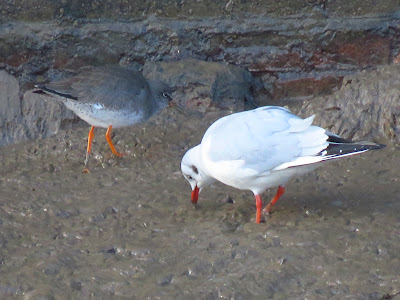
Redshank and Black-headed Gull.
The old moorings of the Arctic Corsair.
This Redshank was dipping its head in the water to feed, right at the tideline.
The glistening feathers of a Carrion Crow by Myton Bridge.
The exposed mudflats by the mouth of the River Hull.
A cormorant was gliding fast with the flow of the river. As it arrived at the Humber, it started to fish, and then I noticed there were two of them, one of them looked young. They dived one after the other several times by the Humber flood defences. 
Then the sun came out and one of the cormorants headed for the spit and started sunbathing and spreading its wings...

...soon followed by the other, who landed and walked to stand closer to the first one.


There were many gulls on the spit at the mouth of the river, by The Deep. Two compact flocks of about 50 Black-headed Gulls were loafing. There were also several Herring Gulls, mostly immature, and Common Gulls. I noticed some of the Black-headed gulls had black heads. Then noticed one with a very black head: an adult Mediterranean Gull! Notice its white wing tips.
Slumbering Mediterranean Gull amongst Black-headed gulls.

The Mediterranean Gull woke up only briefly.
One of the Black-headed gulls with dark head.

River Hull and tidal barrier.
The Humber with The Deep.
Icicles on the Hull History Centre.