Today there was snow on the ground, an easterly wind and a forecast of snow flurries. The snow is much kinder to my camera than the rain, so, of I went via Pearson Park, which always looks beautiful in the snow. The combination of the recently flooded areas and the snow created an undisturbed area in the middle of the grassy area, where a mixed flock of gulls were concentrated facing the wind, loafing. I had to seek the shelter of a tree trunk to be able to photograph them, as the snow was horizontal at the time.
Common Gulls
Common Gulls.
Pearson Park in the snow.
Afterwards, I crossed Beverley Road and I was on the patch km2. A Greenfinch was singing at Sculcoates Park, and a small flock of chaffinches fed on the trees, some Woodpigeons on ivy berries. Although It is a small park, I always make a detour in my visits to the patch, as it is quite good for finches.
I walked around Abby Way, on the grassy area by the train line. I was hoping to flush a woodcock, which have been irrupting in large numbers in the East Coast, escaping the cold weather, but no luck.
The Sculcoates north cemetery had some flooded paths. Three Bullfinches and a large flock of Goldfinches were about.
I walked to the River Hull. The tide was quite low and I counted 5 Redshank.
Wilmington Bridge
I rejoined the drain and walked to Fountain Road and back. I managed to find a Little Grebe, it kept close to the reeds and hid several times.
Little Grebe
Another snow flurry by the drain.
Mallard pair.
The only Coot I saw today.
Moorhen.
View of the drain by Bridlington Avenue.
Another view of the drain.
One of the two Mistle Thrushes feeding by the water line at Pearson Park.
A young Common Gull.
Loafing gulls.
A Black-headed gull.
Note: I made two visits to Sculcoates last week, but it was too rainy for a blog post, hence the lack of week 5 post.
The Mistle Thrush is a plump bird, larger than a Blackbird. It has a grey-brown back, a spotty chest, with round dark spots. The face is marked with white. The white tips of the tail's outer feathers are quite distinctive as the bird flies away. Males and females look alike. Unlike its relative the Song Thrush, it is quite bold, favouring the top of large trees (or aerials!) as singing perch, and often feeding in open grass, standing quite straight, away from cover. It is not unusual to see paired birds or small flocks outside the breeding season in the winter, feeding close to each other on the grass in milder weather.
Mistle Thrushes are widespread resident breeding birds in Hull, favouring parkland-type habitats: open grassland with mature trees, such as cemeteries, parks, churchyards, school grounds and playing fields.
Mistle Thrush using a headstone as look out post, 30 April 2020, Western Cemetery.
Berry tree guarding
In the autumn and winter Mistle Thrushes can be extremely site faithful, associating with particular berry-bearing trees and bushes such as yew, holly, rowan, ivy, hawthorn, mistletoe or whitebeam. Single birds - or sometimes a pair - defend their trees zealously and noisily with their rattling call and tail and wing flicking, and will chase away other birds, including thrushes, Woodpigeons, Waxwings, or bullfinches. Mistle Thrushes uses this resource as a winter food store, and will feed on it only occasionally, using other nearby resources if available. This 'resource guarding' behaviour can be very effective, and a tree still with berries in January or February is testament to the efforts of a guarding Mistle Thrush. As Barbara and David Snow said 'the presence of fruit on a holly or hawthorn after a certain date was an almost infallible sign that it was being defended by a Mistle Thrush'. The guarding bird can sit for long periods on another tree or perch overlooking the fruit tree, only to fly to the tree calling as soon as an intruder arrives to attack and drive it away. The guarding behaviour may collapse, though, if flocks of birds descend on the berry tree.
A Mistle Thrush guarding rowan berries, 14 Nov 2016, East Park.
This pair of Mistle Thrushes look on from a the street lamp while a flock of Waxwings feed on their defended rowans, 5 January 2019, Sainsbury's Way, Hessle.
Singing Mistle thrush, 9th December 2018, Pearson Park.
Breeding Mistle Thrushes
The Mistle Thrush is one of the earliest singing birds in the season, often already in December, and one of the earliest breeders. They will sing from a high perch even in poor weather. Breeding pairs are widespread around Hull: Queens Gardens, Northern Cemetery, Pearson Park, East Park, Pickering Park and Oak Road Playing fields hold a pair or two.
Individual collecting nest material, 17 April 2014, Pearson Park.
Adult carrying food, 19/04/2020, Queens Gardens.
Adult feeding young, 9th June 2014, Pearson Park.
Adult carrying worms, 14 April 2015, Pearson Park.
Recently fledged young, Queens Gardens, 8/5/2020.
Worm-hunting Mistle Thrush poised to strike, 25 March 2014, Pearson Park.
Conservation concern
At the turn of the century, the Mistle Thrush was not a bird of conservation concern, but their populations have suffered recent breeding and wintering declines and it was upgraded to the 'Amber' list and more recently to the 'Red' list in the UK. Low juvenile survival might have contributed to this decline, but the reasons behind this are unclear and more research is needed.
This clip shows a Mistle Thrush defending a clump of rowan berries at East Park, 14th Nov 2016.
An unexpected encounter with a Grey Wagtail this morning at Pearson Park reminded me to finish this blog post, which I started a couple of weeks ago. Grey Wagtails are small energetic birds almost always found near water. Their traditional breeding habitat are fast flowing upland rivers and streams, while during winter they are much more widespread, including towns and cities, where they can be found in parks and even by garden ponds, sometimes away from water. Despite their name, the general impression is of a very yellow bird. They have yellow underparts, with the brightest colour under their tail. The mantle and head are grey, with a pale throat and superciliary arches. The male develops a black throat in the breeding season. They continuously wag their tail as they forage for small invertebrates on the water's edge. Despite this and their bright colours then can be surprisingly hard to spot.
It is not uncommon to have two individuals together in the autumn, these young ones -distinguished by their pinkish chest flush- are likely to be siblings migrating together. Pearson Park, 25/10/2016.
East Park, 4/11/2019.
East Park 14/11/2016.
Breeding urban Grey Wagtails
Until 2019, Grey Wagtails were wintering birds in Hull, with most sightings between October and December, with favoured locations at the parks. However, in 2019, I started to come across Grey Wagtails regularly in the breeding season around a few places around town: by the River Hull by Croda, and by Scale Lane bridge, at East Park and in town near Princes Quay. In 2019 I found a recently fledged young at East Park, and in 2020 an adult carrying food and a fledgling. Richard Broughton had noted the presence of an adult female and an immature at Bransholme Sewage Works in June 2001. All this suggests that several pairs breed in the city. Nesting in suburban habitats in the UK, particularly around sewage farms, was noted as early as the 70s. Grey Wagtails place their nest in cavities in walls, banks and under bridges, sometimes using other birds nests, so it is unlikely that they have a limit in nesting sites.
18/05/2020. East Park adult carrying food.
18/5/2020. East Park. fledgling
4/5/2020 Male singing by the River Hull near Croda.
27/05/2019. Adult male at Zebedee Yard.
Conservation
Although regarded as a bird or Least Concern in Europe and worldwide, Grey Wagtails were moved from Red to Amber listed in the UK in 2021 due to population and range declines in breeding and wintering populations, as is the case of other upland birds. It is unclear if there is an increasing pattern of urban breeding or if this is bucking the declining trend in traditional habitats.
A video of a Grey Wagtail feeding on leaf litter at East Park, 17th December 2018.
A frosty, sunny morning, I decide to take advantage of the crunchy ground and take on a walk that would be uncomfortable in milder weather because of the mud. I walked across the avenues, St Ninian's Walk and Murrayfield Road to the Setting Dyke, then walked across Children's Wood, crossed the railway line on the pedestrial bridge and finally got to Willerby Carr Dyke and community orchard.
One of the most notable thing on the way was a meeting of crows, the noise called my attention from afar, I thought they might be mobbing a raptor, but no. They were all arranged atop a tree, calling, fanning their tails and the variety of their calls was amazing. I took two videos before carrying on.
On the corner, before taking the pedestrian bridge, I watch a large drainage pond on the corner of the playing fields. It is completely frozen.
I watch a Mistle Thrush sallying to pick the remaining berries of an orange-berried rowan. It was here when I last visited on the 1st of December. I haven't seen rowans with berries in a long while, so the Mistle Thrush strategy of chasing all other birds away to keep the berries to itself has worked. It also has a crab apple with some fruits still, and a large birch tree as a refuge.
Rowan still in berry.
The owner of the rowan.
One of a pair of Jackdaws at Priory Road.
The view of fields at the Willerby Carr area.
The Willerby Carr Dyke, frozen on this end.
Redwing.
I spot something red at the base of a hedge, It is a sleeping fox! I flush some woodpigeons and the fox raises its head and looks in my direction. After a few moments, it continues its nap in the sun.
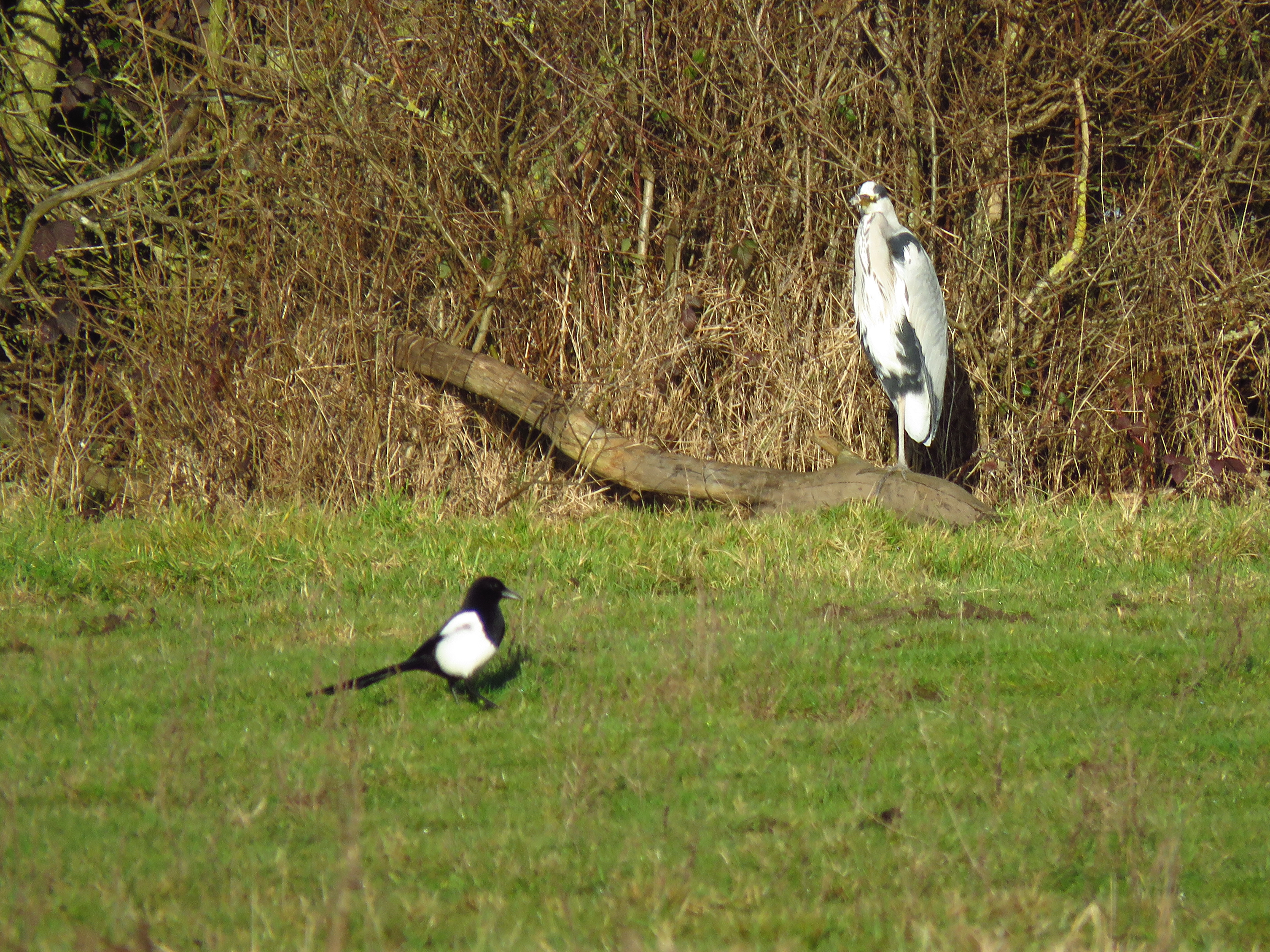
This Magpie passing by a Grey Heron first...
...and by the fox later.
After a walk by the community orchard, with singing Robins, Greenfinches and a Song Thrush as soundscape, I start to walk back.
Magpie.
Singing Robin.
A cat basking in the sun.
The south end of the Willerby Carr dyke wasn't totally frozen.

 Today there was snow on the ground, an easterly wind and a forecast of snow flurries. The snow is much kinder to my camera than the rain, so, of I went via Pearson Park, which always looks beautiful in the snow. The combination of the recently flooded areas and the snow created an undisturbed area in the middle of the grassy area, where a mixed flock of gulls were concentrated facing the wind, loafing. I had to seek the shelter of a tree trunk to be able to photograph them, as the snow was horizontal at the time.