Monday, 3 June 2019

Noddle Hill NR, Foredyke Green and Wilberforce Wood

As part of the Hull Dragonfly challenge I headed to Noddle Hill this morning. This is one of the best dragonflies spots in Hull and East Yorkshire, with an impressive site list of 14 species. It was sunny, but quite windy. I walked around the lake and I didn't see any odonates until I got to the sunny, sheltered NW side.
A Red-eared slider sunnying itself on a log. Azure, Common Blue and Blue-tailed Damselflies were about. After searching on the floating vegetation I spotted 3 male Red-eyed damselflies and later, an egg laying pair.
Male Red-eyed Damselfly

 I walked around the reserve and checked all ditches and ponds unsuccessfully. The only thing of note a lone Southern Marsh Orchid on the northern edge of the reserve.
 I was pleased to have my first Red Admiral of the year. Two Speckled Wood had a long fight over the reeds.
Red Admiral.

Foredyke Green
 About 11 it started to get a bit cloudier and I decided to move onto Foredyke Green and find the pond there. I had been on the area before but didn't managed to find the pond. This time if wasn't too hard. What a beautiful pond (top shot). Water level was quite low, but this exposed a rim of bare soil. As soon as I arrived I saw two male Broad-bodied Chasers in pursuit. They circuited the pond, occasionally bumping onto each other and starting the chase. I decided this was a great lunch spot and sat on an island overlooking the pond. A female turned up and the males gave her chase.
She deftly avoided them and found a quiet spot on the shore, where she started to lay eggs.
One of the males settled for a few minutes on the bank just besides me.

Damselflies were also busy egg-laying. Azure and blue-tailed.
Blue-tailed Damselfly, laying alone.
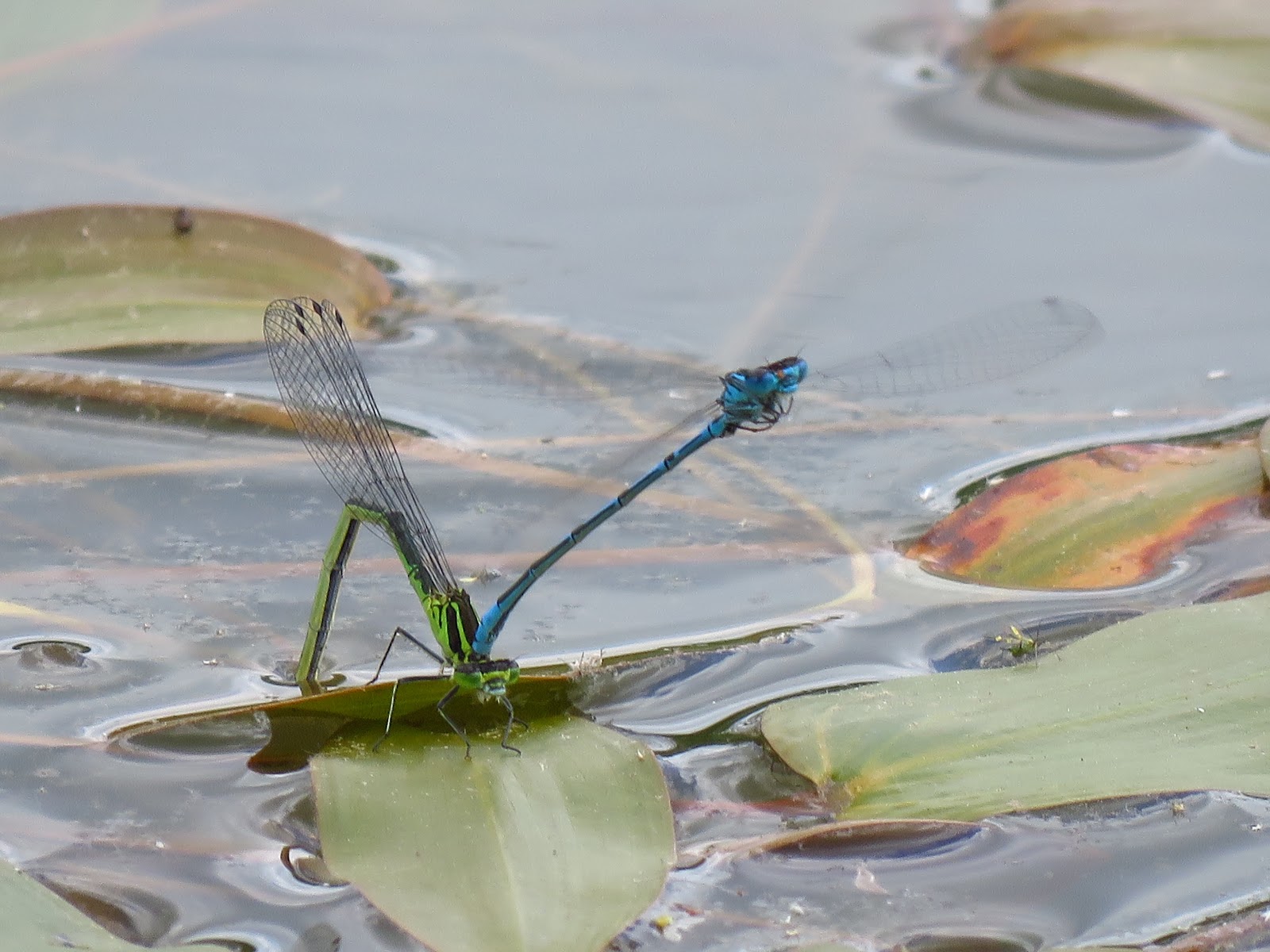
Azure Damselflies in typical egg-laying pose.
The three male Broad-bodied chasers defending the Foredyke green pond was a spectacular sight! I shall get back to this pond later in the year to see how it develops. It does need a bit of nurturing, as there is a lot of litter around the shore.

Wilberforce Wood
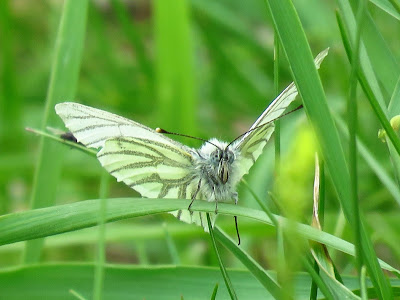
I visited Wilberforce wood too, which is right next to Foredyke Green. There were some Common Blue Butterfllies, Orange tips and a Green-veined white about. I had a fleeting view of a damselfly in a dry ditch but I lost it. The pond seemed to have fish and I couldn't see any odonate.
Green-veined White
Orange Tip female.

Monday, 20 May 2019

Messingham Sand Quarry

My first visit to this fantastic Lincolnshire Wildlife Trust nature reserve. What was formerly a sand quarry has become a patchwork of lagoons, reed beds, conifer woodland, wet woodland, ponds and heath. There are two hides overlooking the northernmost lagoon and benches with a view scattered around the perimeter path. Just upon arrival, near the car park, there were hundreds of Common, Azure and Blue-tailed Damselflies. A Hairy dragonfly hunted atop trees, aggressively charging towards the branches to dislodge insects, but it didn't settle. As I watch the dragonflies, and from the south end of the reserve a Bittern starts booming, and does do intermittently.
 
 I walk around the perimeter path, visiting the hides and taking any possible detour. Birds don't disappoint, with a Spotted Flycatcher (above) on a glade amongst pines, hawking for insects with Chaffinches and Long-tailed tits. When I return to the spot for lunch, it has been joined by hawking Black-headed Gulls over the wood. There is plenty of insects about! There are at least five Garden Warblers singing, and two Cetti's Warblers. In the water, two drake Red-crested Pochards, one Avocet and a common Pochard with ducklings. Also with young the Black-headed gulls and Mute Swans. A Cuckoo calls most of the morning. Then a female calls and I see the male flying over and calling again on a dead tree, where i manage a shot.
Spotted Flycatcher.
Great Crested Grebe with young.
Pochard with young.
Red-crested Pochard.
Black-headed gulls with newly hatched chick.
Cuckoo calling.
Garden Warbler.

Dragonflies and damselflies
The reserve is well known for the abundance of Odonates. Overall I find six species, which is 6 more than I had in my year list at the beginning of the day. I see 3 Hairy dragonflies, but they are hunting and don't stop.
Very abundant Blue-tailed Damselflies.
A couple of Four-spotted chasers.
Red-Tailed and Blue-tailed damselflies.
Azure Damselfly.
Large Red Damselfly.
Common Blue damselfly.
As I check the edge of one of the lagoons, I see the exuvia of a dragonfly, and a damselfly larvae emerging from the water.

Other invertebrates
A wide range of invertebrates around. Including at least 5 Brimstone, with a mating pair, a Speckled Wood and an Orange Tip.
One of several Cinnabar Moths.
Bee Fly, Bombylius major.
This was a new beetle for me. Ontholestes murinus, on a scat, possibly fox, strongly smelling of carrion, with a couple Oiceoptoma thoracica (below).

Cercopis vulnerata.
Brimstone.
Tetragnatha sp.
Nursery web spider, Pisaura mirabilis.
Hornet.
More information
There is a car park, but no other facilities.
A detailed map of the reserve can be found here.
Lincolnshire Wildlife Trust page for the reserve.

Tuesday, 14 May 2019

North Landing to Thornwick Bay

A beautiful sunny day with light wind, I headed to Flamborough early in the morning. I took advantage of the low tide and went down to the North Landing beach, where I ticked the first Puffins for the year. A Grey Seal was visible on and off on the surf line, where rafts of Guillemots and Razorbills sat on the water. The usual assortment of sea birds around, with the also usual House Martins back in the bay, with a sprinkle of Sand Martins too. I walked towards Thornwick Bay. Just after Holmes Gut, on a gully by the cliff Three Wall Browns were chasing, with one occasionally settling to feed on Sea Pink.
 I carried on towards Thornwick Pools, a site I hadn't visited before. It took a while to find, but it is a lovely, open and shallow wetland with a narrow belt of reeds and protected by an earth bund. There are two hides, the lower one had the best light. A pair of Little Ringed plovers were very excited in one of the low islands, doing parallel little races, hunched up, yaffling and making all sort of odd noises. In the hide I meet Andy Hood, from Flamborough Bird Observatory. After a good chat, it's lunch time and I descent onto Thornwick Bay, realising I've never beed there. There is a beach of rough pale and chalk boulders. The chalk makes a shallow platform, giving the water a beautiful turquoise colour. A perfect place for a picnic.

Raft of Guillemots, Razorbills, a Puffin and some Kittiwakes.
North Landing.
Razorbills.
The cleptoparasitic bee Melecta albifrons.
View from the cliff east of North Landing, with Bempton in the distance.
Holmes Gut.
Thornwick Pool.
Shelduck.
Singing Linnet.
Puffin.
Thornwick Bay.
Wall Brown Butterfly.
Singing Sedge Warbler.
Possibly Nomada fabriciana on daisy. A cleptoparasite of several mining bees.
Another view of Holmes Gut.
North Landing.
Thornwick's Bay.

 Thornwick's Bay panoramic.