Friday, 23 September 2016

Filey Brigg birds and half a lifer

The sea was very flat, with almost no wind today and high tide. I had only been to Filey once before and it was nice to be back, right on migration season. By the campsite, on the Sycomores we heard a call reminiscent of coal tit that happened to be a Yellow Browed warbler. It didn't exposed itself very well, so I ended up having a lifer without seeing it's head. Insects were aplenty by the line of trees, including several Red Admirals and many hoverflies. On the pond a Dunlin fed with some Linnets. We walked atop the north facing clifs and spotted a Wheatear.
 The birds were aplenty by the Brigg. A group of six Common Scoter not too far offshore, Cormorants, Sandwich Terns, Shags, various gulls, a flock of snoozing Knot, Dunlin, Purple Sandpiper, Oystercatcher and while having lunch, a surprise in the form of a Kingfisher. The nicest thing about Filey is that you don't really need a telescope to see the birds!
Pied Wagtail.
Helophilus pendulus.
Eristalis tenax.
Mesembrina meridiana.

Red Admiral.
Greenfinch feeding on rosehips.
Dunlin.
View to the NE from the clifftop.


Common Field Grasshopper.
Common scoters.
Rush Veneer, a migratory moth.
Turnstone.
Cormorant.
Red throated divers.

Knot
Beadlet anemone, Actinia equina.
A view of the Brigg.
Knot
Purple Sandpiper
Sandwich Tern
Lion's mane jellyfish, Cyanea capitata
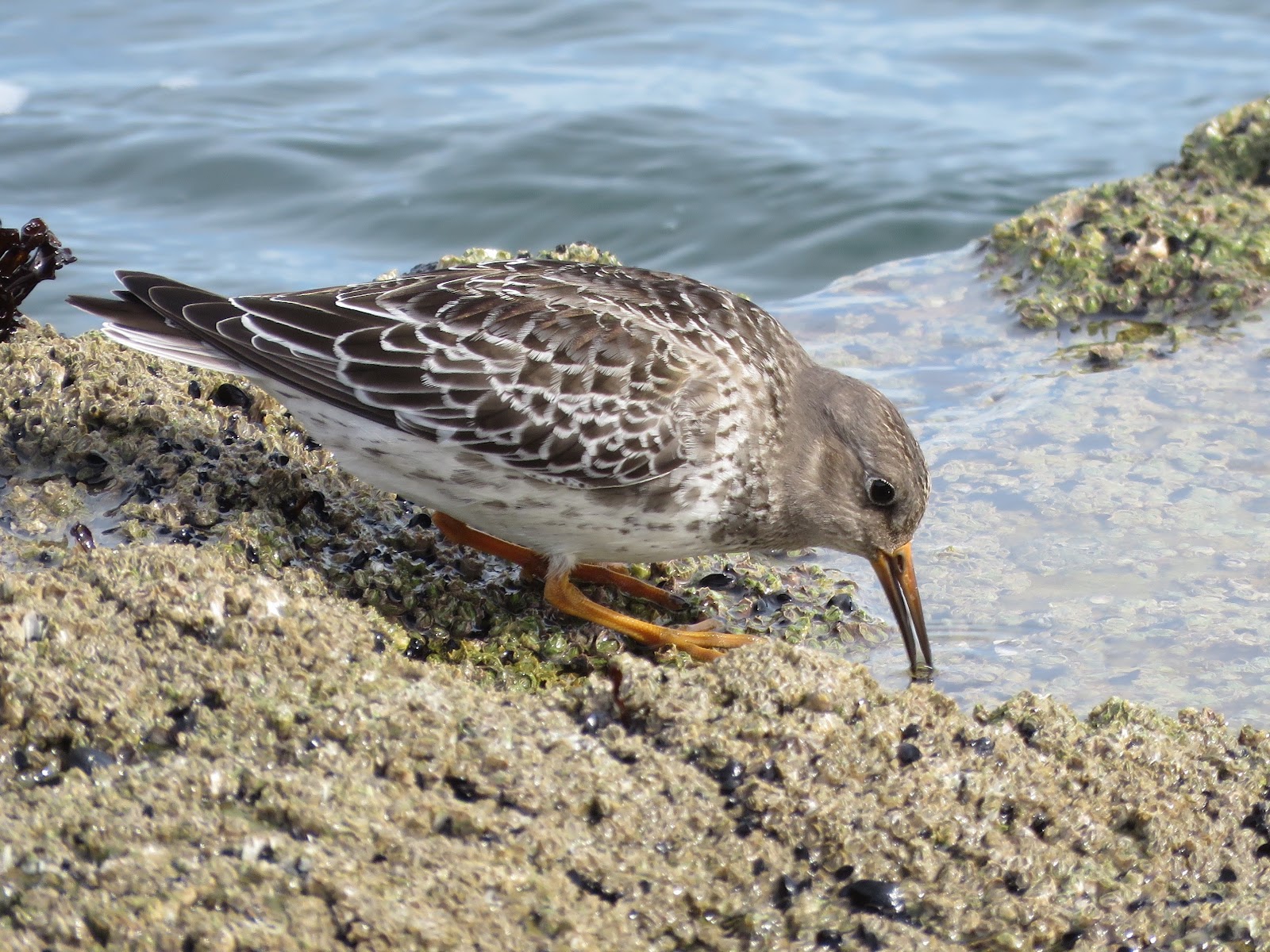
Purple Sandpiper
Shag (left) and Cormorant
Common Shore Crab, Carcinus maenas.


Saturday, 17 September 2016

Shearwater cruise aboard Yorkshire Belle

On the 17th of September we went on one of the RSPB's Shearwater cruises from Bridlington Harbour aboard the Yorkshire Belle. As the cruise was at 3:00 pm we had a day around Bridlington first. It was cloudy with a cold windy and the tide was out when we arrived and we walked around the harbour, me mainly birdwatching. I was pleasantly surprised that the Barnacle Goose that lives there with some mallards is not pinioned as I previously thought and is very able to fly. Turnstones, Redshank and various gulls were feeding on the mud. At least 25 Great Black-backed gulls, adults and juveniles, were under the pier where the fish is processed. There was a fight between some of them, while others did the long call, with a much lower pitch than Herring Gull's and displayed together. What an utterly awesome spectacle!


 After lunch, we walked along the pier. A handful of Purple sandpipers fed on some mussel-covered rocks exposed in the low tide, with Turnstones and a pair of Oystercatchers.
The view of the North beach from the pier with Flamborough in the horizon.
Purple Sandpiper.
Purple Sandpiper.
A few Kittiwakes sitting on the outside of the harbour wall. The little shelf provides enough space for them to nest and roost.
Adult Herring gull atop the pirate ship ticket office.
 And then it was time! The Yorkshire Belle arrived in the harbour (above) and soon we were settled and ready to go. There was a running commentary of birds seen from the deck.  Sandwich and Common terns were fishing not far from the shore. The first exciting moment was to watch Arctic Skuas chasing and mobbing terns into releasing their catch. Flocks of Scoters passed by. At some point a crew member started to drop some fish to the sea to attract shearwaters. We had some distant views of a Manx Shearwater, a first for me. The highlight was a Great Skua or Bonxie (top shot), who fed quite close to the boat with Herring Gulls and Great black-backed gulls.
I am quite awful at sea with seasickness, but still enjoyed the trip very much.
Common Scoter
Arctic Skuas
Arctic Skua.
Gulls gathering behind the boat.
The Great Skua was squabbling with some gulls here.
As we returned to Bridlington, more Kittiwakes had congregated to roost on the harbour wall.

More information
RSPB shearwater cruises with the Yorkshire Belle. Website.

Thursday, 15 September 2016

Alkbrough Flats Spoonbills

I went to Alkborough Flats with Robert Jaques in the hope of ticking the Purple Swamphen that has been there for a couple of weeks. In the end, we weren't lucky with the swamphen, but the visit was quite worthwhile as there were so many birds at the site and we had some great views of many species. We walked to the low hide overlooking the lagoon. There was a large flock of Avocets mixed with Shoveler and Shelduck feeding, and just by the shore a Spoonbill preening with a few others feeding nearby. In all, at some point 13 Spoonbills were visible from the hide, and at least four individuals were colour-ringed. A few Pintail fed on the distance. Black-tailed Godwit, Redshank, Ruff, Avocet and various ducks sat on the mudflats. The pinging calls of a group of Bearded tits were heard and they appeared briefly.
One of the trip highlights was watching a couple of young Water Rails on a shallow ditch by the hide. We had heard their calls, and eventually they showed, relatively well, although quite nervously: a tiny noise from the hide was followed by a rail diving into the reeds.
 When leaving the hide a group of Chub were very visible on a ditch. Many common darters and some hawkers I couldn't identify were also about.
We moved onto the path by the hillside, where some birdwatchers awaited pointing with their telescopes into a distant pool where the Purple Swamphen had previously been seen. None had seen it today, so after a little while we moved onto a sweltering tower hide for lunch. A Marsh Harrier, the only one of the day, quartered over the reedbeds, followed by mobbing Lapwing. This took the day tally to 47 species.
A selection of Spoonbill photos:


Two colour ringed Spoonbills.
Feeding Spoonbills.
Spoonbill and Avocet
Many Ruff in the reserve, this is one of three that walked past the hide.
Curlew.
Reed Bunting.
A male Bearded Tit, part of a small group that fed on the reeds.
Pintail
One of the young Water Rails.
Group of Chub, Squalius cephalus, in a dich by the hide, a new fish for me.
Male Common Darter
Devil's Coach Horse, Ocypus olens, displaying.
A small toad, found crossing the path.
View of the reserve from the path.
One of two Small Coppers settled after a long fight with another. Other than the Small Copper, we saw Speckled Wood, Comma, and Red Admiral around the reserve.