Wednesday, 18 February 2015

Sunny at East Park

An sunny, mild afternoon spent at East Park with the kids. The highlights were a Grey Wagtail flushed from the middle part of the lake, the presence of the two pinkfeet geese, and a singing Song Thrush. The top shot is one of these images that can only be from East Park: diving Tufted duck, Pochard, Pinkfoot and Greylag preening. A selection of photos follows.
A few Black-headed gulls were advanced in the moulting into summer plumage.
These coots were displaying at (or away from) each other. Most of the time, whey were looking away, with their wings puffed up. Given that the white shield is an aggressive signal, maybe they were courting.
I saw 'White Head' and her partner both at Pearson Park early in the morning and at East Park in the afternoon. He tends to keep a vigilant eye while she feeds.
Swan 775 still on its own.
This Coot seems to have started nest building.
Pinkfoot, one of two in the park today, in the Greylag flock by the feeding station.
A drake Pochard.
A Greylag altercation, with the fighting geese in the middle with heads submerged. Both Pink-feet are on the right.
The Pink-footed geese seem completely integrated in the Greylag flock, I observed no agression, despite they keeping very close to the greylags. Here, one of them celebrates victory with some greylags. This is called, the 'triumph ceremony', when, after an altercation, pairs and attached individuals call together with stretched necks.
After things went back to normal, some geese stretched their wings.
Both Pink-feet were together, but one of them was following a greylag most of the time, with the other on tow.
Both pink-feet look now adult.
This distressed Greylag honked inconsolably, maybe having become separated from his partner.
A female Pochard.

Monday, 9 February 2015

Sun and ice at North Cave Wetlands, with a Stoat-Moorhen standoff

I went to North Cave Wetlands with Robert Jaques this morning of sunny, clear sky and still conditions. Island, Carp and Reed Bed were completely frozen, but there were enough clear patches in Village, main and Far lakes for a fair number of birds in the reserve. We admired the new viewing point, with the picnic tables already in place and watched the birds visiting the new well-stocked feeding station: many Chaffinches, House Sparrows, Goldfinches, Blue and Great Tits, a Robin, Blackbirds, a lone drake Mallard and a Long-tailed tit. This development already looks like a big hit, as visitors gathered to have lunch while admiring the views and the birds.
 In the islands of Village lake there were plenty of Teal, Lapwing, Little Grebes and Wigeon and a flock of Snipe.
 In the east path we came across an odd looking chaffinch, which on closer inspection turned out to be a Brambling, with another one around too.
 On the feeding station by the maize field there were many Tree Sparrows, and I missed a Great Spotted Woodpecker.
 After admiring the frozen, bird free Island lake for a few minutes we carried on the anticlockwise tour of the reserve. At least two Skylark were in full song in the north fields. Robert found a Barn Owl pellet by the fence on the north path, which I later found to contain a Field Vole and a Wood Mouse (following the RSPB key here). A few large geese skeins passed flying quite high, which we thought to be Pink-footed geese.
 Siskins and a Lesser Redpoll in the Alders by the west path. There were plenty of birds at one end of the Crosslands hide lake, many Tufted ducks, Pochard and Shelduck. From the main lake the only thing of notice were 7 Buzzards soaring over the hills.
 We popped in the viewing platform before leaving and someone spotted a Stoat. It seemed to be enjoying the sun on a grassy path, although, in pure stoaty fashion it couldn't really sit still for more than a minute at a time. It went up to the bank, it squirrelled back to where it was, it went into a bush and jumped crazily about, and then seemed to settle on the sun and scratched a bit, and groomed a bit, when we realised a Moorhen was walking in the stoats direction. The stoat and the moorhen looked at each other. The stoat seemed completely disinterested, while the moorhen did a display I had never seen a moorhen do. It dropped its opened wings and stood high, while keeping a close eye on the stoat, then it turned around and walked the same way it had come. What a great way to end a great day out.
The view from the viewing platform.
A female Reed Bunting under the feeders
Reed Bunting
A Long-tailed tit on the feeders
A very healthy female Blackbird on the feeders
The newly revamped feeding station by the maize field
I love reed beds, there is a male Reed Bunting in the photo too.
A large skein of geese over the reserve
Barn Owl pellet
The frozen Reedbed Lake
Stoat...
standing up...
...lying down
spotting a moorhen...
The moorhen opened its wings appearing to be larger than its size, and run away. This is a screenshot from a video.

Bird List
  1. Black-headed Gull
  2. Blackbird
  3. Blue Tit
  4. Brambling
  5. Bullfinch
  6. Buzzard
  7. Carrion Crow
  8. Chaffinch
  9. Common Gull
  10. Coot
  11. Cormorant
  12. Dunnock
  13. Feral Pigeon
  14. Gadwall
  15. Goldfinch
  16. Great Tit
  17. Grey Heron
  18. Greylag Goose
  19. Herring Gull
  20. House Sparrow
  21. Jackdaw
  22. Kestrel
  23. Lapwing
  24. Lesser Redpoll
  25. Little Grebe
  26. Long-tailed Tit
  27. Magpie
  28. Mallard
  29. Moorhen
  30. Pied Wagtail (yarrellii)
  31. Pink-footed Goose
  32. Pochard
  33. Redshank
  34. Reed Bunting
  35. Robin
  36. Rook
  37. Shelduck
  38. Shoveler
  39. Siskin
  40. Skylark
  41. Snipe
  42. Stock Dove
  43. Teal
  44. Tree Sparrow
  45. Tufted Duck
  46. Wigeon
  47. Woodpigeon
  48. Wren

Sunday, 8 February 2015

Sunny winter afternoon at Oak Road Lake

It has been ages since I have been at Oak Road, and there is no excuse as I love the place and is just a short drive from home. It has been a glorious winter day today, still and mild, with a wide open blue sky and a sun that definitely feels higher in the sky. 
 There a new area planted with trees, which is new to me. A Great Tit sings from atop a willow.
Although there is still some snow patches here and there, the lake is mostly ice free and there are a bunch of birds on it. A drake Pochard half sleeps by the reeds, the pair of Mute Swans with a young one from last year approach to check if I have any food, I don't but there is a dog walker who does.
 Coots and Moorhens aplenty on the lake, and an eight strong flock of Gadwall, with six males who display calling their funny grunt-whistles, and preening in front of the females. It is only after a while that I notice the drake Shoveler, it must have been feeding in the reed beds. He seemed a bit wary of the walkers around the lake and kept to the middle, often with the Gadwalls.
 I walk on the bank by the river but it is very muddy and I see nothing of interest, so I return to the lake perimeter path. A Song Thrush sung loudly from the willows by the lake. Blackbirds, Great Tits and Dunnocks by the newly planted area.
 I take a walk on Green Lane, which is extremely muddy. A commotion of Starlings; a speeding shadow of a Sparrowhawk chasing a starling. I see the Sparrowhawk again twice, flying low along the lane shortly after, and then soaring over the fields and dropping onto the wood by the lake. A pair of Stock Doves on the lane was nice. There are large puddles on the playing fields, with crows, common gulls and black-headed gulls feeding. With the sun setting it is time to go home.
Newly planted area.
Great tit
Pair of swans with young of last year on the right.
Resting drake pochard (with eye open, though!)
Is there any food coming?
Female Gadwall
Drake Gadwall
Shoveler
 Shoveler
Shoveler swimming by the ice
Moorhen


The shelf of ice gave these gulls some quiet resting space.
Bird List
  1. Black-headed Gull
  2. Blackbird
  3. Blue Tit
  4. Carrion Crow
  5. Chaffinch
  6. Collared Dove
  7. Common Gull
  8. Coot
  9. Dunnock
  10. Feral Pigeon
  11. Gadwall
  12. Goldfinch
  13. Great Tit
  14. Greenfinch
  15. Herring Gull
  16. House Sparrow
  17. Long-tailed Tit
  18. Magpie
  19. Mallard
  20. Moorhen
  21. Mute Swan
  22. Pochard
  23. Robin
  24. Shoveler
  25. Song Thrush
  26. Sparrowhawk
  27. Starling
  28. Stock Dove
  29. Woodpigeon 

Monday, 2 February 2015

Frosty Burton Bushes and Beverley Westwood

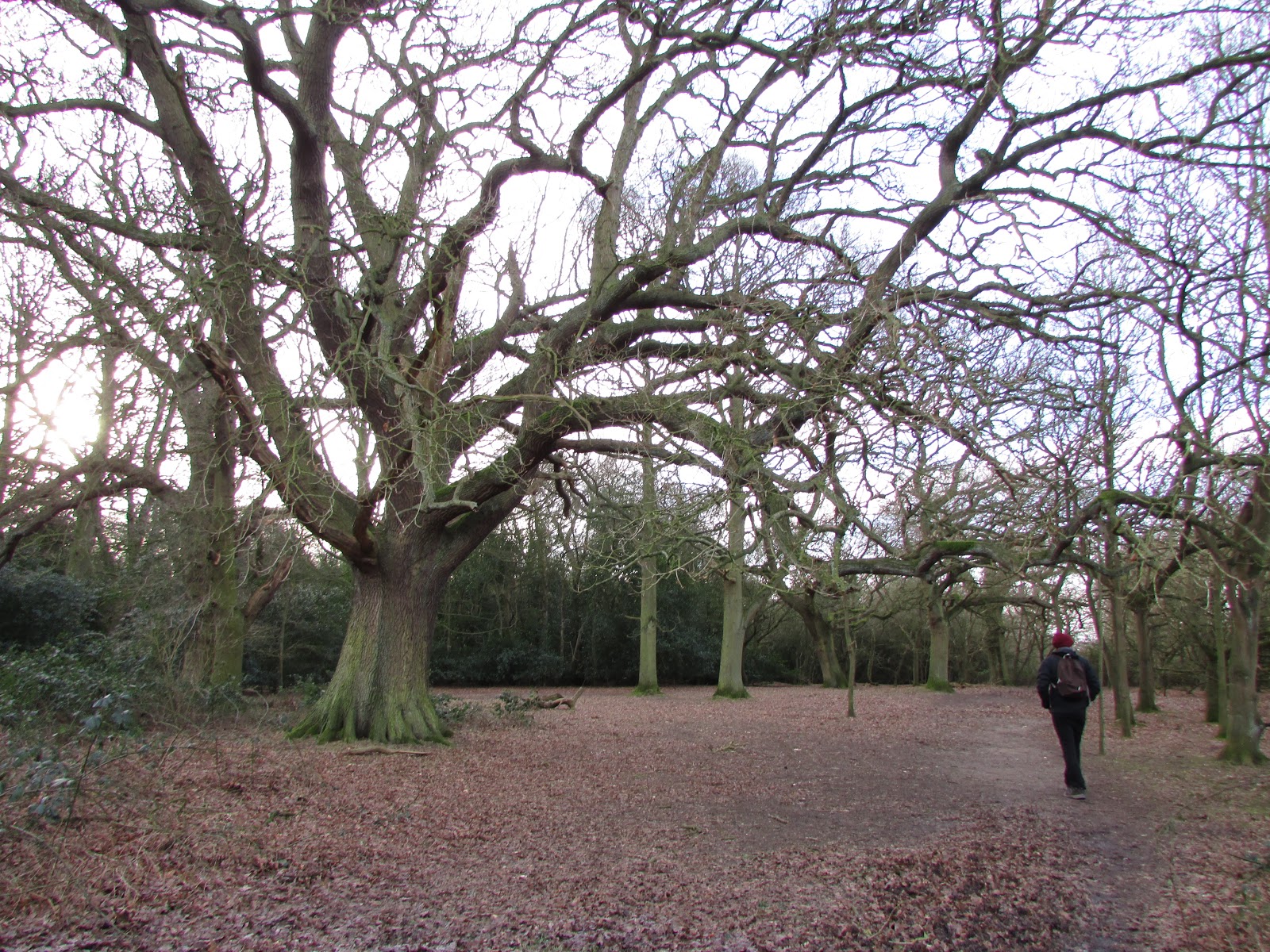
After the last couple of wet days, the morning appeared bright and icy. We headed to Burton Bushes, a SSSI site which contains a small ancient woodland. The wood is mainly oak, some ash, beech and birch and much holly and hawthorn. There is little undergrowth this time of year, just a thick carpet of golden leaves covered the ground under the trees. The thick frost kept the mud mostly solid on the paths, which would have been almost completely impassable without wellies today. We lifted some lying wood, of which more later, and didn't find a lot: some flat-backed millipedes (Polydesmus sp.), some Common Striped woodlice and pygmy woodlice, a harvestman, a couple of ground beetles and a click beetle, and a tiny, really hard to see white snail, barely 2 mm in diameter.
 Blue tits we ubiquitous and very noisy, one of them performed a very passable blackbird impersonation. A couple of Goldcrests fed on a hawthorn and a seemingly lone, male Bullfinch fed on hawthorn buds on the edge of the wood. A distant Buzzard and a couple of Treecreepers in a group of trees by the golf course were highlights too.
 This winter has been windy, and its effects were apparent all around the wood. Some large trees had been blown over, opening large clearings, lifting root plates, and, by increasing the amount of wood on the ground, creating rich invertebrate habitats on their demise.
 Most of the wood's trees are mature, some starting to decay and die. Only in two areas of the wood there was some evidence of younger trees growing. Although cattle has no access to the wood, rabbits appear to be plentiful, and we wondered if there was any chance of natural regeneration of the woodland.
Click beetle for ID
An aggregation of flat-backed millipedes, Polydesmus sp.
Tiny snail for ID
The lovely and tiniest harvestman Nemastoma bimaculatum
A particularly bare area under a large oak
Pools of water on the roots of a beech.
A large (aprox. 2 cm) ground beetle, likely Pterostichus niger, found under a rotting log. Although alive, it pretended to be dead really well.
A large branch of an oak chopped up the hawthorn on the foreground clean, creating a clearing, letting the sunlight in.
A growth on a Holly trunk
As we were leaving, a Skylark did a little song flight over our heads, and then joined another one on the ground.

UPDATE 2/2/2014. Ground beetle ID thanks to Menno Schilthuizen and Martin Harvey on Twitter.

Bird list (Burton Bushes tetrad)
  1. Blackbird
  2. Blue Tit
  3. Bullfinch
  4. Buzzard
  5. Carrion Crow
  6. Chaffinch
  7. Dunnock
  8. Feral Pigeon
  9. Goldcrest
  10. Goldfinch
  11. Great Spotted Woodpecker
  12. Great Tit
  13. Jackdaw
  14. Magpie
  15. Mistle Thrush
  16. Redwing
  17. Robin
  18. Skylark
  19. Starling
  20. Treecreeper
  21. Woodpigeon
  22. Wren


Monday, 26 January 2015

Tophill south, and then north

I visited Tophill Low with Robert Jaques today. A chilly, breezy day with a sunny spells. We avoided the sleety cloud and once there we had a dry day. We started with the south part of the reserve, which I hadn't visited in quite some time. The day started well, with a mixed flock of Siskins and Goldfinches, and some Redwing on the poplars. There was a noisy chase of Great Spotted Woodpeckers, and we heard them drumming a couple of times more.
 Ducks were plentiful today, we ticked all the common species: Wigeon, Teal, Pochard, Tufted Duck, Mallard and Shoveler, Goldeneye looking very dapper, plus a surprise drake pintail flying over O res. To top the duck list we saw the female Scaup later on D res.
 We didn't add much at Watton, but there were birds a plenty, with two Little Egrets and a flock of Curlew, first sleeping and then preening and bathing, amongst greylags, teal and wigeon.
 We went round the south of the reserve quite quickly, so we had time to do the north as well. D woods had lots of Great and Blue tits, but the chill didn't help with waiting for the brown ones, so we headed on towards North Marsh.
On the raptor front, Kestrels were aplenty we saw more than five of them around the reserve, only topped by the fantastic view of six Buzzards flying and mewing over North Marsh (with nothing else to report from there unfortunately).
 Hempholme was entertaining today. Carrion crows mobbed a Kestrel while another one hovered unperturbed nearby. A Grey Heron captured and swallowed a vole unceremoniously, and a pair of Pheasants walked by the hide. Two Kingfishers also made a brief appearance.
Little Egret
Goldeneye
Curlew and Greylags
Robin by Hempholme hide