Showing posts with label commons. Show all posts

Wednesday, 10 May 2017

Swinemoor with Hull Nats

A beautiful, still and mild evening put an end to the Arctic wind we have been putting up with in the last week. I revisited Swinemoor Common in the Tuesday night field meeting of Hull Nats. We walked around the common going south by Beverley and Barmston drain and then following the river upstream.
We started by admiring the horses galloping alongside the river bank.
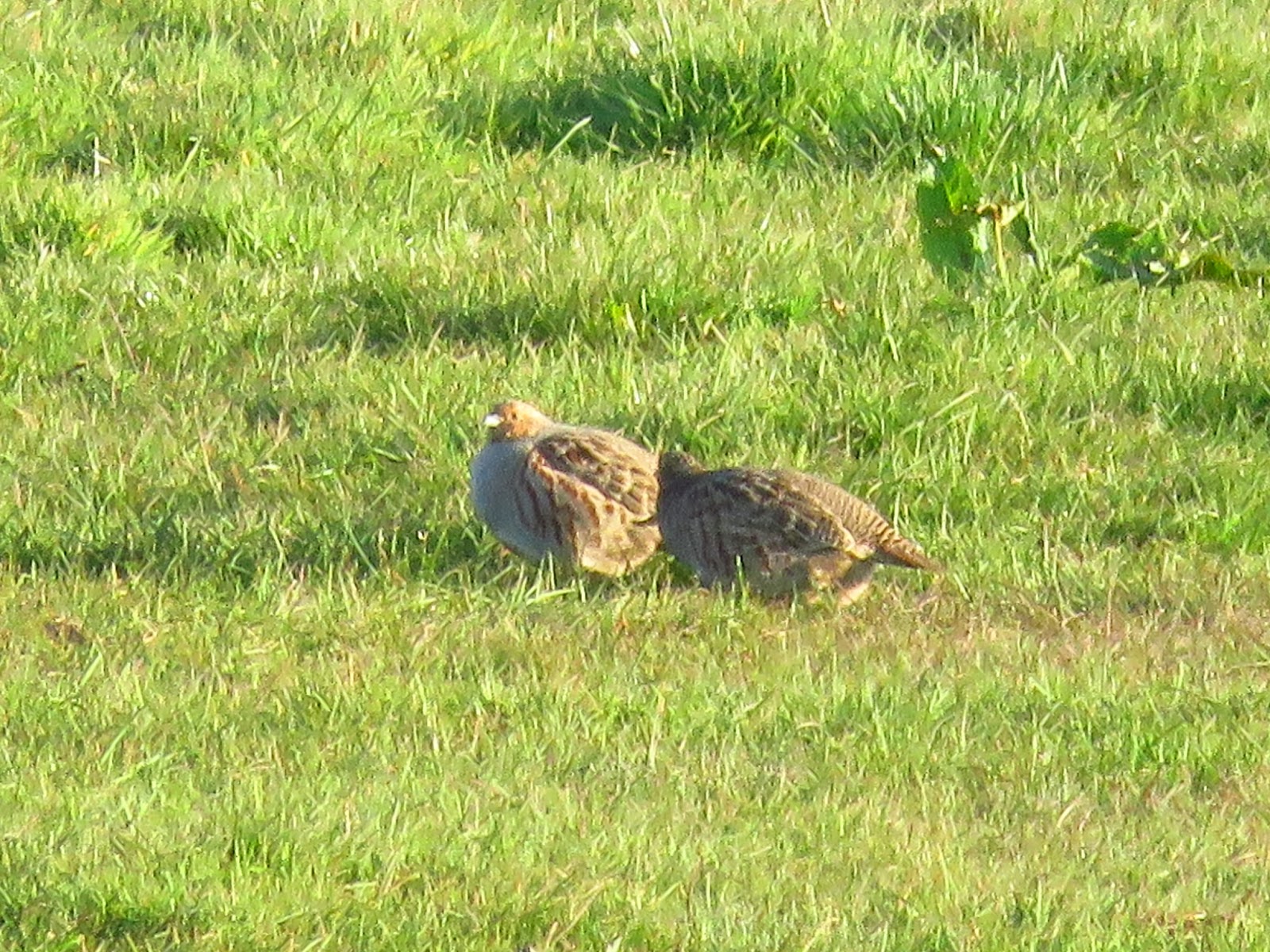
Andrew spotted a pair of Grey Partridge feeding close to us, the first time any of us sees this species there.
One of the two Yellow Wagtails we saw. 
A Lapwing with 5 young chicks. They were very busy chasing crows and jackdaws away (top shot), and also an unfortunate Little Ringed Plover that dare approach the chicks. 
The shadows of Hull Nats members observing Lapwing chicks through Andrew's telescope. 
Male Lapwing in the wet pasture. 
We were hoping to watch Snipe drumming. Instead, we were treated to the sight of 16 local Snipe joining in a flight (a wisp of Snipe that is) around the common.
Plenty of Swifts and Swallows about, and this is what they are after following the river, drains and other wet areas during their migration, clouds of midges gathering over Beverley and Barmston Drain. 
The only Domestic Geese left. 
The trip finished with a beautiful sunset over Beverley.

Sunday, 23 April 2017

River Hull. Stage 8. Swinemoor

A beautiful afternoon with a light breeze and cottony clouds, I headed to the second of the Beverley Commons that adjoin the river Hull: Swinemoor. Swinemoor, which occupies an area of about 119 ha, sits between the SE of Beverley and the River Hull. It is a flat expanse of pastures prone to flooding, with some flooded scrapes and lines of overgrown hedgerows and occasional trees. It is crossed by the Beverley and Barmston drain. I walked by the drain to reach the beginning of the river stage proper, on the west side of the river, just opposite of where I left it the last stage.
 The sunny, warm weather brought butterflies out. Three Peacocks fluttered up and down circling each other for a long while at the north side of the common and Small Tortoiseshells were plentiful and very active too. I also had my first Holly Blue of the year and a male Orange Tip.
 The cattle and horses have been allowed on the common in the last few days (top shot).
Swinemoor is well known for its bird diversity. Today, hirundines, including Sand Martins, House Martins and Swallows were busy feeding over the river. Both Swallows and Sand Martins appeared established, as some were collecting mud by the shore of the drain. Several pairs of Lapwing seem to be breeding, with some occasional skirmishes with the local Carrion Crows. A Meadow Pipit sung. Snipe are known to breed in the common, but it was an early visit in the season and in the day, for them to be drumming. Other than the breeding birds, Swinemoor is known as a migration hotspot in the area. I repeatedly searched for Yellow Wagtails, with no luck, although Pied Wagtails were plentiful, with at least two pairs. One highlight was a flock of about 10 Whimbrel, which landed near the drain and started feeding for a while on the pasture. In addition to a Redshank, two Ruffs fed on one of the scrapes. Overall, I listed 42 bird species in today's stage. A telescope would have been very useful, as the pools are distant from the paths and it is unadvisable to approach the pools to avoid disturbance to ground breeding birds.
I finished the stage by near the pedestrian bridge parallel to Hull Bridge.
The pedestrian bridge at Tickton.
Holly Blue butterfly. 
Cattle and horses at the common. 
Swallow and House Martin picking mud for nesting.
A young Grey Heron fishing by the drain.
The wide expanses of the common. From the drain, looking East. 
Lapwing by scrape. 
The Yellow Dung flies waste no time as soon cowpats are available. 
A speedboat went past. 
A bend of the river shows the reedbed fringing its East margin.
Whimbrel. One of of a flock than landed and started feeding near the drain.
Ruff. 
One of the pools and the bridge over the drain on the background.  
From this patch of reedbed came the scratchy, repetitive song of a Reed Bunting, the first of the year for me. 
View of the river from the pedestrial bridge 
View of Hull Bridge over the river Hull. 
An alderfly by the drain.
More information
An entry at Birdnerd with information on the common. Here.

Check the Google maps in the blog for the routes involved in each stage.

Saturday, 25 March 2017

Up the River Hull. 6. Figham Common

A mild, sunny afternoon, I started today's stage in Woodmansey, where a public footpath joins the southern end of Figham Common. The river bends west, hugging the old common land laying on the SE of Beverley. Historically, the common has been very low laying, waterlogged ground despite repeated draining attempts since medieval times. Today three large drains cross it, but only the western side of the common, which is drier, is suitable as pasture land, while the eastern side by the river is marshy, with rushes and temporary pools or boggy terrain all year round. There are quite a few scattered trees, old willows, hawthorns and just a patch of reed bed by the river near the lock at Beverley Beck.
 As I reach the river I watch a tractor tilling a field on the other bank followed by a retinue of birds: Carrion Crows, Jackdaws, Lesser Black-backed Gulls, Herring Gulls, Common gulls, Woodpigeons, Stock Doves, a few Lapwing and two Oystercatchers. A Skylark sings above.
In the middle of a field further ahead, two Grey Herons sit still like scarecrows, and two Hares further away feed on the grass. A pair of Greylag dozes on the bank opposite.
I make the walk into a circular route, returning by the Beverley and Barmston Drain towards Woodmansey after reaching the lock at Beverley Beck. You can see the route in the Wild at Hull map on the right.
Entrance to the common from Woodmansey.
As I enter the common a Small Tortoiseshell flutters and settles on the grass. Later, a peacock flies by.
Pool.
Two Little Egrets fly over the river. 
Female Kestrel. 
Beverley and Barmston Drain, from Figham Bridge. 
Tractor followed by birds. 
View of the river, looking downstream from the S end of Figham. 
Waterlogged ground and trees. Blackthorn in bloom.

Old elder (a bit redundant wording!)
View of the common from the river bank.
River, bank and common. 
Arriving at the lock of Beverley Beck. 
Beverley Beck lock.
A pair of swans on the drain.

More Information
Archaeological Survey of Figham common. here.
Information on the birds of Figham Common. here.

Friday, 15 August 2014

Walking with cows at Figham Common


I had a pleasant outing to Figham Common with the Hull Natural History Society on Tuesday evening. Figham is one of the three commons of Beverley, which I had never visited before. As I arrived at 7 pm, a double rainbow glowed bright on the horizon and a group of swallows flew low over the fields. The weather was mixed, and we managed to avoid the rain for most of the time, except for a good shower at the end. There were good numbers of bullocks of various breeds in the common, and we were object of their attention (above) in between curious and nervous. What more obvious thing than looking for dung beetles in a common? After all, dung is one of the most abundant microhabitats there. I quickly armed myself with a suitable poo-stick and started poking into cow pats of a range of sizes and consistencies, while Robert Jaques predicted our chances of success remarkably well. These efforts were quickly rewarded with several beetles, which ended in the bug pot for later ID and photos. What!? dung beetles? I hear you say, in the UK!? but yes, not the large African dung ball-rolling beetle, but awesome little critters regardless, the largest about 2 cm long, which are involved in the processing of the tons of dung produced by cattle, horses and other mammals. Dung beetles, some aquatic beetles and their larvae live in the moist, rich environment of the cow pat, feeding on bacteria, fungi and decomposing vegetable matter. We also came across Yellow Dung Flies, early colonisers of fresh cowpats (below).
Robert brought me the beetles back today, nicely IDd and I had a session on them on white background. The first beetle, Aphodius fossor, a true dung beetle of the family scarabeidae, walks slowly, and when surprised in the dung, they played dead and were easy to collect. During the photo session they were quite obliging and after a few shots in the white bowl, I ended up placing it on a white sheet of paper as background, as it allowed me to get the right angle and try to portray its lovely shovel-shaped head.
Aphodius fossor, a dung beetle. The shovel-shaped head allows them to dig easily into the dung. Its species name 'fossor' means digger in latin.
a front view of A. fossor


The second species is a smaller, water scavenger beetle, Sphaeridium sp., I tried to use the same technique with this species, but it was a much more lively, fast beetle, and as shortly after coming out of the pot, it lifted the front of the body, antennae spread, like smelling the air, and it just flew off vertically, carrying its mite with it.
Water scavenger beetle, Sphaeridium sp. with mite
Sphaeridium sp. stretching its wings.
A Lesser Marsh Grasshopper
You can see the bird and plant list of this and other field visits at the Hull Natural History Society website.