Showing posts with label Honeysuckle farm. Show all posts

Tuesday, 10 April 2018

Honeysuckle Farm revisited

A foggy, cold day. If not for the singing chiffchaff, the mating toads or the grown Moorhen chick one would say it was still February. Everything feels late this year after the spell of snow and cold weather in March. The only invertebrate was a bumblebee nest searching.
 I'm always surprised by the diversity of birds in the farm and I put together a decent list every time I go. I added Song Thrush to the site list today. With a pair feeding on the cows field and a male singing.
Starlings were hard to see in the distant fields through the fog.
This Toad mating ball in one of the ponds had me a bit puzzled until I realised that the browner mass is actually a pair in amplexus, with the greyish individual trying to get in.
A Chiffchaff was singing, and two were chasing at some point, this was one of them.
Tree Sparrows seem to be doing well, with nests in two areas of the farm, with a good provision of next boxes in trees as shown in the next photo.

Rooks were looking for food in the cows field, and Jackdaws were also about.
By the sheep field a Woodpigeon (I take the male) approached its partner with a conciliatory posture, the opposite of the aggressive high stance.
The other woodpigeon, probably the female kept approaching the other to groom and demand being fed.
In the ponds the sudden 'ket,ket,ket!' of squabbling moorhens. Two individuals displayed in parallel, tails fanned...
Then they showed their rears to one another and parted their own ways.
One of the pairs actually had a grown chick. Quite surprising given the recent weather. The chick was probably born during the beast from the east event!
Song Thrush and blackbird feeding on the grass.
The nicest surprise was to find three yellowhammers feeding on the chickens and turkey pens. They were a bit flighty, and I only managed this shot. I hadn't seen Yellowhammers in the farm for a couple of years.

Monday, 13 April 2015

Honeysuckle farm

The kids requested a visit to the farm for their last day of Easter holidays and I was only too happy to oblige. The day was sunny and mild, and while they played endlessly on the hay bales, I had a few walks around the farm, enjoying the spring weather. There was a blackthorn covered in blossom and droneflies and other flies, a few active bumblebees and a Comma were feeding and hovering by it. I heard a Chiffchaff singing and getting closer and soon he was also feeding on the blackthorn flies.
 I also heard a Willow Warbler and managed to locate it, but it was in the young woodland area and stayed in areas of thick cover so I couldn't get any decent shots. A male Blackcap sung, and a female was nearby.
 I was very pleased to find a number of Tree Sparrows near nest boxes. One of them was being chased by a Blue Tit, maybe competing for a box? Unfortunately, there was no trace of Yellowhammers in the farm.§
 The highlight of the day for me was finding a number of Dark-edged Bee-Flies, Bombylius major. One fed on primroses and then sunbathed for a while. Others were egg laying on colonies of mining bee (Andrena sp.). They were most fascinating to watch. They hovered near the ground, and either stopped to rest or laid eggs, by swaying their body towards the bees nest holes.
Male Chaffinch
Singing Chiffchaff
The flowering blackthorn.
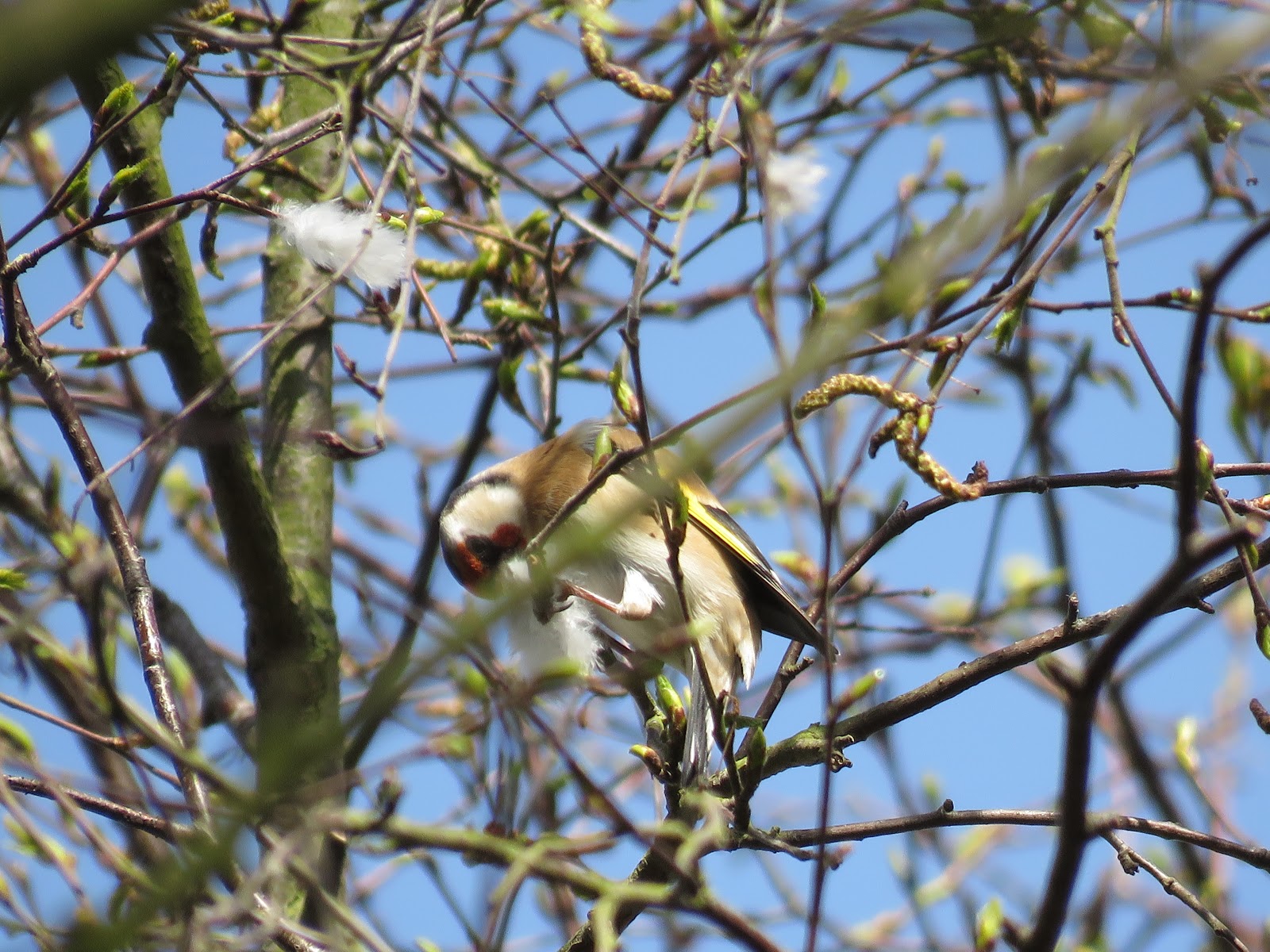
Goldfinch collecting pigeon feathers for nest lining.
Sunbathing peacock.
Moorhen chicks. I counted seven.
Parent feeds the chicks.
Moorhen and chicks
Bullfinches were very visible today. I counted four at the same time. This male feeds on buds.
Tree Sparrow
Tree Sparrow
Comma on the flowering blackthorn.
Sunbathing Bee-fly
This, like the one at the top of the post shows the egg laying process, as the fly drops eggs on the soil by nest entrances.
A quick bask on the soil
This is one of the females of the large Mining bee, Andrena nigroaenea (many thanks to Ian Beavis for ID) that nested on the soil heaped up after digging ponds.
Bee-Fly feeding on primroses.
Bird list
  1. Blackbird
  2. Blackcap
  3. Blue Tit 
  4. Bullfinch
  5. Buzzard
  6. Carrion Crow
  7. Chaffinch 
  8. Chiffchaff 
  9. Coal Tit 
  10. Collared Dove 
  11. Dunnock 
  12. Feral Pigeon 
  13. Goldfinch
  14. Great Tit 
  15. Greenfinch 
  16. House Sparrow 
  17. Jackdaw 
  18. Kestrel
  19. Long-tailed Tit 
  20. Mallard
  21. Moorhen
  22. Mute Swan 
  23. Pheasant
  24. Pied Wagtail
  25. Robin 
  26. Rook
  27. Skylark
  28. Tree Sparrow
  29. Willow Warbler
  30. Woodpigeon
  31. Wren

Sunday, 15 March 2015

Spring in the farm

A family outing to Honeysuckle Farm. There were sunny spells when we arrived and it was mild enough in the sun for a picnic. The pond by the barn was teeming with frogs. Most appeared to be males bumping into each other and croaking, but there was a female about with attendant male. No frogspawn yet though. 
A buzzard flew over, the first one I've seen in this location, I was very pleased to hear my son later (who was somewhere else at the time) say he had spotted a buzzard too.  The nicest find was a Lesser Redpoll feeding with a Coal Tit in a group of larches.
 We walked around the young woodland. Trees are growing fast, most already outgrowing their guards! Other than primroses and gorse little else was in bloom.
 In the cow field there was a male yellowhammer, but I didn't hear any singing while we were there. A flock of chaffinch, jackdaws, a pied wagtail and a few rooks fed around the cows.
It clouded over and the breeze gave a strong wind chill factor. After icecreams we were more than ready to get back in the car and head home.
Calling Dunnock
A nicely spotted Frog
Purrrrr!
A pair in amplexus dives as another male jumps on them
More croaking.
Coal Tit feeding on larch seeds.
And a Lesser Redpoll doing the same.
Lesser Redpoll
Cows and Jackdaws
Two male House Sparrows with different bib size
Yellowhammer
Yellowhammer.
Bird list
  1. Blackbird
  2. Blue Tit
  3. Buzzard
  4. Chaffinch
  5. Coal Tit
  6. Common Gull
  7. Dunnock
  8. Feral Pigeon
  9. Goldfinch
  10. Great Tit
  11. Greenfinch
  12. House Sparrow
  13. Jackdaw
  14. Lesser Black-backed Gull
  15. Lesser Redpoll
  16. Long-tailed Tit
  17. Pied Wagtail
  18. Robin
  19. Rook
  20. Starling
  21. Woodpigeon
  22. Wren
  23. Yellowhammer

Sunday, 13 April 2014

Cold spring day at Honeysuckle farm

I eagerly await the opening of Honeysuckle farm each spring. It is a lovely place to spend a day, not only for the kids, who can spend hours jumping on the hay bales, but for adults alike, especially if you enjoy that rural feel associated to farms. Today it started sunny, but it clouded up and we had only brief sunny spells, with a persistent cool breeze.
 The Woodpigeon at the top shot was sitting atop a hen house, having a rest. It looked most relaxed, closing her eyes every now and then, but also keeping a keen ear, as became alert and stretched her head at a disturbance by the chickens.
One thing I look forward specially is to watch the Yellowhammers, but today they were absent, I didn't hear their song and they weren't around in their usual place. Unusual as well it was that there was no chiffchaff song. We also drew a blank with the water voles.
 There were several butterflies about, a Green-Veined white, a Peacock and a pair of Commas.
A male sparrow chirping from a gutter
This female Greenfinch collected moss for her nest.
Jackdaws like to feed by the cows, they also often perch on the cows back and remove some of the winter coat hair for nest lining.
Lesser Celandine.
Mute Swan
Cuckoo flower, Cardamine pratensis, the first flowers of the year.
A Rook feeding on a field, probably a young from last year judging by the brown tinge of its primaries and lack of shine on its back.

A record shot of a Swallow, who fed on this field with horses and Common Gulls
One of a small flock of Common Gulls
Female House Sparrow
Linnet singing
Green-veined white, 1st of the year.