Showing posts with label dunes. Show all posts

Sunday, 12 July 2026

Risby Warren with Hull Nats

My first visit to this Nature Reserve and SSSI in North Lincolnshire, near Scunthorpe. Risby Warren sits on a post-industrial landscape, result of the open cast extraction of iron ore from an almost 12 km long seam running near the surface, N-S just east and north of the town Scunthorpe, and which fed first its iron production and then the steelworks. The ore extraction led to depressions in the land (The Ironstone Gullets) which eventually filled with water and re-vegetated, and are used for leisure, recreation, wildlife conservation and also as land landfill. Iron ore extraction continues in some areas and the continuous extraction has also led to land subsidence and the appearance of sink-holes. Although Risby Warren NR is on the edge of one of the gullets and not far from ore extraction and iron works, the place feels wild,expansive and remote, perched on higher land that contains the largest relic inland sand dune in Britain. The recent heat waves (three and counting!) and very little rain means that the sandy ground is very dry and many plants wilted or bone dry. The abundant Viper's-Bugloss, Wood Sage and Hound's Tongue retain their greenness. As we expected given the historical use as a rabbit warren, Rabbits are plentiful and together with the effect of wind and sand, are keeping the vegetation short. The heather forms short mounds with flower spikes starting to bloom. We planned the meeting this time of year to try and see the elusive Grayling. John a local who has carried out butterfly surveys for many years greets us and leads the way. We leave the botanists behind and we sweep the area in search for the Grayling. The morning started cloudy, but the clouds are parting, the sun burning every time it shines, but it is breezy, a cool NE wind which appears to deter the species. John has to leave and we have had no holy Grayling!


The wheat is ready for harvest. The next field was being harvested as we parked by the reserve entrance.

Labirynth Spider.
Roesel's Bush-cricket.
Painted Lady on Viper's Bugloss.
A huge congregation of Jackdaws rose over the warren.
Brown Argus.
Mottled Grasshopper.
A view of the vegetated dunes.
A view of the mobile dune.

We have lunch under the shade of a lone hawthorn and then we join the botanists and explore the dunes together. We end up doing a circular walk and finish the trip with a few additional dragonflies.

Essex Skipper.
Painted Lady on ragwort.

A group of Exmoor ponies emerges from the dunes by a woodland. They make a very picturesque sight, and they add to the rabbits and some sheep in grazing the common to manage scrub encroachment on the heath and acid grassland.

pony.

Small Heath.

Saturday, 22 March 2025

Kilnsea to Spurn Lighthouse with Hull Nats

As we arrive at the visitor centre, it's a bright and mild day with no wind. The tide is not very high and is already ebbing, with the tideline far from shore. House Sparrows are using the nest boxes set for Tree Sparrows, males chirping from the entrance. We make a quick stop at Canal Scrape, then start to walk towards the lighthouse. We take our lunch at the Narrows, after having been entertained looking at the sprouting plants, including carpets of Spring Neauty and tiny flowering Sea Mouse-ear.


Little Egret, Canal Scrape.
Gadwall, Canal Scrape.
Bill checks for insects in the saltmarsh.
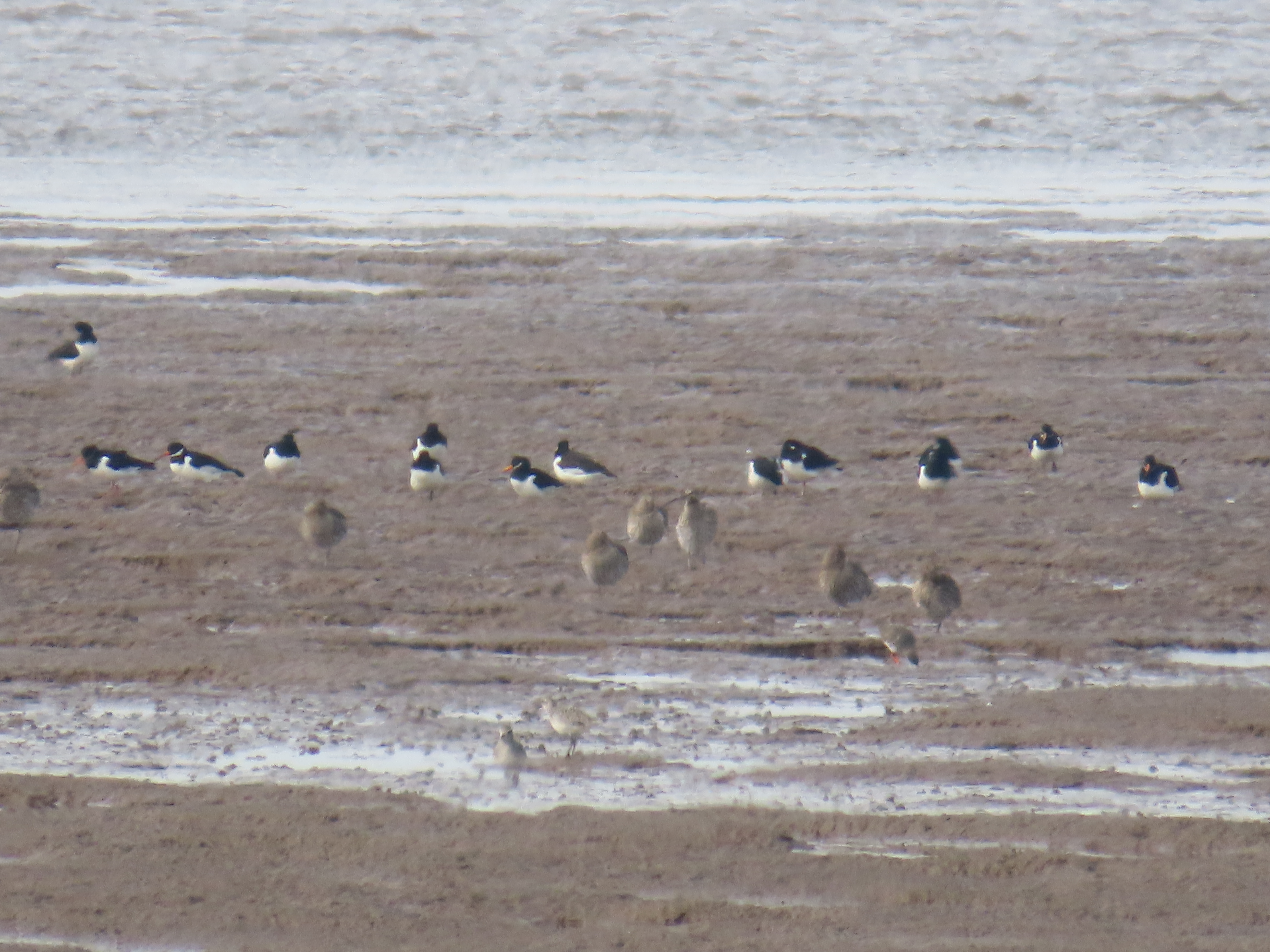
There are many Oystercatchers on the mudflats, here with Curlew, Redshank and Grey Plover.
Eristalis tenax on Dandelion.
This Larinioides cornutus (I think!) had spun its silky retreat in a Wild Carrot seedhead.
A shy Roe Deer.
Trochosa sp. under a piece of chalk at the Potato Field.
The lighthouse in the horizon.
A tight flock of Brent Geese.

The lighthouse. 
We turn round after popping in the lighthouse for a bit. The weather has turned and it is now cold and drizzling, the rain becoming more steady and impossible to ignore as we trundle back to the visitor centre.
A Stoat carrying prey as we arrive there is a great reward for our return walk.

Sunday, 18 August 2024

Wilsthorpe Dunes and Fraisthorpe Beach with Hull Nats

I was keen to visit Wilsthorpe dunes on a warm summer day to check on its invertebrates. Other than at Spurn, sand dunes is not a common habitat in East Yorkshire, and I was curious to see if this small patch of dunes at the top of Bridlington Bay held something of interest. Today's was a day visit with Hull Nats. It was warm, with a breeze and sunny spells. I had brought my bat detector and checked for bush crickets, both Long-Winged Coneheads and Roesel's sung from the more grassy areas.

We spend some time identifying the dune grasses: Lyme grass, silver blue at the front, and Sea Couch in the next fringe. On a low hump by the edge of the dune we identified Sand Couch, with long, creeping rhizomes.

Sand Couch, Elymus farctus.

Both Long-winged Bush-cricket and Roesel's were present. A possible Short-winged conenead on a dune slack coudn't be confirmed.
It's worth looking up and admire the setting every now and then. The Flamborough headland is in the horizon.
Gannets were fishing offshore.
Many dry seedheads of Hounds Tongue and young rosettes of its distinctive leaves.
Sandwich Terns. This time of year a visit to the dunes has the background sounds of calling Sandwich Tern juveniles chasing adults.
Plenty of Linnets and Goldfinches feeding on thistle seeds.
I was very pleased to spot a Sand Bear Wolf Spider, Arctosa perita, at the front of the dune by the anti-tank blocks where we had our lunch. I've only previously recorded it in Spurn.

Some chicks looking like they are close to fledge are still present at the Sand Martin colony at Fraisthorpe.

We saw a flock of 10 Ringed Plovers, this one lander a bit nervous as the tide was high amongst the passers by.
Common Field Grasshopper.
I believe this is a sand digger wasp, Ammophila sabulosa. The adult female captures and paralises caterpillars and stocks nests she digs in the sand with those, and then lays eggs on the caterpillars.
A dune robber fly, Philonicus albiceps.
We found a few clumps of Sea Rocket and other coastal dune specialists.
Saltwort, Salsola kali.
This was the most bizarre find of the day, a mummified rabbit that Andy uncovered at the beach.

Wednesday, 18 October 2023

Train trip: Wilsthorpe Dunes

Before the wind picked up in the afternoon, it was a relatively mild day with the sun breaking between light clouds. I had planned to head to Bridlington and walk along the south beach to Fraisthorpe, but I was so entertained exploring the dunes by the Park and Ride and Wilsthorpe that I never made it there. I had long wanted to explore this lovely stretch of dunes, a rare habitat of the East Yorkshire coast where there is little erosion and the sand accumulates with plenty of natural vegetation, and as I found, plenty of insects.

I catch the 8:01 train to Bridlington and I head towards the harbour. It's high tide. As usual, there are Turnstones everywhere, Redshanks on their usual roost on the outer wall, and the first of several surprises: two Red-throated Divers fishing just outside the harbour south wall, later one inside the harbour at low tide. 

Herring Gull long calling near the station.
Oystercatcher roosting.
Great Black-backed Gull.
Juvenile Red-throated Diver.
Adult Red throated Diver winter plumage.
Dunlin.
Turnstone.
Knot
Sadly, there were many dead Guillemots on the beach, about 8 carcasses, and some individuals in the water looked weak. This one got stranded on the beach as the tide ebbed. Someone came with a cloth and bag and picked it up.

Amongst the dunes

I walk along the south beach to reach the dunes by the Par&Ride and Wilsthorpe. The sunshine is getting insects out, so I take the chance and explore the dunes. 

An Ivy Bee on a dandelion. They seem to be in active expansion!
A female Long-winged Conehead catching the sunshine on a wall. I managed some recordings of males calling too.
The male of a pair of Stonechats on the dunes.
Rabbit with Mixomatosis. Many rabbit warrens.
Looking north towards Bridlington.
One of a number of Common Field Grasshoppers.
These crows harassed this young gull as it was feeding on something by the trick of pulling its tail. The gull was not impressed and after a while, it took off.

Another view of the dunes.
As I take my lunch sitting on an anti-talk defences as the dunes fizzle out into the cliff by Fraisthorpe, I notice hundreds of Kelp Flies were gathered at the top of the beach.
A crow checks the mud this man had dug out in search for worms.
Some horse riders at the beach.
A Pied Wagtail had it easy catching flies as there were so many.

Time to walk back. I walk on the beach this time. There is some migration off shore. Some Wigeon fly south and five Eiders north. The most astounding thing is to watch an Arctic Skua chasing a common gull across the s beach! Pity it was too distant for good shorts.

The tables turn and the gull appears to chase the skua.
The skua, probably an Arctic Skua, flies towards the sea.
One of six Guillemots in the harbour at low tide. 
After a hot drink at a cafe, I head towards the train station to catch my train back.