Showing posts with label Cemeteries. Show all posts

Wednesday, 12 November 2025

Urban birds at Hull. 57. Goldcrest

The Goldcrest is the smallest bird in the UK. They are most often heard (if your hearing is good!) than seen, their calls and song are very high pitched, the latter sounding like a tiny violin, up and down for a while with a final flourish. It favours dense-canopy trees such as conifers and ivy-clad trees, where they feed on tiny insects and spiders, but in the winter it can be found more widely, often joining mixed flocks of tits, always active. Goldcrests have a greenish-grey back, warmer head and paler underneath, with white wing bars and black wing patch. The eyes are big and dark and the bill thin. Its most distinctive feature is its crest, a bright stripe lined with black, yellow in females and with a central orange stripe in males, often flat and thin, but open and erected when the bird is excited. Goldcrests have a very compact shape, without a discernible neck, and a short tail, but their legs are relatively long.

Goldcrest in hedgerow. The Avenues. 13 November 2021.
A singing Goldcrest. Pearson Park, 17 April 2016.
Fledgling Goldcrest at Pickering Park. Sculcoates, 4 June 2022. Note the lack of 'crest'.
Another fledgling at Pickering Park,12  June 2022.

Status and Distribution in Hull

Goldcrests are widely distributed in Hull, although they are never common. They can be seen year round, but in the autumn and winter, when numbers swell with migrants they are more obvious and widespread. It is amazing to think that they fly across the North Sea away from the cold continental winters. Mature yew trees in cemeteries are a favoured breeding spot, but they can also be found in garden and park conifers. Locations where breeding has been proven include Pickering Park rock garden, East Park Khyber Pass, Pearson Park and the cemeteries. It may seem surprising that they used to be quite rare in Hull, as described by Richard Broughton in his 'Birds of the Hull Area'.

Goldcrest being ringed at Spurn Bird Observatory, 31 October 2019.

Conservation and Management

The Goldcres is a Green Listed species. Although Goldcrest numbers drop after harsh winters, the population size has remained stable since the 90s. The species might benefit from climate warming and milder winters. The species is more abundant in urban environments than in other natural habitats (except woodland, especially conifer woodland). Fashion for gardening with conifers benefits the species in urban environments as do mature wood in churchyards and cemeteries. 

More information

BTO Bird Facts. Goldcrest.

Broughton, R.K. 2002. Birds of the Hull area.


Monday, 13 December 2021

Urban birding at Hull: Sculcoates week 50 and December River Hull Webs

A dull dark morning turning into drizzle later. I did the usual route around the patch and ended at Fountain Road, where I walked along the drain. Flocks of Goldfinches were feeding on birches around the area. I walked around the North Sculcoates Cemetery and two birds were feeding also on a birch. I checked with the binoculars, Redpolls! I had this species in my wish list for the Hull year list so it's nice to get it with a couple of weeks to spare. The Redpolls were flighty, but kept returning to the birch. I walked around to get a (marginally) better angle for the light and managed some record shots. Unfortunately they didn't stay very long. This species brings the species list in the patch this year to 67 and the Hull species year list to 108.


A pair of Bullfinches were also at the cemetery.
Three Stock Doves atop the old Sculcoates School building sorting a territorial dispute.
One of two Cormorants posing on the mast of a barge.
The bathing spot was busy early on. I scanned the flock, mostly made of Herring Gull young of the year. There were also two adult Great Black-backed Gulls and a 4th year one.
Four Redshank were scattered along the river. One flew off calling and was joined by another, who came back to its spot. I wonder if this escorting passing individuals is a type of territorial behaviour.
One of the GBBGs was trying very hard to eat a flounder. Flouder is too wide to be swallowed whole, which is the usual technique in gulls. It is too stiff and wide. The gull tried pecking it and  shaking it.
As I was taking a video of the GBBG, something spooked the gulls and, like a wave, all took off. The GBBG carried it's flounder in its bill. I scanned the sky, looking for a raptor. A female Sparrowhawk was on the hunt, diving a couple of times, maybe after Feral Pigeons. I was surprised the gulls reacted so strongly. The two Cormorants and the Redshank didn't fly off. A Grey Wagtail flew from the puddles at Transwaste.
 After this, a few gulls settled back in the wash area, but not many, so I carried along Wilcolmlee and then by Fountain Road to the drain. I saw the ripples of a Little Grebe diving in the middle of the drain, but it also saw me and moved quickly to the side vegetation, where I found it, watching me nervously. 

Little Grebe.
I could hear a Song Thrush singing, the first of the year. It was on a poplar by the drain.

After almost three hours on the patch, the last one in the drizzle, I headed home for lunch.The best thing on the way was a Mistle Thrush on the Endeavour lawns. Mistle Thrush has been scarce on the patch, maybe because I not normally walk on this southernmost edge of it. There are plenty of berries, mainly Rowan, large trees and grassy areas here, so it looks like the place could hold a pair.

We've been away in the weekend, where the core Webs for the River Hull was scheduled, so I headed to Scott Street bridge in the afternoon, an hour before high tide. It didn't stop drizzling, but at least it was quite mild. The alarm starts ringing as I step on North Bridge. I rush to the other side to watch the bridge lift to let a barge pass. I think it is always the same barge.


Drypool bridge lifting.
As the bridge lifts, I realise that there is a chance the barge will flush the Redshank from their roost. A Grey Wagtail flies from my bank, I would have missed it if not for the barge. The boardwalk from Drypool Bridge is still closed, but the Redshank roost site is visible from the bridge. Fortunately, as I get to the bridge, I see there are 8 Redshank on the Roost. 
I walk by High Street, noticing this lovely tile with Sperm Whales by the Hull and East Riding Museum.

There is some exposed mud and I find four scattered Redshank between the roost and the Deep.


Three Moorhens are on the river too. 

The drizzle is relentless, and I keep having to wipe my glasses every few minutes despite wearing a rain cap, the binoculars and camera are suffering too. I don't hang on. It's been a long day of walking, 18 km in total. I'm rewarded by the Med Gull at Princes Quay, who is moulting into its black head.

Mediterranean Gull on it's usual spot atop Princes Quay.

Saturday, 4 December 2021

Urban birding at Hull: Sculcoates week 48

An early walk to the patch. There are long sunny spells to start with but it is mild and no frost. As I cross Pearson Park, a skein of Pink-footed Geese flies over towards the south.

Pink-footed Geese.
Singing Robin.

First I walk through Sculcoates park, by the playing fields, along the drain and by the cycle path to reach the river. I've missed the high tide, it's two hours after high tide and there is quite a lot of mud exposed. Just two Redshank are visible from the river bank. A Cormorant lands on the water. I cross the Wilmington bridge and see a Peregrine flying high around the silo, then I lose it when it goes around and, despite scanning the building, I can't find it again until I spot it later atop the Reckitt chimney. 

Peregrine.
A pair of Carrion Crow lands on their nest and one of them starts tweaking and tiding branches.
A female Kestrel sitting in the same spot where there was a pair last week.
Two Great Black-backed Gulls on the industrial roof.
Bullfinch feeding on seedheads.
Drake Mallard.
A view of the drain form the pedestrian bridge of Abbey Way. It was busy with Moorhens today, with the peak count this year of 24.

I go into the Northern Cemetery. D. Longhorn is just finishing scything the workhouses burial area. He's got a new blade as his old one broke and seems quite pleased with the performance and lightness of the new one.

The South Sculcoates cemetery.
A snoozing Stock Dove by the drain.
A male Bullfinch piping from atop a tree.
This Sparrowhawk flew over the housing estate, followed by alarmed gulls, just as I finished my walk. Not bad as my first December visit with 33 bird species counted.

Tuesday, 16 March 2021

Urban Birding at Hull: Sculcoates week 11

 A morning walk around the patch, the 1 km square at Sculcoates, Hull, that I am visiting at least once a week. It started a bit drizzly and cold. It was quite high tide, so I headed straight for the river along the cycle lane. Greenfinches screeched and warbled all through. The photos and observations are from Tuesday 16th and Saturday 13th March.

By the river at Wilmington bridge, a young feral pigeon looking just out of the nest was being fed by a parent. Although some city pigeons look quite scruffy, I find Hull feral pigeons beautiful and can't stop myself from photographing them.

Adult and fledgling feral pigeon.

One of the feral pigeons breeding by the Wilmington bridge.

I checked the Redshank roost. Ten birds were present at high tide, only 2 were visible at low tide in the area on Saturday. As birds spread along the river banks to feed at low tide, the high tide allows a count of birds present in the area.
Redshank roost.
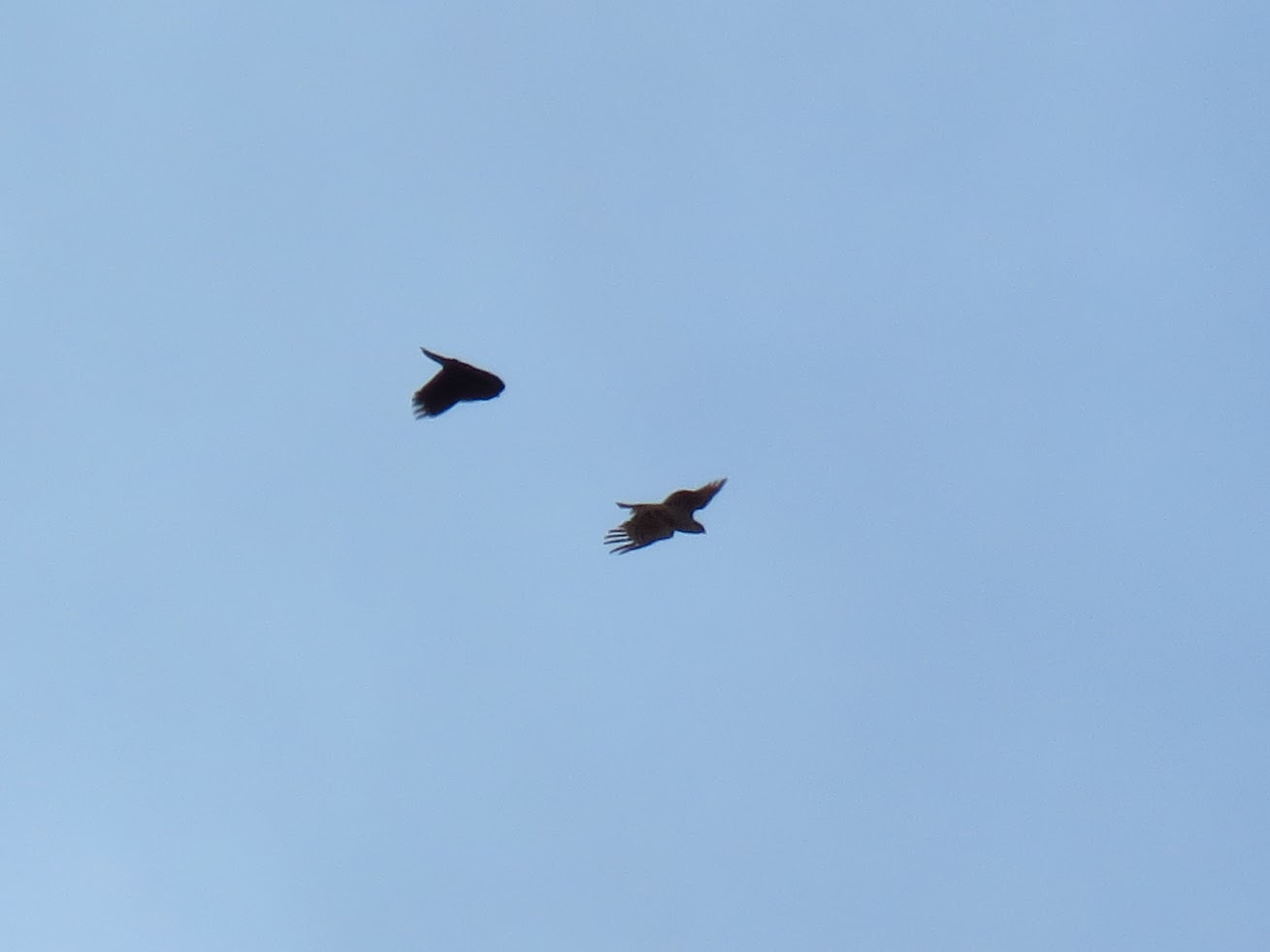
A sparrowhawk was being chased by crows, and a small bird (not in the photo), possibly a feisty goldfinch.
Carrion Crow chasing sparrowhawk.
Long Tailed tits were all in evidence, their constant movement makes them difficult to photograph.
The mixed gull roost at the playing fields included two Lesser Black-backed gulls, with many Black-headed Gulls and a few Common Gulls.
Stock Dove pair.
At the north cemetery at Sculcoates Lane, when under the large oak, I hear a chiffchaff singing. I catch up with it, but it only allows a record shot.

The flowering willow is humming with bumblebees, they all look like Buff-tailed bumblebees.
A magpie pair in the cemetery is nest building, one of them is in the nest, but hard to see. Crows are also nesting. One flies by holding a branch in its bill, but it caws and drops it! A Linnet lands on a bush in the cemetery, only the second I see this year.
There were at least 3 Bullfinches, a pair started feeding on the hawthorn with the magpie nest. Here is the male
...and the female.
Some crows gathered atop a tree.
I longingly keep checking the spot where the pair of Little Grebes used to be. They are gone. But I got a lovely surprise, a drake Teal, a patch tick!
Drake teal.
I heard a loud call. It was a female moorhen calling its mate. She solicited copulation by standing near the water with her head down. The male obliged. This happened both on Saturday and Tuesday. I gather they might be nesting nearby.
A Mallard pair, showing how camouflaged the females are.