Friday, 4 April 2014

Spring at North Cave Wetlands

The fog was very thick on top of The Wolds as I was driving towards North Cave. Fortunately, it was lighter and slowly lifting in the reserve, although a bit on the chilly side. The Black-Headed gulls are on full swing and the noise levels full on, especially on Village Lake and Island Lake.
 I did the usual anticlockwise tour of the reserve. A sprinkling of Wigeon, Teal and Shoveler about, but i didn't see Pochard.
 From east hide I could see a pair of Avocets. The female adopted a submissive posture and the male walked a few times around her, before mating. A few seconds later a pair of Black-headed gulls followed their example.
 Little else than Black-headed gulls on Island lake. I struggled to hear a singing Skylark outside Island lake, its song was much easier to hear from the north path. Three Sand Martins (1st of year) flew low over the path to Turret Hide.
A Chiffchaff sung from the willow on the west path.
A Crosslands, the water level have left shallow islands exposed, and numbered tiles to serve as refuge for tern and avocet chicks. The numbers were very handy to locate the cryptic Ringed Plovers. There were Redshank and an little flock of Dunlin.
As I arrived in the hide overlooking main lake, the warden pointed out that there was a drake Scaup on the lake (a lifer for me). However, I was much more excited to see one of the two pairs of Great Crested Grebes swimming to each other and starting their synchronised courtship. This was the first time I have watched the Great Crested Grebe dance. I even took a short clip of it (see below).
As I was leaving near the car park I heard the lovely song of a Willow Warbler. It didn't sing again, but I watched it as it fed on the hedge. A good way to finish a great morning, with a tally of 50 species.
Avocets, female on the left, soliciting the male
Avocets mating
Black-headed gulls mating
Gadwall pair preening
A lone Greylag
Male Shelduck
Charm of Goldfinches by maize field
Coot on one of the dragonly ponds.
Male Lapwing
Pied Wagtails
Great Tit apparently feeding on burdock seeds?
Chiffchaff
Long tailed tit. This one sat on this branch for what it felt like an eternity (probably was 5 seconds). Allowing me one of my best photos of this species.
Ringed Plovers by air-raid shelter
My first Drake Scaup
dancing Great Crested Grebes

A short video of the courting grebes.

Tuesday, 25 March 2014

A spot of patch birding

A sunny, mild afternoon, we go to the park after the school run. While the kids play with a ball, I watch and photograph the park birds. A lone Canada Goose, who damaged its wing earlier in the year, is bound to stay in the park now year round, her companions, which only winter in the park have left already for their breeding grounds. Three greylags keep her company, for now.
 Blackbird, Robin, Dunnock, Chaffinch and Stock Dove sing and a Carrion Crow calls, making gargle-like calls from a tree.
 Mallards are mostly resting, most females paired with two males, as the sex ratio is very unbalanced in the park.
 A Mistle Thrush feeds on the grass, oblivious to the hustle and bustle of people in the park. I get 5 m away from it and sit on a bench to take some photos. Tilting its head looking and listening for worms, and occasionally keeping an eye for aerial predators.


 Common Gulls won't stay in the park for much longer, soon, they will migrate to their summer grounds for breeding. Already the winter flock, usually 100 strong, has dwindled and is dominated by young immature birds. These squabble for some rice crispies.
This one posed nicely for me.
  The larger Herring Gulls are resident in town, they winter here and breed on roofs, safely concealed from view. Today an adult pair and five immatures hanging out together, behaving like a family group.  Three are 1st winter immatures, and 2 of them are 2nd winter. Gulls are long-lived birds and I wonder if young stay around their parents territory until they are fully adult.
One of the adults in summer plumage, drinking. The red spot on the bill very bright and no trace of winter speckling on the head.
An adult, 1st winter and 2nd winter.
A 1st winter individual, with no grey on the mantle and speckled brown all over.
The 2nd winter looks paler, with almost white head, and has silver feathers on the mantle.
Woodpigeon.
Moorhen. I wonder if its partner is already incubating.
Feral pigeon males dance and twirl round to impress females. One handsome male, after courting a female (its mate?) and receiving an annoyed peck in return, gets on with finding suitable sticks for nest building.

Monday, 24 March 2014

Back to the cliffs

Spring was well ahead in Bempton Cliffs today. Despite the chilly breeze and foggy start at Hull, the sun shone all day by the coast.
 By the visitor centre, large flocks of Tree Sparrows chirped from the roof or fed on the feeders. Jackdaws, Linnet, Goldfinch, Greenfinch, Pheasant and Great Tits were also present.
 By the grasslands on the way to the cliffs Skylarks sung and we flushed a few Meadow Pipits. We also witnessed a funny squabble between two male Pied Wagtails on the path, jumping and chasing each other with a bouncy flight.
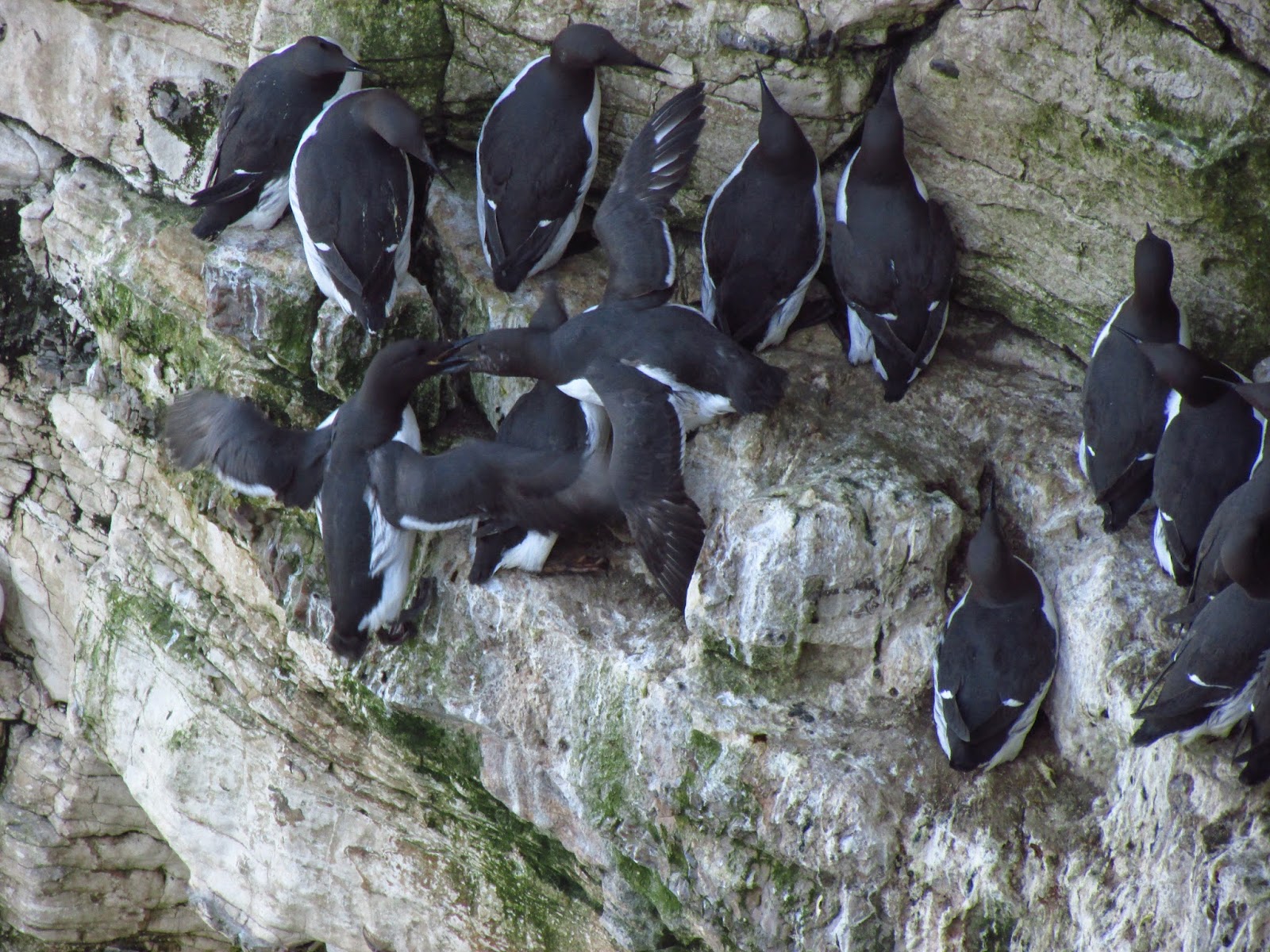
 The cliffs were buzzing with all the classic Bempton species already paired-up, squabbling for the best positions on the cliff shelves.We quickly spotted the first Puffins. I have never seen so many, some of them quite close to the viewing points (above). We watch mating Guillemots and Gannets, and Razorbills grooming each other. A Gannet flew over bringing some nest material.
 I briefly spot a porpoise diving and we can't see it resurfacing again.
After a chilly picnic by the visitor centre we head towards the southern half of the reserve. Staple Newk is covered on Gannets, with the side shelfs holding a few Puffins and Guillemots. To top it all, as we watch from the viewing point, a Peregrine appears flying and circles a few times over our heads. My best view ever and a great end for a day on the cliffs.
Tree Sparrow on the tiled roof of the visitor centre
Meadow Pipit
Herring Gulls calling
Sleepy Kittiwake
Razorbill pair preening
Another cosy Razorbill pair
A pair of Guillemots. One of them is from the bridled form.
Guillemot dispute. No vacancies!

Jackdaw
Pied Wagtails
Fulmars
Gannets
Gannet calling showing its black mouth
More preening couples
Rock Doves. All the pigeons we saw were of the beautiful wild-type plumage
Kittiwake complaining to an usurper
Staple Newk
Peregrine Falcon circling over our heads

Monday, 17 March 2014

Redpolls and Chiffchaffs at Noddle Hill Nature Reserve

A dull, cloudy, breezy day, I headed to Noddle Hill for an early spring walk. The sallows and willows are in full bloom, and, despite the cloud, there were a number of active Buff-tailed bumblebees about.
As soon as I start the woodland walk, I hear the song of a Chiffchaff. Soon, other replies and I manage some shots. A pair of Bullfinches feeds on buds, and Greenfinch, Chaffinch and Goldfinch are singing. As I enter the open scrub northern side of the reserve, I hear some chirps, they come from a few Tree Sparrows, the first time I see them on the reserve. There are also many Linnets about.
 Near the pumping station, a couple of Carrion Crows mob a Buzzard (a first for the reserve). The wind makes it almost impossible to take shots, unfortunately.
 I peek into the drain hoping for a Kingfisher, but I spook a couple of Teal (also a first for the reserve), mallard and a Moorhen instead.
 I walk along the criss-crossing paths. The hoof prints of Roe Deer are marked on many of them. There are 20+ Greylags on the fishing lake, but little else. Just as I was going to leave, I see some birds on the alders by the pond. They are Lesser Redpolls. Some look wet, like they just had a bath. They appear to be feeding alder buds and, when they fly to a tree nearby I see the flock is about 15 strong. They come back to the alder and carry on feeding, doing acrobatics like tits and keeping quiet.
 Skylarks are singing around the reserve. On a ploughed field by the entrance, a large Starling flock feeds with Carrion Crows, Woodpigeons and a pair of Stock Dove.
Singing Chiffchaff
Male Bullfinch
Tree sparrow
Linnet
A view of the reserve
Lesser Redpoll
Lesser Redpoll
Male Lesser Redpoll looking wet.

Singing Skylark
Bird List
  1. Black-headed Gull
  2. Blackbird
  3. Blue Tit
  4. Bullfinch
  5. Buzzard
  6. Carrion Crow
  7. Chaffinch
  8. Chiffchaff
  9. Collared Dove
  10. Dunnock
  11. Feral Pigeon
  12. Goldfinch
  13. Great Tit
  14. Greenfinch
  15. Greylag Goose
  16. Lesser Redpoll
  17. Linnet
  18. Magpie
  19. Mallard
  20. Moorhen
  21. Pheasant
  22. Reed Bunting
  23. Robin
  24. Skylark
  25. Starling
  26. Stock Dove
  27. Teal
  28. Tree Sparrow
  29. Woodpigeon
  30. Wren