Monday, 15 April 2013

More than birds in North Cave Wetlands

Today really feel like spring at the Wetlands. I decided to do the perimeter walk clockwise. There was a splash of colour with Colt's Foot joining Lesser Celandine flowering and several non-avian species for a change. Although windy, it was a warm wind that is bringing the migrants in. It was lovely to watch the little bunch of Yellow Wagtails feeding with Pied and White Wagtails in the new area of the reserve by Crosslands Hide. A couple of Pipits joined them, I'd go for Meadow pipits, but hard to tell. A Little Ringed Plover joined them. Some sand Sand Martins, the first of the year few overhead. I thought I saw three Swallows on the ridge by a farm in my way to the reserve, but I couldn't have a good look, so my first swallow of the year will have to wait.
 Despite the new birds for the year, for me the stars of the day were the toads. Several dozens, at least, appeared to be gathering in the ditch at the north side of the reserve. I think, judging by their small size, most of them must have been males. There was a single pair in amplexus, and I didn't see any spawn. I laid down trying to get better shots and got my hand full on some growing nettles. Ouch, it still hurts! but well worth some toad photos.
 There were many Avocets, and I witnessed a pair mating in the water, with only the female's head visible over the surface. Black-headed gulls were mating, and nest building.
Yellow Wagtail
A sluggish queen Buff-Tailed Bumblebee Bombus terrestris
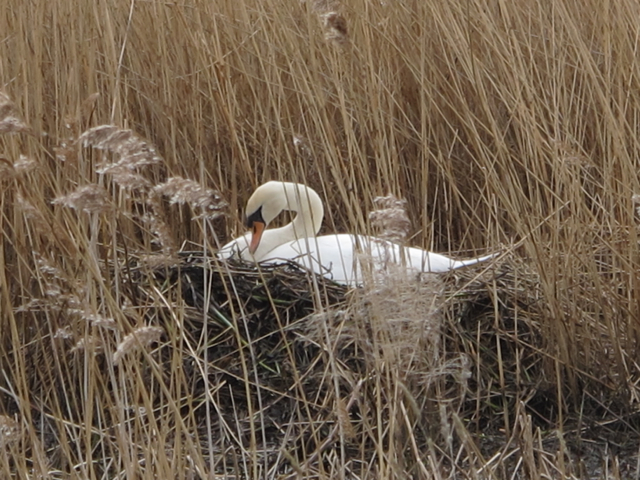
The Mute Swans in Reed Lake sitting on the nest. The other one was resting just to the right of the photo.
Toads. Some of them were calling intermittently.
Pair of Common Toads in amplexus
Male Andrena sp. probably A. bicolor in Colt's Foot (thanks to Ian Beavis for ID).
A particularly spotty toad
Record shot of the handsome Black-Tailed Godwit in Reed Lake.
There was a large group of Shelducks by the rabbit warrens. I wonder if they are planning a take-over. Shelducks like to breed in old rabbit burrows.
Three jumping spiders were sunbathing on the fence by Turret Hide. Looking lovely and curious, as always.
Another Yellow Wagtail
A White Wagtail
Male Reed Bunting feeding at the bottom of a hedge
Avocets resting
Black-headed gulls. Hard to keep balance with the wind. 
Pair of Rooks

Bird List

  1. Avocet        
  2.  Black-headed Gull        
  3.  Black-tailed Godwit        
  4.  Buzzard        
  5.  Carrion Crow        
  6.  Chaffinch        
  7.  Coot       
  8.  Dunnock        
  9.  Feral Pigeon        
  10.  Gadwall        
  11.  Goldfinch        
  12.  Great Tit        
  13.  Greylag Goose        
  14.  House Sparrow        
  15.  Jackdaw        
  16.  Lapwing        
  17.  Little Grebe        
  18.  Little Ringed Plover        
  19.  Magpie        
  20.  Mallard        
  21.  Meadow/Rock Pipit?        
  22.  Moorhen        
  23.  Mute Swan       
  24.  Oystercatcher        
  25.  Pied Wagtail (yarrellii)        
  26.  Pochard        
  27.  Redshank        
  28.  Reed Bunting        
  29.  Robin        
  30.  Rook        
  31.  Sand Martin        
  32.  Shelduck        
  33.  Shoveler        
  34.  Skylark        
  35.  Starling        
  36.  Stock Dove        
  37.  Teal        
  38.  Tree Sparrow        
  39.  Tufted Duck        
  40.  Wigeon        
  41.  Woodpigeon        
  42.  Wren        
  43.  Yellow Wagtail 

Friday, 12 April 2013

Breeding time!

As light rapidly increases day after day, and temperatures rise - not so rapidly! life prepares for reproduction. Building up body condition, attracting or finding a mate, building a nest, laying eggs. No time to lose! Birds, frogs, invertebrates too. You can easily notice even in the middle of a city. This afternoon, after the light overnight rain, some frogs came our of their hiding places, and - with the smaller male tightly embracing the female - moved in search of a suitable pond for spawning.
Male blackbird singing atop a building
Female collecting nest lining material
A blue tit by its nest box Blue Tits pairs check their nest in the local wildlife garden
Carrion Crow pair collecting nest lining material. One of three pairs I have seen doing this only this week around town.
Chaffinches sing now regularly, strongly, with inexhaustible energy their monotonous phrase.
A Moorhen carries a large stick towards a nesting site in the park
Its partner sat, with head low and tail up, as if signalling where the nest should be built. When the Moorhen carrying the stick arrived, the other one pick it up and put it in place.
A sudden 'ke-ke-ke-ke' call alerted me, and as the displaying Sparrowhawk, with its undertail covert feathers spread out, passed over my head I took this lucky shot. 
Tonight, this male blackbird was collecting worms. To feed an incubating female or chicks already?

Note: all photos taken this week, except for the singing blackbird from the 20th of March.

Saturday, 6 April 2013

A spy in the garden

I got a Bushnell Natureview HD cameratrap less than two months ago as a birthday present. The camera takes either video or stills, and works at night too, as its has got a battery of LEDs that activate at low light levels, but only black and white photos are taken at night. It can record the time, date and temperature on the photo itself. You set it on with the memory card in place, and wait as long as your patience allows before checking what has been photographed.
 I have been using it in the garden, to see what visits at night, or when we are not around. Our garden is quite small, with a fence on one side and a brick wall on the other, but the garden door has a large gap under it to allow cat access. First, I attached it to the small apple tree, pointing to the bird table, but the camera only took photos of Woodpigeons and Blackbirds, and not all the visits by these species resulted in photos - judging by the disappearing seed. In contrast, within a week, I got a fox photo - three in fact, as you can set the camera to take three shots every time the motion sensor is activated. It took me a bit by surprise, as we had no prior evidence of a fox visiting. After this, I set the camera on a tripod, as low at it allowed, quite often. Every time we roasted a chicken for dinner we had taken the bones and carcass outside, and recently I had noticed that even the big bones had been cracked and eaten, so I wondered if a large cat could do that, or it had to be a fox.
 The two following times we had chicken and placed the bones in front of the camera, it only got cat photos, loads of them. I wasn't expecting so many different cats to visit (about 11 so far in my garden cat list). No wonder our little female cat was afraid of feeding outside.
 I have been placing the camera on the tripod, overlooking the base of the bird feeder and a drinking bowl. This was a bit of a compromise between trying to get more photos of the visiting fox and getting some bird shots too. This location indeed has been quite successful, as birds and cats come to drink regularly, especially in spell of dry weather.
 I have to say something about bird photos with this camera. The smaller bird I got was a robin, but the quality for small birds is not very good, as they take a very small area of the photo, as the camera is set to focus about at 3 m in distance. There is a little clip on lense you can purchase to be able to take close ups, which apparently works very well with birds. A newest model of the camera includes this in the box.
 I set the camera with a fully charged battery set while we went away last week.  The drinking bowl had been emptied completely, despite the cold. I got the card out today and there were about 1600 photos in it. As I was downloading them into my photo editing software I glimpsed the profile of a fox in one of the shots. After checking them all, twelve fox shots had been taken, including one of the fox drinking on the bowl.
It is always such a thrill to download the photos (and it is only my garden!), I can't imagine how exciting it must be to check it after having set it up in the wild. It has been truly enjoyable to use the camera, and I shall continue setting it up every day. I now have nicknames for all the cats visiting my garden.
 Follows a selection of the best of last week's photos.
First glimpse of the fox head
The fox was thirsty too
A bushy tail
This is my neighbour's cat Lewis
and my other neighbours' cat Blackjack
A blackbird visits
Another thirsty cat, Yellow Collar
I have called this one Mia, looks like a female
This is Fatcat I (yes, there is a II, see below)
A very disappointed Collared Dove checks the empty water bowl
A pair of Woodpigeons
Fatcat I and II together
Black Chin...
...and our cat Mai

Friday, 29 March 2013

Hide and seek

Being half term, I take my 4 year old to North Cave for a bit of birdwatching. As we are parking I spot a brown rat by the drain opposite the cafe, my daugher can see it clearly, as I stop the car and point it to her. Not the fox or hedgehog she wanted to see, but another mammal and she's quite thrilled. She is also pleased to write it down on my notebook.
Given the weather, with flurries of snow every now and then, and a biting breeze, we go quickly from hide to hide and after East Hide and Turret Hide, we turn round and go down Dryham in the car for the other two hides. Lazy, really, but it is too cold for her.
The Black-Headed gulls are back in force getting ready for nesting (above), they are so loud in Island Lake that although I think I can hear a Skylark singing, I can't make it out clearly from the background noise.
I scan the area north of the reserve for raptors, and can make out a Buzzard being mobbed by crows in the distance.
 Four species of gulls are visible from Turret hide. Two immature Great Black Backed gulls dwarf a Herring gull nearby, and also a few Common gulls sprinkled amongst the BH gulls.
Great Black-backed gull immatures.
Displaying Black-headed gull
A Herring gull to the left looks tiny compared with the immature GBB gull
Drake Tufted Duck showing its impressive tuft
Bird List

  1.  Black-headed Gull        
  2.  Blackbird        
  3.  Blue Tit        
  4.  Buzzard        
  5.  Carrion Crow        
  6.  Chaffinch        
  7.  Common Gull        
  8.  Coot        
  9.  Dunnock        
  10.  Feral Pigeon        
  11.  Gadwall        
  12.  Great Black-backed Gull        
  13.  Great Crested Grebe        
  14.  Great Tit        
  15.  Greylag Goose        
  16.  Herring Gull        
  17.  House Sparrow        
  18.  Lapwing        
  19.  Little Grebe        
  20.  Magpie        
  21.  Mallard        
  22.  Moorhen        
  23.  Mute Swan        
  24.  Oystercatcher        
  25.  Pied Wagtail (yarrellii)        
  26.  Pochard        
  27.  Redshank        
  28.  Robin        
  29.  Rook        
  30.  Shelduck        
  31.  Shoveler        
  32.  Teal        
  33.  Tufted Duck        
  34.  Wigeon        
  35.  Woodpigeon     


Tuesday, 19 March 2013

Hints of spring

The sun came out today and I walked through Pearson Park on my way to work today. I stopped to take a portrait of this relaxed Mallard drake. He kept an eye on me, but didn't flinch as I got closer.
 The Stock Doves were very active, chasing, doing circular display flights and cooing with that unique call of theirs that I read somewhere is reminiscent of a lions roar.
This Stock dove showed some interest in a nest box. The hole looks like it has been made larger, but I am not sure who did that.
One of them surprised me by alighting on the ground and feeding. They are quite timid and keep to the trees. It is the first time I spot one on the ground in the park. 
There has been about a dozen Greylags overwintering in Pearson Park, with a maximum of 45 on early February. They do not appear to roost in the park, but fly in every morning.
A mating pair of Mallards with a not very good looking drake interfering. The female is underwater, being held by the drake with the shiny green head.

The drake and female bathe while the interfering male swims away.
 The Common Gull flock was still strong. They probably won't be around much longer.
 There had been a light frost, but the pond in the wildlife garden was frost free, and full of clumps of frogspawn. 
Mistle thrush feeding by the large puddles on the grass
Bunch of Feral Pigeons enjoying the sun.

Monday, 18 March 2013

Four white beauties in Tophill Low

The weather forecast was appalling this morning: cold, windy and heavy rain. My choices were North Cave wetlands and Tophill Low, and I decided on the latter. On the way, it was only raining lightly. A Brown Hare crossed the approach road near Decoy Road and then run across the field. I parked by D res and walked back to the information center for a permit. I popped in South Lagoon hide, where a couple of Greylags were having a noisy altercation with a Mute Swan. There were three Pochard pairs which kept diving one after another, but little else. I headed back to D res hide and watched for a while. Two drake and a female Goosander were just visible in the distance. Goldeneyes, Coots and Tufted Ducks in abundance. By 10:40 I headed to D woods, a Redwing hid on the bushes, and Chaffinches and two male Song Thrushes sang completely ignoring the dark clouds.
 In D woods I heard the wheezing calls of a Willow Tit travelling with Blue and Great Tits. I stopped briefly by North Marsh, where the only birds in evidence were a Moorhen and a pair of Mallards, and pressed on. The rain had altogether stopped and as I came out of the woods into the scrub, I saw a Barn Owl hunting. She saw me too, and, with nowhere to hide, I carried on, with her flying ahead of me towards Hempholme Meadows. A Goldcrest and a Treecreeper fed on the pollarded trees just before the hide. In the meadows, Two Little Egrets, first of the year for me, Teal, Gadwall, Oystercatcher and the Barn Owl hunting by Hempholme Lock. At some point three birdwatchers came in and one of the Little Egrets moved on, but then two Barn Owls became visible, sitting or flying low at the other side of Beverley and Barmston Drain. They must be having a hard time hunting with so much rain, so I guess that's why they are being active in the day. A large flock of Goldfinches flew about and there were Pheasants everywhere, and lots of shooting around the reserve, which I find very unnerving. A Grey Heron flew to the river bank, scaring the ducks.
 Just before I left the hide, I spotted a male Kestrel atop a tree, and one of the Barn Owls flew over the river bank towards North Scrub. As I walked back I came across this barn Owl again, and it allowed great views, at some point it was less than 20 m away and looking away from me, with occasional glances over her shoulder. My best Barn Owl encounter ever!
 In the car park, a male Reed Bunting fed on the ground with Chaffinches, and in the approach road, the Hare was in the same spot, tiptoeing on all fours, all watchful.
Little Egret
A distant view of the Barn Owl
The Barn Owl by the bank of the River Hull, on North Scrub.

Bird List

  1. Barn Owl       
  2.  Blackbird       
  3.  Blue Tit       
  4.  Bullfinch       
  5.  Carrion Crow       
  6.  Chaffinch       
  7.  Coal Tit       
  8.  Common Gull       
  9.  Coot       
  10.  Dunnock       
  11.  Gadwall       
  12.  Goldcrest       
  13.  Goldeneye       
  14.  Goldfinch        
  15.  Goosander       
  16.  Great Spotted Woodpecker       
  17.  Great Tit       
  18.  Grey Heron       
  19.  Greylag Goose       
  20.  Jackdaw       
  21.  Kestrel       
  22.  Lapwing       
  23.  Little Egret       
  24.  Long-tailed Tit       
  25.  Mallard       
  26.  Mistle Thrush       
  27.  Moorhen       
  28.  Mute Swan       
  29.  Oystercatcher       
  30.  Pheasant       
  31.  Pochard       
  32.  Redwing       
  33.  Reed Bunting       
  34.  Robin       
  35.  Song Thrush       
  36.  Stock Dove       
  37.  Teal       
  38.  Treecreeper       
  39.  Tufted Duck       
  40.  Wigeon        
  41.  Willow Tit       
  42.  Woodpigeon       
  43.  Wren